
Chapter 9: The Transpersonal Will
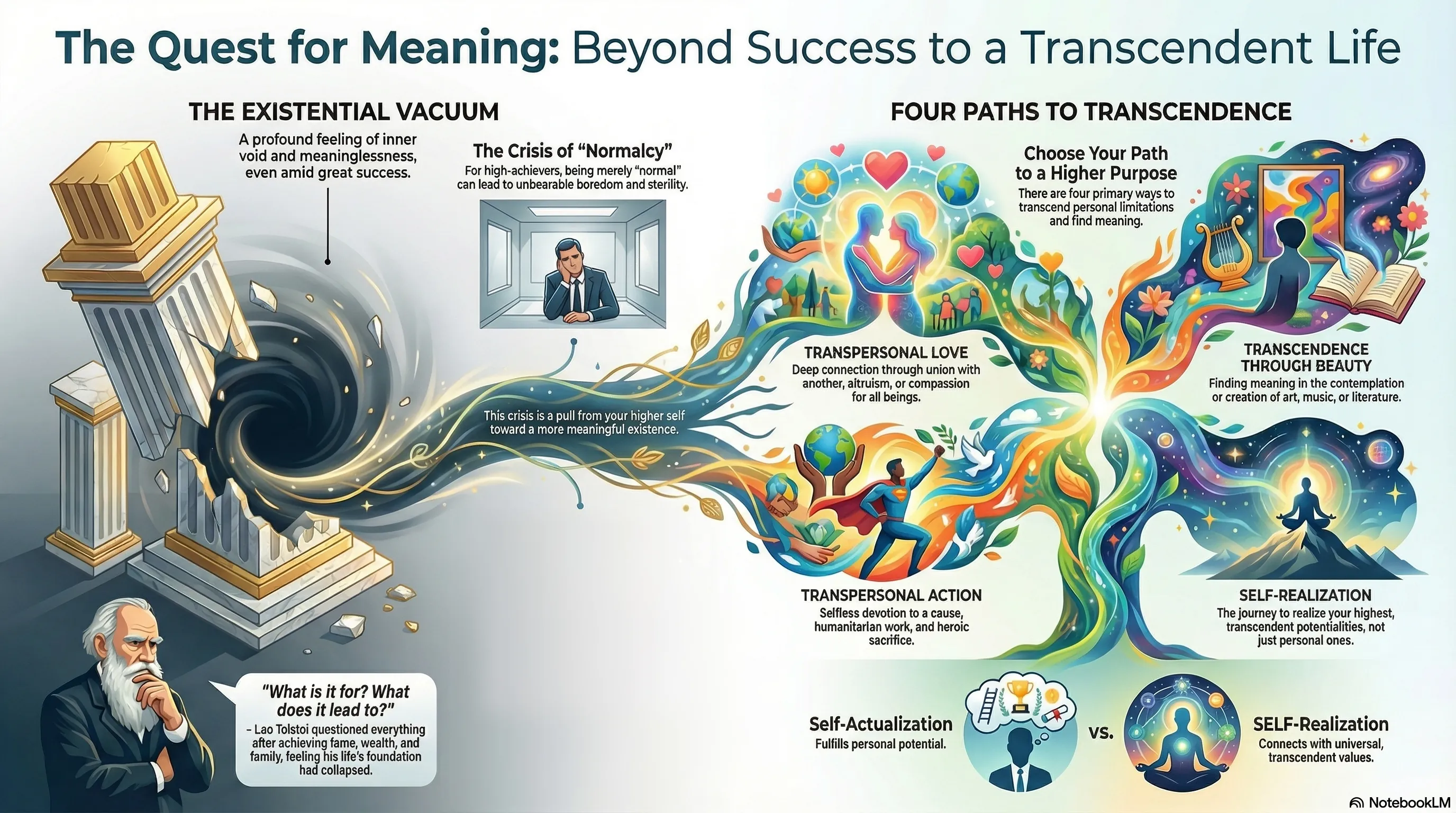
Purpose
Clarify how higher (“transpersonal”) needs generate a distinct kind of willing—experienced as meaning-seeking, a “pull/call,” and a drive toward transcendence rather than regression.
Learning Outcomes
By the end of this chapter, you should be able to:
- Explain, in your own words, how unmet transpersonal needs (especially meaning) can generate the Transpersonal Will.
- Distinguish regression from transcendence as responses to existential anxiety, and state why the chapter treats them as opposites.
- Define the Transpersonal Will and describe how it is experienced by the personal “I” (as “pull/call”).
- Differentiate self-actualization from SELF-realization using the chapter’s criteria.
- List the four “ways of transcendence” and identify one you can recognize in lived experience.
Core Insights
Insight 1
When higher (“transpersonal”) needs emerge (especially meaning), they arouse a corresponding will that presses beyond “normal” life toward transcendence.
- The chapter repeatedly ties dissatisfaction/emptiness (“existential vacuum,” boredom/meaninglessness) to a need for meaning and to the drives/will that follow from needs.
- It frames the “drama and glory” of humans as the eventual demand for satisfaction from the superconscious level culminating in the Transpersonal Self.
- Treats meaning-crisis not as mere malfunction but as a signal of unmet higher needs demanding to be “taken into account and lived.”
- Re-anchors purpose: without an answer to “what for?”, action can collapse into paralysis or self-destructive drift (illustrated in Tolstoi).
Insight 2
There are two opposite ways of dealing with existential anxiety—regression (escape downward into primitive/collective absorption) versus transcendence (rising above ordinary consciousness without losing individual awareness).
- The chapter explicitly warns that many seek expanded states through harmful/destructive means, then insists on distinguishing these two “opposite” ways.
- It asserts regression only postpones crisis, whereas transcendence requires facing demands “courageously and willingly” while keeping the center of awareness.
- What it changes in practice (1–2 bullets, grounded in chapter):
- Adds a decision-test for coping strategies: do they dissolve individuality into “mother/prenatal/collective,” or do they transcend while preserving the “center”?
- Reframes “expanded consciousness” pursuits: the method matters as much as the aim, because one path is non-solution.
Insight 3
The Transpersonal Will is the will of the Transpersonal Self (superconscious) and is often felt by the personal “I” as a “pull” or “call,” which can cooperate or conflict with the personal will; SELF-realization develops in stages culminating in unification with higher will and (ultimately) Universal Will.
- The chapter defines the Transpersonal Will explicitly (as expression of Transpersonal Self operating from superconscious levels) and describes its phenomenology (“pull/call”).
- It organizes transpersonal development via (a) multiple “ways of transcendence,” (b) a crucial distinction between self-actualization and SELF-realization, and (c) “three different stages” of SELF-realization.
- Provides a workable interpretation of “vocation/call” experiences without reducing them to personal preference or pathology (while bracketing metaphysical interpretation).
- Offers a map for aligning personal will with higher will across forms of transcendence (love, action, beauty, SELF-realization).
Key Quotes
On Victor Frankl: “While a prisoner in Nazi concentration camps, he noticed that those who saw meaning in life, or who gave it meaning, demonstrated a surprising degree of strength and resistance. Finding this meaning proved to be of decisive survival value, as many of those who lacked such incentive gave up and died.”
“In these cases the initiative is taken by the Transpersonal Self, which exerts a ‘pull’ from above. This fact can be understood by considering the psychological constitution of human beings. We have seen that the will is the function in closest relation to the self, the most direct expression of the self. This is true both for the personal self and for the Transpersonal Self. Just as there is a personal will—the one we have been considering up to now—so there is a Transpersonal Will, which is an expression of the Transpersonal Self and operates from the superconscious levels of the psyche.”
“It should be noted, however, that when the Transpersonal Will becomes active, many diverse effects can result from the interplay between it and the often rebellious will of the personal self.”
Key Concepts
Transpersonal Will: The will that expresses the Transpersonal Self and operates from superconscious levels, often experienced as an upward “pull” or “call.”
Transpersonal Self: The culminating center at the highest level of the superconscious, the source of transpersonal impulses and will.
Superconscious: The higher level of the psyche (beyond lower/middle psychological life) where transpersonal potentials and the Transpersonal Self are situated.
Metaneeds / Transpersonal needs: A third group of needs beyond basic and personal needs; their emergence can produce dissatisfaction with ordinary satisfactions and push toward “something other.”
Existential vacuum: A condition of inner void/meaninglessness that can occur even with external success and health; not necessarily pathological.
Will to meaning: The drive and corresponding willing aroused by the need to understand and live meaning; portrayed as survival-relevant and decisive for endurance.
Personal futility (sense of futility): The feeling that one is useless and life has no point/value; described here as a delusion corrected by seeing one’s part in a larger whole.
Regression (as response to existential anxiety): Attempt to escape anxiety by returning to a primitive/prenatal/collective absorption—“to lose oneself in the collective life.”
Transcendence (as response to existential anxiety): Rising above ordinary consciousness while keeping the center of individual awareness; a genuine way through existential anxiety.
Low nirvana / High nirvana: Maslow’s labels used here for regression (low) versus transcendence (high).
Vocation: Being “addressed by a voice” of the “inner man,” prompting one to choose one’s way and leave mass identity; can occur in “small” people too.
Call / Pull (from above): How the Transpersonal Will is experienced by the personal “I”: as a drawing, calling, or even imperative demand from the Transpersonal Self.
Self-actualization: Actualization of potentials within the “normal” personality; does not imply higher motivation and can remain self-centered.
SELF-realization: Progressive manifestation of transcendent, transpersonal potentials culminating in direct experiential awareness of the Transpersonal SELF.
Jonah Complex: The fear/evasion of one’s greatness or destiny; running away from one’s best talent and “constitutionally suggested vocations.”
Three stages of SELF-realization: A staged process: (1) activation/expression of superconscious potentials; (2) direct awareness of the SELF and unification of personal “I” with Transpersonal Self; (3) communion with Universal Self and individual will with Universal Will.
Check Your Understanding
- Why can success and satisfaction in “ordinary” life still produce boredom/emptiness?
- Give one concrete example of “regression” and one of “transcendence” strictly as the chapter defines them (no outside terms).
- What is the Transpersonal Will, and how does it show up in experience according to the text?
- What is the key difference between self-actualization and SELF-realization here?
- Name the four types of transcendence listed and define one in one sentence.
Reflection Questions
Choose one of the prompts below. Read through it and think about how it relates to your life or experiences. Spend some time writing about it in your journal or notebook.
- Where do you notice “boredom, ennui, emptiness, and meaninglessness” arising after ordinary satisfactions—and what “something other” does it seem to demand?
- Which is more tempting under stress: regression (escape into absorption) or transcendence (rising above while keeping your center)? What in the chapter explains that tendency?
- Have you experienced anything that fits “vocation” or an inner “call”? If so, what evidence in experience makes it feel like more than a personal whim?
- In what way might you be self-actualizing (integrating abilities, functioning well) while still avoiding SELF-realization (transcendent potentials)?
- What risks or “abandoning the familiar for the unknown” do you associate with further growth, as described in the discussion of evasion (“Jonah Complex”)?
Exercises
Metaneed Spotting Log
Grounding (30–45 sec)
Sit comfortably. Let your shoulders drop. Take two slow breaths. On the exhale, silently note: “Here, now.”
Steps
- Draw three quick rows on a page: Moment / What satisfied / What showed up after.
- Recall three recent moments where something “should have” felt satisfying (success, comfort, praise, purchase, completion), but was followed by boredom, emptiness, restlessness, or meaninglessness.
- For each moment, write:
- What was satisfied (basic or personal need; keep it concrete).
- What showed up after (one of: boredom / ennui / inner void / “so what?”).
- Add one final line under each: “Something other wanted:” and complete it with a cautious, plain phrase (e.g., “a larger purpose,” “a truer direction,” “a deeper understanding,” “a wider love,” “real contribution”). Don’t force certainty—write the best fit.
Success criteria
- You produce 3 entries that clearly show the “after-effect” (emptiness/restlessness) and a plausible “something other” without trying to dramatise it.
Need → Will Translation
Grounding (30–45 sec)
Sit upright. Take two slow breaths. Briefly place attention on the contact of your feet with the floor. Silently note: “I can choose.”
Steps
- Choose one entry from Exercise 1 where the “something other” felt most real.
- Write this sentence at the top of the page:
“Every need arouses, sooner or later, a corresponding will.” - Translate your “something other wanted” into a corresponding will statement using this structure (one or two sentences):
- Aim (what): “I will …”
- Reason (why/meaning): “… because …”
- First tiny intention (first step): “First, I will … (≤ 5 minutes).”
- Add a brief valuation check (one line):
“If I did this, what would it lead to?” (answer in one sentence). - Circle the first tiny intention and write a start time for today or tomorrow.
Success criteria
- Your statement includes all three parts (aim + why + first tiny intention) and the first step is genuinely small and doable, not a dramatic life overhaul.
Review & Practice: Chapter 9: The Transpersonal Will
Test your understanding of the core ideas from this chapter and capture your personal reflections. Scored questions provide immediate feedback; reflections are stored privately on your device.
In this chapter, what best describes the “transpersonal will”?
Which contrast best matches Maslow’s framework as used in the chapter?
The “existential vacuum” is always a sign of mental illness.
Which option best corrects a common misunderstanding from this chapter?
Scenario: Maia has a stable job, good relationships, and plenty of entertainment. Yet she feels bored and asks, “What’s the point?” She’s tempted to numb out with constant scrolling. What best fits the chapter’s emphasis?
Complete the following statement by filling in the missing term(s):
Which option best states what this chapter is trying to do?
Which option best summarises the chapter’s main contribution?
Scenario: Arlo feels a strong inner “call” to devote time to a cause, even though it brings inconvenience and risk. In the chapter’s terms, what is this most like?
In 3–5 sentences, describe the difference between self-actualization and SELF-realization as presented in this chapter.