Chapter 8: Love And Will
Purpose
Clarify why love and will often oppose or distort each other in practice, and how to deliberately integrate them through balancing, raising their level, and synthesizing them (not compromising).
Learning Outcomes
By the end of this chapter, you should be able to:
- Distinguish the failure patterns of love without will and will without love.
- Explain why the chapter treats love as an art requiring will-qualities and knowledge parallel to good willing.
Describe the three methods for harmonizing love and will and select one appropriate to a given case. - Differentiate synthesis from compromise in the chapter’s sense and identify what changes when acting “from the vantage point of the self.”
- Apply the chapter’s guidance to one real-life love–will conflict by proposing a concrete balancing or synthesis approach.
Core Insights
Insight 1
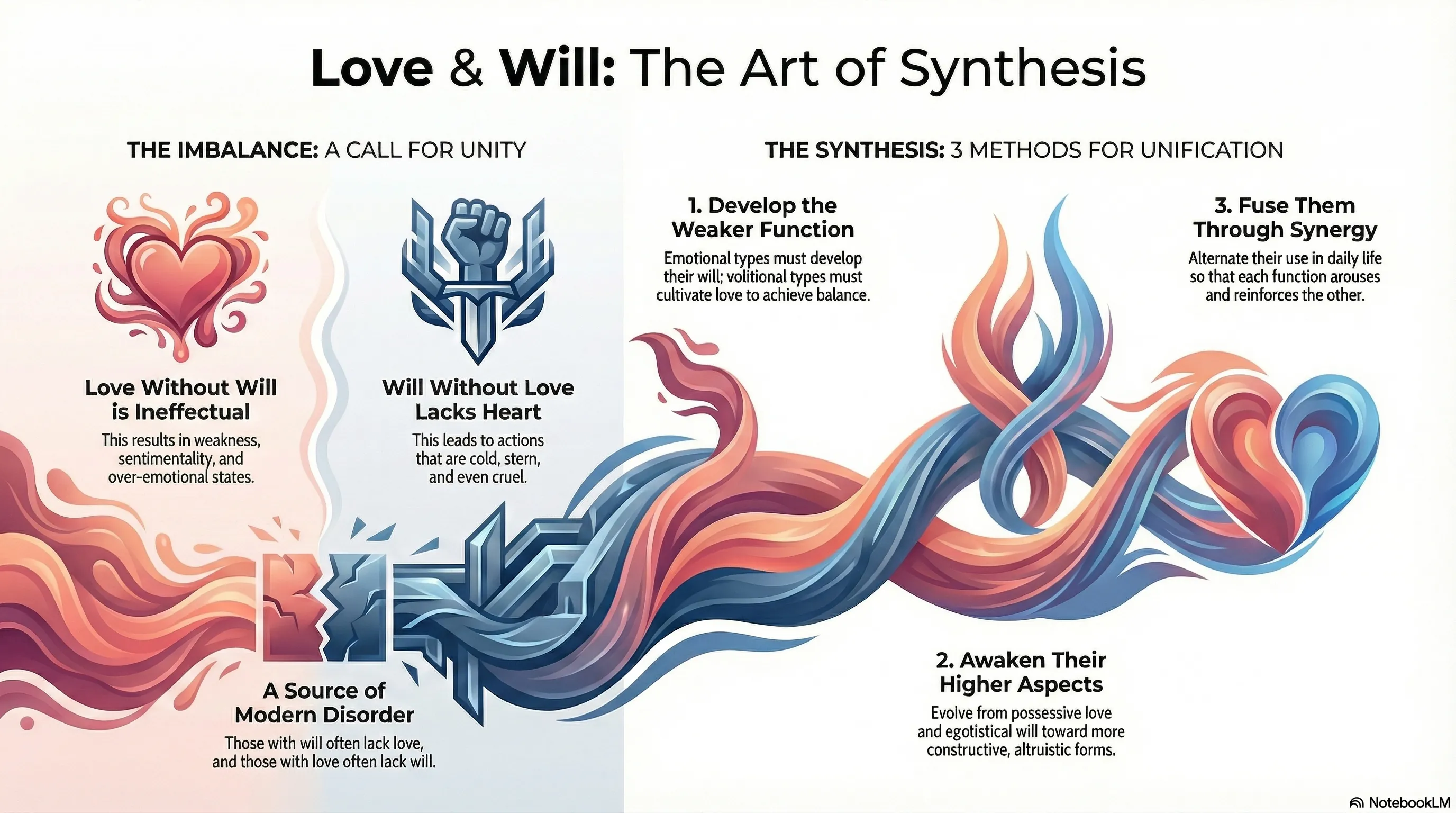
Love without will becomes weak or distorted, and will without love becomes harsh or harmful; effective living requires integrating them.
- The chapter frames modern “disorders” as stemming from the separation: will without love, and love without will, and states an “urgent need” for unification.
- It opens by contrasting the failures of each when isolated (“cold… cruel will” vs “weak… ineffectual” love).
- You treat imbalance as a primary diagnosis (which is weaker—love or will?) rather than blaming circumstances or the other person.
- You aim for integration (availability of both) rather than intensifying your habitual side.
Insight 2
“Loving well” is an art that requires will-qualities (discipline, patience, persistence) and knowledge similar to that required for “good willing”; mere attraction or “falling in love” is insufficient.
- The chapter explicitly rejects love as “simply” feeling and argues the widespread conflicts in relationships show attraction is not enough.
- It states successful love entails acquiring knowledge about human structure, functions, and laws—parallel to good willing.
- You stop treating love as only spontaneous; you treat it as something that can be cultivated through training and understanding.
- You evaluate “relationship skill” as something requiring practice analogous to mastering an art.
Insight 3
The integration of love and will is achieved by synthesis (a higher unity), not compromise; it requires sustained inner presence plus active direction by the self, using “wise will” to regulate opposites without identifying with either pole.
- The chapter makes the synthesis/compromise distinction “fundamental,” ties it to psychosynthesis, and describes “persistent vigilance” and conscious “presence.”
It asserts the self is not merely an observer but a “willer,” capable of active intervention via self-identification.
Instead of splitting the difference between heart and force, you aim to absorb both into a higher unity.
You practice non-identification with extremes and deliberately regulate their interaction from a “higher unifying center.”
Key Quotes
“The danger of untempered will is that it lacks heart. We see, and used to see especially in Victorian times, the operation of a cold, stern, and even cruel will. On the other hand, love without will can make an individual weak, sentimental, overemotional, and ineffectual.”
“The first love is love for oneself. Mention of this may occasion some surprise, as love directed toward oneself is generally considered to be synonymous with egotism or narcissism. This kind of self-love does of course exist, but it is not the only kind; here, as always, the great complexity and multiplicity of the human being must be taken into account. In the case of self-love, all depends on what we love in ourselves and how we love it. It is truly egotism if we love the egocentric and separative aspects in us, the craving of pleasure, possessions, and domination.”
“Love and will are generally present in individuals in inverse proportion. That is to say, those in whom love is predominant tend to possess less will and are little inclined to use what they have, while those endowed with a strong will often lack love or even exhibit its contrary. But this personal imbalance between love and will can be further accentuated by the essential differences in the quality, nature, and direction of the two aspects themselves”
Key Concepts
Integration / unification (of love and will): Bringing love and will into a coordinated unity so each tempers and strengthens the other.
Untempered will: Will operating without the balancing quality of love, tending toward coldness or cruelty.
Love without will: Love expressed without the active support of will, becoming weak, sentimental, overemotional, or ineffectual.
Self-love: Love directed toward oneself that can be egotistical (if aimed at separative cravings) or constructive (if aimed at one’s higher nature and potentialities).
Oblative love: A giving, devoted love oriented to protection and care, accepted joyously, contrasted with attachment/possessiveness.
Attachment / possessiveness (in love): A distortion where devotion becomes clinging, demanding, or controlling, often producing rebellion.
Semantic confusion (about love): Using the same word “love” for different mixtures (physical, emotional, mental, spiritual), producing misunderstanding and conflict.
Fanaticism / idée fixe: A distortion of impersonal love for an ideal into obsession and cruelty toward dissenters.
Inverse proportion (love and will): A tendency for individuals to have more love with less will, or more will with less love.
Discipline, patience, persistence (as will-qualities used in love): Volitional qualities required to cultivate love as an art over time.
Higher aspects / levels / values (of love and will): Qualitative differences where some expressions are “lower” (possessive, ruthless, egotistical) and others “higher” (tender, concerned with wellbeing; will devoid of egotism).
Higher needs: Needs that emerge as basic needs are met and draw one toward “expansions of consciousness and realization.”
Synthesis (vs compromise): A higher unity that transcends both love and will, not merely splitting the difference.
Conscious inner “presence”: Sustained awareness that observes inner/external events and enables active intervention by the self.
Self-identification: A principle used from the vantage point of the self to direct functions and energies rather than being carried by them.
Wise will: The will guided by wisdom that can “play with opposites,” regulate antipodal forces, and establish dynamic equilibrium without compromise.
Check Your Understanding
- Give one concrete example of “love without will” and one of “will without love,” and name what each tends to become.
In your own words, why does the chapter say “falling in love” is insufficient for successful loving? - What is the difference between “compromise” and “synthesis,” and why is it “fundamental”?
- What does “conscious inner presence” add beyond simply noticing what happens?
Reflection Questions
Choose one of the prompts below. Read through it and think about how it relates to your life or experiences. Spend some time writing about it in your journal or notebook.
- Where in your life do you see the chapter’s “inverse proportion” pattern—love stronger than will, or will stronger than love?
- Which distortion is more familiar to you under stress: possessive/attached “love,” or separative/domineering “will”? What is the cost?
- What would it mean, concretely, to treat your loving as an “art” requiring disciplined practice?
- In a current tension, what would change if you stopped trying to “compromise” and aimed for synthesis?
- What is one pair of opposites you frequently oscillate between (reason/feeling; receptivity/dynamism), and what would “dynamic equilibrium” look like there?
Exercises
Love–Will Balance
Steps
- Write one sentence describing a current relationship tension (or inner conflict) where you feel stuck.
- Mark one box (don’t overthink):
- ☐ Love is stronger than will here (I feel a lot, but don’t act/direct well)
- ☐ Will is stronger than love here (I act/direct, but it feels cold/harsh/separative)
- Write two short lines:
- “Without will, my love shows up as: ___” (e.g., weak/ineffectual, sentimental, overemotional, attached/possessive)
- “Without love, my will shows up as: ___” (e.g., stern/cold, domineering, separative, harmful)
- Choose one of the chapter’s methods and write one next action for today:
- Develop the weaker function OR
- Awaken a higher level of love/will OR
Alternate love and will so each reinforces the other
Success criteria
- You name the imbalance and select one method with one concrete next step.
Synthesis (Not Compromise) Rewrite
Steps
- Recall a moment where you tried to “split the difference” between caring (love) and firmness (will), and it still felt wrong.
- Name the two poles in one line (e.g., care/union vs assertion/boundaries).
- For each pole, write one sentence: “Its legitimate function here is: ___” (so neither dominates).
- Write a synthesis statement (1–2 sentences):
- “From the vantage point of the self, I will absorb both into a higher unity by: ___”
- Add one “wise will” move (1 sentence): how you will regulate the interaction of the two (moment-to-moment), without identifying with either extreme.
Success criteria
- Your plan is not a compromise; it explicitly preserves both functions and describes regulation from a higher, directing center.
Review & Practice: Chapter 8: Love And Will
Test your understanding of the core ideas from this chapter and capture your personal reflections. Scored questions provide immediate feedback; reflections are stored privately on your device.
In this chapter, what does “untempered will” most nearly mean?
Which contrast best matches the chapter’s core distinction?
The chapter suggests love and will are often present in inverse proportion in many people.
Which option best corrects a common misunderstanding about love in this chapter?
Scenario: You want to help a friend, but you avoid a needed conversation because you fear upsetting them. Later, the problem gets worse. What best fits the chapter’s meaning / emphasis?
Complete the following statement by filling in the missing term(s):
Which option best states what this chapter is trying to do?
Which option best summarises the chapter’s main contribution?
In 2–4 sentences, describe one everyday example of “love without will” or “will without love,” and name one small way to add the missing side.