
Chapter 7: The Good Will
Purpose
Introduce good will as a new, higher task in will-training—disciplining the will to choose aims consistent with others’ welfare—and show practical means for reducing conflict through removing obstacles and developing will-to-understand (especially via empathy).
Learning Outcomes
By the end of this chapter, you should be able to:
- Explain why treating the individual as “isolated” leads to conflicts that defeat aims.
- Define “good will” and distinguish it from strength/skill alone (by the criterion of aims consistent with others’ welfare).
- Identify and distinguish the three obstacles and describe how each disrupts good will.
- Describe the “will-to-understand” and its requirements.
- Reproduce the chapter’s empathy method as a sequence of actions.
- State how intention relates to influence on others, using the chapter’s wording and implications.
Core Insights
Insight 1
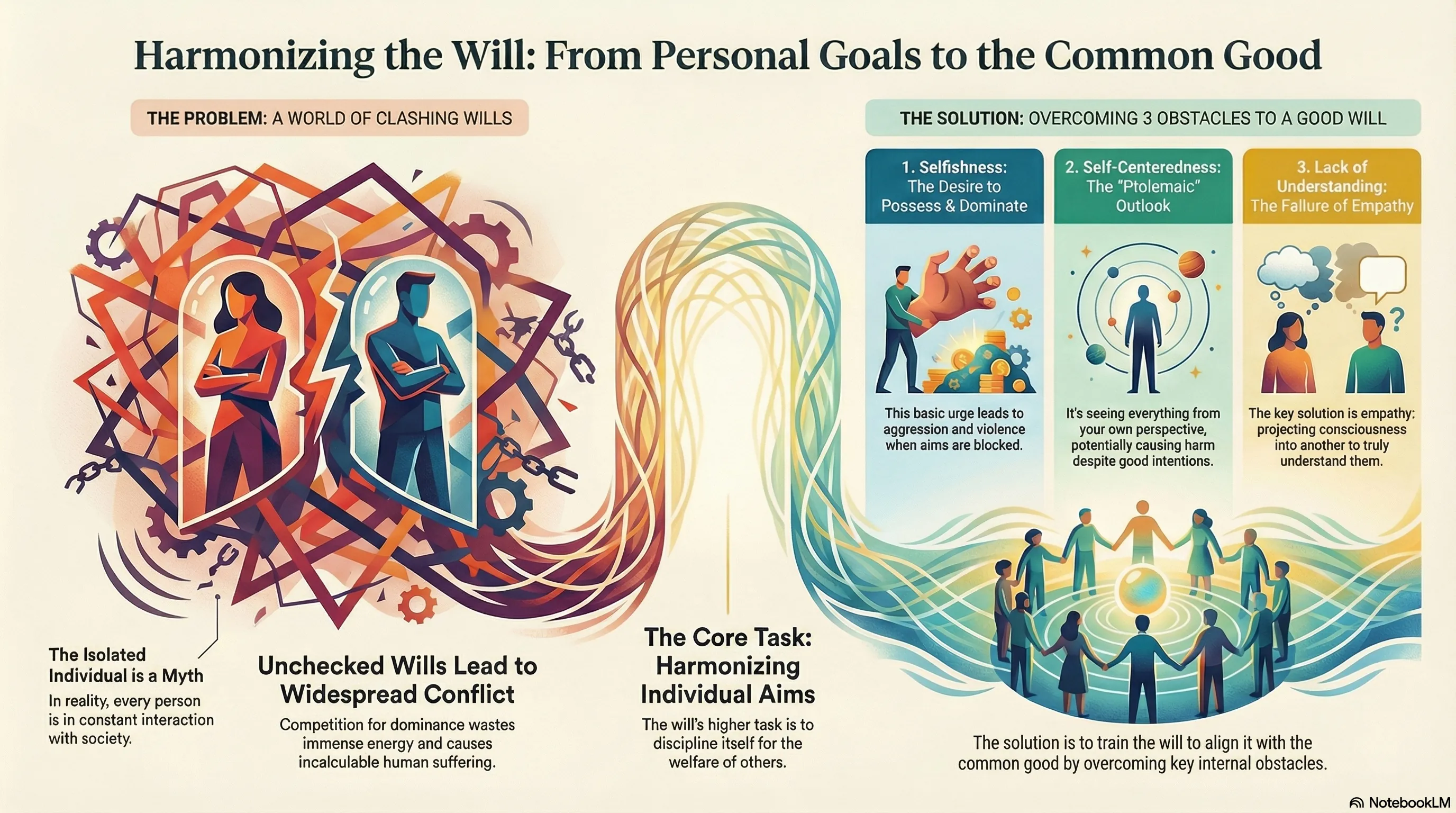
If you ignore human relationships when pursuing personal aims, you will often trigger conflict that defeats your aims; therefore willing must include harmonizing wills within a wider human solidarity.
- The chapter opens by correcting the “isolated unit” view and argues that failing to consider relationships “inevitably arouses reactions and conflicts that often defeat his aims.”
- It frames social conflict as “basically a question of willing,” with success depending on “gradual harmonization of the wills of all concerned.”
- You treat aims and methods as relational (anticipating reactions and conflicts), not merely personal achievement.
- You aim to fit “differing individual aims” into “a wider human solidarity.”
Insight 2
Good will is will-training that disciplines the will to choose aims consistent with the welfare of others and the common good; it requires both removing obstacles (selfishness, self-centeredness, lack of understanding) and actively developing good will.
- The chapter explicitly names a “new aspect in the training of the will” and defines the “higher task” as “disciplining itself and choosing such aims as are consistent with the welfare of others and the common good of humanity.”
- It then structures the chapter around “two methods”: “elimination of obstacles” and “active development and expression of a good will.”
- You make “welfare of others” a criterion in what you choose to pursue (not just how strongly or skillfully you pursue it).
- You treat selfishness/self-centeredness/misunderstanding as trainable obstacles that must be addressed for good will to function.
Insight 3
The practical core of good will is a will-to-understand: an intention to understand others supported by relinquishing self-centeredness and by training empathy (projecting consciousness into another), with deliberate attention to the influence you exert—because “it all hinges on our intention.”
- Eliminating self-centeredness and lack of understanding “requires primarily the will-to-understand,” which “requires the intention to understand” and “relinquishing” what blocks it.
- It gives a concrete method for empathy (projection, living contact, temporary identification, imagining thoughts/feelings/reactions) and links constructive influence to intention: “We are constantly influencing others… It all hinges on our intention.”
- You train empathy as an active skill (not a mere feeling), to produce “true understanding of others” and reduce judgment/condemnation.
- You become more intentional about the influence you exert—aiming for “beneficent and constructive” impact.
Key Quotes
“In the preceding consideration of the development of the will, the individual has been regarded as an isolated unit, with his will as an instrument of personal achievement. But in reality the isolated man does not exist: he is in constant interaction with his family, his working associates, and society in general. His relationships are many and diverse.”
“We have seen how the individual will has the power to strengthen itself and skillfully direct the activity of the other psychological functions. Now the individual will faces another and higher task, that of disciplining itself and choosing such aims as are consistent with the welfare of others and the common good of humanity.”
“On the other hand, the individual is not fixed and immutable but is in a continual state of becoming. Everyone can direct and regulate his own ‘becoming’ process to a certain extent; thus comes into play the responsibility he bears for the beneficent or harmful influence he has on other people.”
Key Concepts
Isolated man: The mistaken view of a person as existing apart from ongoing relationships and social interaction.
Interaction: Ongoing mutual influence between a person and family, associates, and society.
Clash of wills: Competing efforts for dominance that create widespread conflict across groups and within families.
Harmonization of wills: Gradual fitting of different aims into a wider solidarity so efforts don’t defeat one another.
Good will: A trained aspect of will that disciplines itself to choose aims consistent with others’ welfare and the common good.
Two methods (for the good will task): The chapter’s two-part strategy: remove obstacles; develop and express good will.
Selfishness: Desire to possess and dominate, rooted in self-preservation and self-assertion, tending toward aggressiveness when blocked.
Curbing of selfishness: The deliberate control of selfishness for safety, aided by skillful use of the will and by mobilizing will-to-good.
Self-centeredness: Tendency to refer everything to the personal self and to insist on doing good “in one’s own way,” often becoming overbearing/fanatical.
“Ptolemaic” vs “Copernican” outlook: A mistaken perspective that places the personal self at the centre (Ptolemaic) rather than decentering it (Copernican).
Lack of understanding of others: Misunderstanding people who differ from us and also those we love; love alone does not ensure understanding.
Will-to-understand: The primary requirement for removing self-centeredness and misunderstanding: a deliberate will aimed at understanding others.
Intention to understand: The deliberate intention required for will-to-understand to operate.
Empathy: “Projection of one’s consciousness into that of another being,” necessary for genuine existential understanding.
Impersonality and self-forgetfulness: The attitude needed to develop empathy—decentering the personal self to understand another.
“Thou”: Approaching another as a person of intrinsic reality and depth, enabling a deeper inner relationship.
Living contact → (temporary) identification: A deepening of empathy from contact to momentary identification, imagining oneself as being the other person.
Essential unity of human nature: The basis for empathy: beneath differences, humans share a common nature with potentials for virtue and vice.
Passing judgment: The ordinary stance of criticizing, condemning others, which empathy/understanding tends to replace with compassion and solidarity.
Intention / intentionality: Intention is the hinge of influence; “intentionality” is named as a characteristic of the will, and good will chooses/wants the good.
Check Your Understanding
- Why can ignoring relationships “defeat” your aims even if you are strong and able?
- What is the “higher task” the individual will faces and what are the two methods for accomplishing it?
- Give one clear difference between selfishness and self-centeredness.
- Why does the chapter say love does not guarantee mutual understanding?
- List the steps of the empathy approach described in the chapter.
- What “hinges on our intention,” and what practical implication follows?
Reflection Questions
Choose one of the prompts below. Read through it and think about how it relates to your life or experiences. Spend some time writing about it in your journal or notebook.
- Where in your current life do you see a “clash of wills,” and what evidence suggests it creates “wastage” (time, energy, suffering) as described here?
- In what ways might you “want to do good” yet still try to do it “in your own way,” and what harm could that create?
- Think of someone you love or feel close to: what “vital need” might you be missing that love alone hasn’t revealed?
- When do you most easily fall into judging/condemning others, and what would it look like (in your case) to replace that with understanding?
- What specific intention would make your influence on others more “beneficent and constructive” this week?
Exercises
Obstacle Scan After a Recent Conflict
Grounding (1 min)
- Sit comfortably and unclench your hands.
- Take 3 slow breaths.
- On the last exhale, set a simple intention: “I want to see clearly.”
1) Pick one friction (1 min)
- Choose one recent interpersonal friction (family, work, or social).
- Write 2–3 lines describing what happened, sticking to observable facts (who/what/when).
2) Name your original aim (30 sec)
- Finish this sentence: “My aim in that moment was…”
(Keep it concrete: “be heard,” “solve X,” “set a boundary,” “help them,” etc.)
3) Scan for the three obstacles (3–4 min)
Read each prompt and answer Yes / Maybe / No, then add one short reason.
- A) Selfishness (possess / dominate)
- Prompt: “Was I trying to possess something or dominate the situation/person?”
- If blocked: “Did I feel aggressiveness or a push to ‘break through’ resistance?”
- Note: 1–2 lines describing the evidence.
- B) Self-centeredness (everything through ‘me’ / ‘my way’)
- Prompt: “Was I referring everything to my own viewpoint or reaction?”
- Prompt: “Even if I meant well, was I insisting it had to be done my way?”
- Note: 1–2 lines of evidence (e.g., language you used, tone, refusal to adapt).
- C) Lack of understanding (missed vital needs)
- Prompt: “Did I misunderstand (or not try to understand) their vital needs?”
- Prompt: “Did love/attachment exist, yet understanding still fail?”
- Note: 1–2 lines stating what need might have been missed.
4) Choose the active obstacle(s) (1 min)
- Write one sentence: “The obstacle(s) most active were…”
(Name 1–2 only, unless all three are clearly present.)
5) Link to how it defeated the aim (1–2 min)
- Write one sentence: “This likely defeated my aim because it triggered…”
(Complete with a plausible “reaction/conflict” chain: defensiveness, escalation, withdrawal, counter-push, etc.)
Close (30 sec)
- Write one line: “Next time, I will aim to reduce this obstacle by…”
(Keep it minimal and realistic—one behavioural change.)
Success criteria
- You identified at least one obstacle with a clear, text-faithful reason (possess/dominate; “my way”; missed vital needs), and you linked it to a plausible reaction/conflict that undermined your original aim.
Empathy as a Progressive Approach
Grounding (1 min)
- Sit comfortably. Let your shoulders drop.
- Take 3 slow breaths. On each exhale, soften your face and jaw.
- Silently set a simple aim: “I intend to understand.”
1) Choose a person (30 sec)
- Pick one person you want to understand better (ideally someone you’ve recently felt friction or distance with).
2) Interest (1–2 min)
- Bring them to mind.
Ask, and answer in one sentence: “What do I genuinely want to understand about them?” - Then add: “What might matter to them right now?” (Keep it tentative; no conclusions.)
3) Thou-stance (1–2 min)
- Picture them as a “Thou” (a whole person, not a role, problem, or opponent).
- Let one of these attitudes arise (choose one): sympathy, respect, or wonder.
- Write one short line beginning: “As a ‘Thou’, they are…” (e.g., “a person with their own inner life.”)
4) Living contact (2 min)
- Hold their image steadily for a minute, without rehearsing arguments.
- Each time you drift into evaluation (“they should…”, “they always…”), gently return to:
“I am here to understand.” - Write 3 plain observations (not judgments) about them that you know to be true.
5) Temporary identification (2–3 min)
- Say inwardly: “For a moment, I will imagine being them.”
- Imagine waking up as them tomorrow—same body, same responsibilities, same pressures.
- Write 3 lines starting with:
- “As them, I might be thinking…”
- “As them, I might be feeling…”
- “As them, I might be needing…”
(Keep each line short.)
6) Imagined situations + reactions (2–3 min)
- Pick two concrete situations:
- A recent interaction between you and them (or one you expect soon).
- A situation unrelated to you (work, family, health, money—whatever fits).
- For each situation, write:
- Possible thought
- Possible feeling
- Likely reaction
(You’re not asserting facts—just generating plausible inner experience.)
Close (30 sec)
- Write one sentence: “The most useful thing I now understand is…”
- Write one sentence: “My intention for the next interaction is to…”
Success check (quick)
- You can point to at least one place where you shifted from “my view of them” to “their possible inner experience,” and you produced a clear intention for constructive influence.
Review & Practice: Chapter 7: The Good Will
Test your understanding of the core ideas from this chapter and capture your personal reflections. Scored questions provide immediate feedback; reflections are stored privately on your device.
In this chapter, “good will” is best described as:
What key shift does the chapter add to earlier will-training?
Personal love automatically creates mutual understanding between people.
Which option best corrects a common misunderstanding about self-centeredness in this chapter?
Scenario: A coworker struggles with a task. You jump in, take over, and insist your method is “the best.” They become defensive and avoid you afterward. What obstacle from this chapter best fits the situation?
Complete the following statement by filling in the missing term(s):
Which option best states what this chapter is trying to do?
Which option best summarises the chapter’s main contribution?
In 3–5 sentences, describe one everyday situation where “will-to-understand” would change how you respond. Keep it low-stakes and practical.