
Chapter 6: Practical Applications of the Skillful Will
Purpose
To present a small set of tested, typical techniques that apply the psychological laws of the previous chapter under the direction of the skillful will in common inner and outer situations.
Learning Outcomes
By the end of this chapter, you should be able to:
- Explain (in plain terms) why concentrating on “not thinking” about something can intensify it, using the chapter’s account of attention/interest reinforcement.
- Apply the technique of substitution to a recurrent unwanted thought/image and describe the expected progression (peripheral → tenuous → fades).
- Identify at least four “psychological poisons” named in the chapter and outline one psychological hygiene measure for each that relies on withholding attention/interest.
- Implement an evocative word practice using at least two of the chapter’s listed methods (e.g., observe + write; reflect + say aloud).
- Use “acting as if” in a specific situation by deliberately changing posture/facial expression/speech and tracking whether the emotional state follows.
- Design a simple “team” of two techniques (sequence) for a single difficulty, consistent with the chapter’s guidance on combining methods.
Core Insights
Insight 1
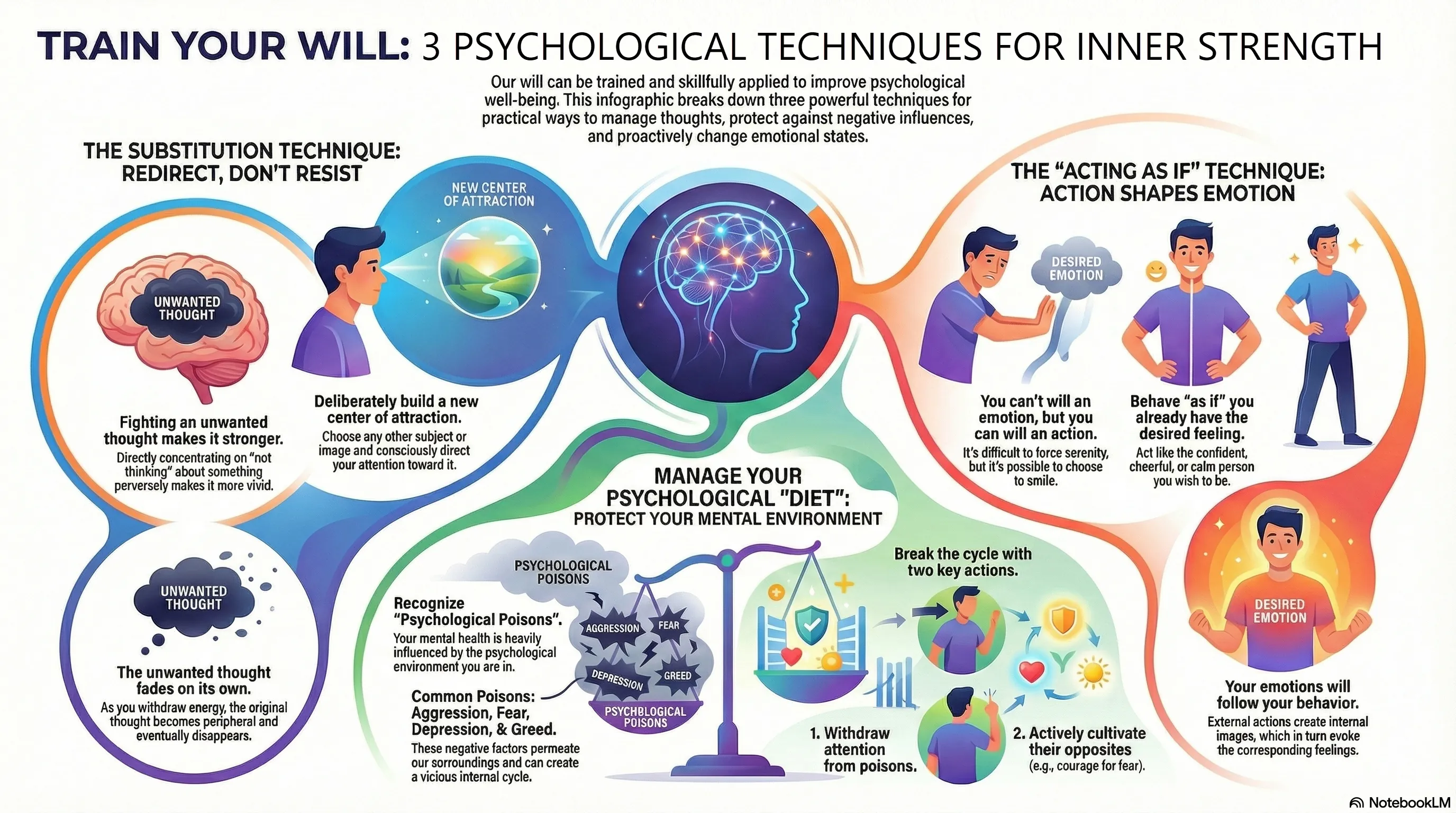
When direct willpower struggles fail, use the skillful will to redirect attention (and thus energy) so unwanted thoughts/emotions lose force and chosen aims gain force.
- The chapter repeatedly frames attention as energizing (“attention centered on an object gives it energy”) and presents multiple methods that work by withholding or re-centering attention (substitution; psychological hygiene; limiting exposure to sensational material).
- Instead of concentrating on “not thinking about” something (which makes it more vivid), you deliberately build a new “center of attraction” and let the unwanted content fade.
- You protect mental health by refusing needless attention/interest to “psychological poisons,” freeing attention for constructive focus.
Insight 2
The skillful will can evoke desired inner states indirectly by using words, images, and bodily actions that trigger corresponding ideas and feelings.
- “Evocative words” and “acting as if” are presented as direct applications of the laws: ideas/images and repeated attention have effects, and physical attitudes/actions can evoke corresponding images and then emotions.
- You stop waiting for the “right feeling” and instead use chosen words and chosen behavior to produce (gradually, sometimes rapidly) the emotional state needed.
- You use repetition, placement (cards), and multi-sensory reinforcement (seeing/saying/writing a word) to increase cumulative effect.
Insight 3
Effective self-training often requires combining techniques; selecting and harnessing a “team” of methods is itself a task of the skillful will.
- The chapter explicitly states that when one technique fails, “various ones in combination can succeed,” and calls the selection of a “team” a “specific task of the skillful, wise will.”
- You don’t treat techniques as one-shot fixes; you sequence them (e.g., preparatory methods before “acting as if” when fear is strong).
- You experiment and adapt methods to your “psychological type” and what proves “most rewarding.”
Key Quotes
On the Realizing the Value of the Will: “This procedure of vividly imagining the limitations and drawbacks of an existing condition we want to change, and the advantages of changing it, is very valuable to generate momentum before initiating any kind of inner or outer activity. It is a psychological analogue to power steering, or to the servo brakes of an automobile, or to the many other devices that, by means of mechanical advantage, allow man to augment his physical strength by practically any desired amount.”
On the Technique of Substitution: “Continued attention tends to increase interest and interest in turn reinforces the attention, thus creating a positive feedback loop. When the unwanted thought or image draws our awareness, it becomes like a magnet that captures our attention and continues to draw increasing energy from it. So if we pit the strength of our will directly against it, we are likely to fail. But if we use a more skillful, less direct and ‘aggressive’ approach, by deliberately building another such center of attraction, we can easily use it to liberate our captive attention.”
On Psychological Breathing and Feeding: “The principal negative factors are aggressiveness and violence; fear; depression and despondency; greed and all forms of selfish desire. They are true ‘psychological poisons’ … A most effective way to break the vicious circle is to withdraw attention deliberately from these psychic poisons.. This will liberate the energy of the attention and allow it to be focused elsewhere, in a direction where it will do the most good. The act of this withdrawal of attention is a definite act of the skillful will and in turn contributes to strengthening the will itself.”
Key Concepts
Skillful will: The will’s capacity to obtain desired results by using indirect, well-chosen methods that stimulate, regulate, and utilize psychological functions and laws (rather than relying on direct force).
Realizing the value of the will: An exercise that uses imagination to vividly recognize the costs of an unwanted condition and the advantages of change, thereby generating motivation and momentum aligned with intention.
Technique of substitution: Replacing attention to an unwanted thought/image with attention to a chosen alternative, so the unwanted content becomes peripheral and fades.
Feeding power of attention: The effect by which focused attention energizes and intensifies what it attends to, increasing its prominence and influence.
Positive feedback loop: A reinforcing cycle in which attention increases interest and interest strengthens attention, amplifying the attended content.
Psychological breathing and feeding: A general approach to everyday life that treats psychological influences like “intake,” emphasizing regulation of what one mentally “breathes” and “ingests,” and skillful protection from harmful influences.
Psychoecological conscience: An emerging awareness and responsibility regarding the psychological “environment” and its effects, analogous to ecological concern for physical environment.
Psychological poisons: Aggressiveness/violence, fear, depression/despondency, greed/selfish desire—harmful influences that “pollute” the psychological environment and operate both externally and internally.
Psychological hygiene: Practical protection of mental health through limiting needless exposure to harmful influences, withholding attention/interest from them, and counteracting them with constructive focus.
Withholding (withdrawal of) attention: A deliberate act of the skillful will in which attention/interest is refused to harmful content, freeing attention to be used constructively.
Evocative words: Words used as stimuli that “evoke” associated meanings and energies, influencing moods and ideas through the psychological laws described.
Beneficent obsession: The cumulative effect of repeated, repeated exposure to the same chosen word (e.g., multiple cards placed around) so it steadily impresses the unconscious.
Ambivalence: A mixed reaction in which a word evokes both positive and negative responses, possibly split between conscious reaction and unconscious response.
“Acting as if” technique: Acting outwardly as if one already possessed the desired inner state, so behavior evokes images and then emotions that gradually align inner state with the acted attitude.
“Turenne method: Acting “as if” fear were absent in urgent situations where there is no time for gradual training—commanding the body to act despite emotion.
Check Your Understanding
- Why is trying to “not think about” something often self-defeating, and what is the alternative move?
- What is the “vicious circle” described around psychological poisons, and what single act is named as a most effective way to break it?
- Describe the causal chain the chapter gives for “acting as if”, without adding any steps not stated.
Reflection Questions
Choose one of the prompts below. Read through it and think about how it relates to your life or experiences. Spend some time writing about it in your journal or notebook.
- Where in your life do you most often “pit the strength of [your] will directly” against something—and what would substitution look like there, in concrete terms?
- Which “psychological poison” most reliably captures your attention, and what is one specific, repeatable way you can withhold attention from its sensational form while still keeping “objective information… for a useful purpose”?
- Which evocative word (single word) would you genuinely be willing to work with for a week, and what reaction (positive, negative, ambivalent) does it immediately evoke?
- Identify one situation where you claim you “can’t” change a feeling by will; what outward attitude/behavior could you change “as if” you had the desired state?
- If one technique fails, what two-technique “team” (sequence) would you try next, and what would you use as evidence that the combination is working?
Exercises
Realising the Value of the Will
Refer back to Lesson 4 for this exercise.
Technique of Substitution — Reclaiming Captive Attention
Purpose (what you’re training)
To use the skillful will to free attention from an unwanted thought/image by building a chosen “center of attraction”—instead of struggling directly against the unwanted content.
What this relies on
- Law VI: whatever sits at the center of attention gets energy and becomes clearer/more prominent; attention ↔ interest can form a feedback loop.
- Therefore: don’t “fight” the unwanted thought. Stop feeding it. Feed something else (by choice).
Grounding (30–60 sec)
- Sit comfortably. Let your shoulders drop.
- Take three slow breaths.
- On the exhale, let your attention soften as if you’re widening a camera lens.
- Briefly note: “I’m about to move the center of attention on purpose.”
1) Identify the “magnet” (10–20 sec)
- Name what’s capturing you: a thought, tune, phrase, image, or scene.
- Label it neutrally (no argument with it):
- “Unwanted thought” / “Old tune” / “Looping image.”
Rule: Do not analyze it here. The exercise is about attention placement, not interpretation.
2) Stop the direct struggle (10 sec)
Say (silently):
- “Not thinking about it makes it more central.”
Then drop the goal of “getting rid of it.” Your immediate goal is simpler: change what you feed.
3) Choose your substitute (20–30 sec)
Pick one substitute that is:
- Easy to hold in attention for 30–60 seconds, and
- More useful than the unwanted content.
Choose one of these forms (keep it simple):
- A single image (e.g., a calm scene, an object with clear details).
- A short phrase you can repeat without effort (not to “fight,” but to occupy the center).
- A concrete task-image (the next small action you genuinely intend to do).
Important: The substitute must be yours by choice—that’s the point of the technique.
4) Move the “lens” to the substitute (60–90 sec)
- Put the substitute at the center of attention.
- Use Law VI deliberately:
- Attention: make it clearer—add detail (shape, edges, parts, sequence).
- Interest: find one genuinely engaging detail (even small).
- If the unwanted thought returns, treat it as a tug—not an enemy:
- Note: “pulling”
- Then re-center on the substitute immediately.
You’re training a repeated move: center → re-center → re-center.
5) Reinforce (optional) with brief repetition (30–60 sec)
If helpful, apply “hammer blows” (repetition) to the substitute:
- Repeat the substitute phrase slowly 5–10 times OR
- Revisit the substitute image detail-by-detail in the same order 2–3 times.
This uses the chapter’s point: repetition can fix an idea/image so it becomes dominant—here, dominantly useful.
6) Close (15 sec)
Check what changed:
- Is the unwanted content less central?
- Has it become more peripheral/tenuous?
- Do you have more free space in consciousness?
End with one sentence:
- “I can choose what holds the center.”
Quick “In-the-moment” version (15–30 sec)
- Name it: “loop.”
- Choose substitute (one image/phrase).
- Center it for 10 seconds.
- Re-center whenever pulled.
When NOT to use substitution
Use caution if the unwanted content feels like a signal of an emotional block that has not been “explored, understood, and dealt with.” In that case, substitution can become suppression.
A practical way to honor that caution while still using the skillful will:
- Make a brief note: “Explore this later” (one line).
- Then do substitution to function in the present.
This keeps you from feeding the loop without pretending the underlying issue doesn’t exist.
Common pitfalls (and the chapter’s correction)
- Pitfall: Trying to “not think about it.”
Correction: That increases centrality; instead build another center. - Pitfall: Choosing a substitute that’s vague or uninteresting.
Correction: Make it clear, detailed, and easy to attend to. - Pitfall: Treating each return as failure.
Correction: Each return is a rep—re-centering is the exercise. - Pitfall: Using substitution too early when deeper work is needed.
Correction: Use timing: explore/deal with the block first; then substitution clears lingering “debris.”
Success criteria (observable)
- The unwanted thought/image becomes less vivid, less central, and occupies less time.
- You can redirect attention without aggressive struggle.
- You experience more free and clear space in consciousness for chosen activity.
Optional reflection (60 sec)
- What substitute did you choose, and why was it “of greater usefulness”?
- What was the earliest sign the unwanted content became more peripheral?
- In future, what’s your best “ready substitute” for this kind of loop?
Psychological Breathing & Feeding — The Attention Hygiene Protocol
Purpose (what you’re training)
To use the skillful will to protect and strengthen your mind by regulating what you take in (psychological “air/food”) and by withholding attention and interest from “psychological poisons,” so attention is freed and directed where it “will do the most good.”
Core idea
- Psychological influences operate like environmental exposure: they can infect, pollute, and reinforce what’s already in us.
- A “vicious circle” forms: internal poisons open the door to external poisons, and external poisons intensify internal ones.
- A “most effective” breaker of the circle is: deliberately withdraw attention from these poisons, then focus elsewhere.
Grounding (60–90 sec)
- Sit comfortably. Unclench jaw, soften shoulders.
- Take three slow breaths.
- On the last exhale, close your eyes (or lower your gaze).
- Say silently: “I will place attention on purpose.”
- Open a notebook (or notes app). Write today’s date and one line:
- “My psychological hygiene today: ____”
Part A — Diagnose your current “air and diet” (3–4 min)
1) Quick scan: external + internal (60 sec)
Write two short lists:
- External exposures (last 24 hours): headlines/news, shows, social media, conversations, work atmospheres, etc.
- Internal residues (right now): what is lingering in mood, imagery, tone, or impulse.
Keep it factual. No analysis.
2) Identify poisons present (60–90 sec)
From the chapter’s list, mark which are present outside, inside, or both:
- Aggressiveness / violence
- Fear
- Depression / despondency
- Greed / selfish desire (including forms of attachment that push toward excess)
Write one line for each that applies:
- “Poison: ____ | Outside: Y/N | Inside: Y/N | Example: ____”
Part B — Break the vicious circle (5–7 min)
3) Choose ONE target for today (30 sec)
Pick the poison that most captured your attention recently.
Write:
- “Today’s target poison: ____”
4) Separate “useful objective information” from “sensational intake” (1–2 min)
For your chosen target, answer two prompts:
- Useful purpose: What information (if any) do you genuinely need for a useful purpose?
- Needless flood: What part is “needless and indiscriminate” (sensational descriptions, dramatic pictures, repetitive coverage, unfounded catastrophe talk)?
Write one boundary you will apply today (specific and small):
- “Boundary: I will ____ (limit / avoid) ____.”
This matches the chapter’s distinction: not closing your eyes, but avoiding needless exposure that feeds the poison.
5) The key act: withhold attention and interest (2 min)
Do this as a short deliberate act (not willpower combat):
- Bring to mind one recent “poison input” (a headline, scene, worry-loop, resentful replay) for 5 seconds only.
- Then say silently: “I deny this my attention and interest.”
- Immediately shift attention to something neutral for 15 seconds (your breath, the feeling of feet on the floor).
- Repeat the sequence 3 times.
The point is the move: withdraw → liberate attention → redirect.
6) Redirect attention to what is constructive (substitution) (1–2 min)
Choose one constructive focus that is yours by choice and hold it at the centre of attention for 60–90 seconds:
- a concrete task you will do next, or
- a simple helpful image, or
- a single stabilising idea you actually intend to live by today.
You’re applying the chapter’s method: cultivate “other, better interests” and systematically focus attention on constructive things.
Part C — “Disinfectant” measures (2–3 min)
7) Neutralization: cultivate the antithesis (2–3 min)
Pick the matching antidote named in the text and practice it as a deliberate inner cultivation for a minute or two:
- Against violence/aggression → harmlessness / nonviolence
- Against fear → courage
- Against depression/despondency → joy in healthy pleasures
- Against greed → moderation
- Against overemphasis on sexuality → true love (“not loving less, but loving better”)
How to do it (simple and faithful to the text):
- Name the antidote quality: “Today I cultivate: ____.”
- Bring to mind one ordinary situation you’ll face today where it can be expressed.
- Picture one small, concrete expression of it (one sentence you’ll say, one restraint you’ll practice, one constructive act you’ll choose).
- Write the “one small expression” as a single line.
Close (30–60 sec)
Write two lines:
- “What I will limit/avoid today (psychological hygiene): ____.”
- “What I will deliberately feed today (constructive focus): ____.”
Common pitfalls (from the text, translated into practice)
- Pitfall: Trying to become “immune” by fixing only the inside or only the outside.
Correction: Work “side by side”: reduce exposure and reduce internal resonance. - Pitfall: Calling it hygiene but still bathing in sensational material.
Correction: Keep objective information for a useful purpose; refuse “needless and indiscriminate” floods. - Pitfall: Mistaking withdrawal of attention for denial of reality.
Correction: The chapter explicitly distinguishes: you can acknowledge conditions without submitting to sensational feeding.
Success criteria (observable)
- You can name one boundary you applied to reduce needless intake.
- You performed at least one deliberate act of withholding attention/interest.
- You redirected attention to a chosen constructive focus and felt more free space and more centred focus afterward (even if only slightly).
Evocative Words — A Daily “Password” Practice
Purpose (what you’re training)
To use the skillful will to deliberately evoke and strengthen a chosen quality by directing word → idea/image → state → action, using attention, affirmation, and repetition, while allowing the unconscious to adopt means of fulfillment without constant interference.
The mechanism (from the text)
- Law I: an idea/image tends to produce corresponding physical conditions and actions (“every image has a motor element”).
- Law VI: attention/interest/affirmation/repetition reinforce what they’re centred on.
- Law VIII: once given an aim, the unconscious tends to adopt means of achieving it, often outside awareness; over-attending can disturb the process.
Evocative words list
admiration • appreciation • attention • beauty • bliss • brotherhood • calm • compassion • comprehension • cooperation • courage • creativity • daring • decisiveness • detachment • determination • discernment • discipline • endurance • energy • enthusiasm • eternity • faith • freedom • friendship • generosity • goodness • good will • gratitude • harmony • humor • inclusiveness • infinity • initiative • integration • joy • liberation • light • love • order • patience • peace • persistence • positiveness • power • promptness • quiet • reality • renewal • resoluteness • serenity • service • silence • simplicity • synthesis • tenacity • truth • understanding • universality • vitality • wholeness • will • wisdom • wonder
Grounding (60–90 sec)
- Sit comfortably; let your hands rest.
- Take three slow breaths.
- Close your eyes (or soften your gaze) and notice your current state without trying to change it.
- Say silently: “For the next few minutes, I will place attention on purpose.”
- Open a notebook. Write:
- Date / Time
- Word (blank)
- Current state (3–6 words)
1) Choose the word (30–60 sec)
Choose in one of two ways (both are in the chapter):
- Deliberate choice: pick the word that expresses the quality you want to “evoke and develop.”
- Random choice: pick a word at random and adopt it as the “password” for the day (or chosen period).
Write it clearly in large letters:
- WORD: ________
2) Set the “environmental cue” (30–60 sec)
Create the chapter’s “card” effect (paper or digital):
- Put the word where it will “readily catch the eye” (desk, bedside, wall, phone lock-screen, etc.).
- Optional: place several instances in different places for cumulative effect (“beneficent obsession”).
Write:
- Where it will be seen: ________
3) The core practice (choose 2 of 5 methods) (3–6 min)
You’re applying Law VI by giving the word focused attention and repetition, and Law I by letting the idea/image move toward state/action.
Pick two methods (or three if you have time). Keep each short.
Method A — Observe (1–2 min)
- Relax, then observe the word attentively for 1–2 minutes.
- If ideas/images arise, let them come.
- Record what emerges (words, images, memories, impulses).
Method B — Reflect (1–2 min)
- Reflect on what the word means (in your own understanding).
- Record 2–4 lines: “For me, this means…”
Method C — Feel / Identify (1–2 min)
- Try to feel the quality the word embodies.
- Let it “permeate” you (even toward identification, if possible).
- Record: “Felt sense: …”
Method D — Speak (30–60 sec)
- While looking at the word, say it aloud (or murmur it) slowly several times.
- Record any shift in mood/attitude.
Method E — Write (60–90 sec)
- Write the word many times (one line after another).
- This is deliberate repetition (Law VI).
Minimal structure:
- Start timer → do chosen methods → write 2–6 lines of notes.
4) Convert the word into one outward act (60–90 sec)
This is where Law I is made practical: idea/image tends toward action.
Write one small act that expresses the quality today:
- “If this word were active in me, I would ________ (one concrete act).”
Make it simple and observable (one sentence, one phone call, one restraint, one short service).
5) Rhythm plan (30–60 sec)
Choose the chapter’s timing rhythm:
- Steady: the same word for a week / month / more, then repeat after an interval, or
- Rotation: a different word each day.
Write:
- Rhythm: steady / rotation
- Duration: ________
Then one line:
- “I will experiment and adopt what seems most rewarding / attuned to my constitution.”
6) “Hands off” phase (Law VIII) (30 sec)
To avoid disturbing the unconscious “worker,” end with a deliberate release:
- Close your notebook.
- One breath.
- Say silently: “The aim is given; I allow it to work without interference.”
Micro-version (30–60 sec) for during the day
- Look at the word (card/phone).
- Say it once (or silently read it).
- Recall your one outward act.
- Do the act (or do the next small step).
Handling negative or ambivalent reactions
If the word triggers irritation, resentment, or mixed feelings:
- Name the reaction plainly: “resentment” / “irritation” / “mixed.”
- Note the split if present (chapter examples):
- “Conscious dislikes it; unconscious may be impressed” or the reverse.
- Adjust skillfully (still staying inside the chapter’s options):
- Try a different word (deliberate or random), or
- Keep the same word but shorten exposure and rely more on the “card” being seen briefly, or
- Use observe + record rather than forcing “feel/identify.”
Write one line:
- “Reaction noticed: ____ ; adjustment: ____.”
Success criteria (observable)
- You placed the word where it will repeatedly catch your eye (cue created).
- You completed at least two methods (observe/reflect/feel/speak/write).
- You defined one concrete act consistent with the word.
- You noticed whether the word evoked a positive, negative, or ambivalent response and adjusted without forcing.
Optional log template
Word:
Methods used: (A/B/C/D/E)
What arose (ideas/images):
Felt quality (if any):
One act today:
Reaction (positive/negative/ambivalent):
Rhythm chosen: steady / rotation
“Acting As If” — From Chosen Action to Changed State
What this is
A repeatable technique: you deliberately act outwardly as if you already possessed a desired inner state. The claim in the text is that (often) the emotional state follows and matches the enacted attitude and behaviour.
Core mechanism
- The will has limited direct control over emotions, but can act more directly on physical attitudes and external actions.
- Attitudes, movements, actions → evoke corresponding images/ideas → evoke or intensify corresponding feelings.
- During performance, self-observation creates an image that reinforces the process (a feedback effect).
Grounding (60–90 sec)
- Sit or stand comfortably.
- Take three slow breaths.
- Briefly notice your current state without trying to change it.
- Say silently: “I can choose my actions.”
1) Pick one target state (20–30 sec)
Choose the inner state you want to evoke (examples named or implied in the passage): cheerful, serene, confident, courageous, optimistic, joyful.
Write one line (optional but useful):
- Target state: ________
2) Choose your “as-if” behaviours (60 sec)
Pick 2–4 outward behaviours that fit the target state. Use the text’s concrete examples as your baseline:
- Face: smooth the forehead; smile
- Posture: lift the head; stand/sit upright
- Speech: speak words of harmony / optimism / confidence / joy (simple phrases are fine)
- Action stance: behave “as if” (move, engage, proceed) in the way you would if you had the state
Write:
- As-if behaviours I will enact: ________, ________, ________
3) Enact the “as-if” (2–4 min)
- Begin doing the chosen behaviours now.
- Keep them steady for 2–4 minutes.
- Let the body “lead” without waiting for the feeling first.
- As you do it, lightly observe:
- “This is what confident/calm/courageous looks like in action.”
Key rule from the passage: you are not trying to force emotion directly; you’re letting emotion follow enacted attitude and behaviour.
4) Let the state adjust (30–60 sec)
Pause and notice:
- Did the inner state shift even slightly toward the target?
- Did you get a “feeling of freedom” (i.e., not being a slave to the changing emotion)?
Write one short line:
- What changed (if anything): ________
5) Apply it in real time (1–3 min)
Choose one small real-world moment you’re about to enter (a conversation, a task, a decision) and carry the same “as-if” behaviours into it for the first minute.
“Turenne method” (urgent, 10–30 sec)
Use when there is no time for gradual training and you must act despite fear or another strong adverse emotion.
- Name what the body is doing: “Trembling / tight / afraid.”
- Issue a direct command to the body (the spirit of Turenne’s line):
- “Do it anyway—walk / speak / proceed.”
- Immediately perform the required outward act with resolute behaviour.
This is still “acting as if,” but in command form.
“Ideal model” rehearsal (preparatory, 2–5 min)
Use when you want to overcome a strong adverse tendency (fear is the given example) and you have time to prepare.
- Briefly relax.
- Visualize yourself as you would want to become.
- “See” yourself acting in the desired manner in the real situation (like an actor rehearsing a part).
- Then carry out a short “as-if” enactment immediately afterward (the core protocol above).
Caution stated in the text: if this imaginative evocation magnifies fear to the point of an anxiety crisis, don’t push it—use the next option.
Imaginative training / “desensitization” (preparatory when fear spikes)
This is named as a preliminary help when fear is acute (or largely repressed) and rehearsal worsens it.
A conservative, text-faithful way to structure it:
- Choose a milder entry point of the feared situation in imagination (a less intense version).
- Visualize it briefly, then stop.
- Repeat over time, allowing the imagination to become less disturbing.
- When fear no longer escalates sharply in imagination, then return to ideal model → acting as if.
(Keep the emphasis on preliminary use to “help to change the situation,” as stated.)
External training (gradual real-world acclimatization)
Used independently or after imaginative training.
- Identify the action that arouses aversion/fear.
- Break it into degrees (small steps).
- Practice the smallest step until the unwillingness diminishes, then move to the next.
- Avoid forcing (the text emphasizes “teach by degrees” rather than forcing, especially with children; the same principle is extended to adults “when there are means and time”).
How to choose which protocol (the “team” idea)
The passage explicitly recommends combining techniques when one alone fails. A simple “team” selection:
- Everyday mood shift / low-to-moderate resistance: Core Acting As If.
- Urgent situation / no time: Turenne method.
- You can prepare and fear is present but manageable: Ideal model → Acting As If.
- Imagery rehearsal makes fear worse: Imaginative training → (then) Ideal model → Acting As If.
- Fear/aversion needs real-world retraining: External training, with “as-if” used during each step.
Common failure modes (all grounded in the passage)
- Trying to will emotions directly (the text says this often doesn’t work).
- Waiting to feel confident/calm before acting (the technique reverses that order).
- Using a drastic, high-intensity approach that presupposes a very strong will (Goethe’s method is explicitly flagged as not for everyone).
- Forcing exposure when gradual degrees are available (risk of repression is mentioned in the educational discussion).
Minimal “practice assignment”
For the next 7 days:
- Once per day, do the core protocol for 5 minutes on one target state.
- Use the Turenne method only when genuinely necessary.
- If fear is the main obstacle, choose either ideal model or external training (and switch to imaginative training first if rehearsal makes fear spike).
Review & Practice: Chapter 6: Practical Applications of the Skillful Will
Test your understanding of the core ideas from this chapter and capture your personal reflections. Scored questions provide immediate feedback; reflections are stored privately on your device.
In this chapter, what best describes a “skillful” use of the will?
What is the key idea behind the technique of substitution?
Trying hard “not to think about” something often makes it more central in awareness.
Which option best corrects a common misunderstanding about “psychological hygiene”?
Scenario: You keep replaying an embarrassing moment from earlier today. You try to “stop thinking about it,” but it keeps coming back. What best fits the chapter’s recommended approach?
Complete the following statement by filling in the missing term(s):
Which option best states what this chapter is trying to do?
Which option best summarises the chapter’s main contribution?
Name one technique from this chapter and describe (in 2–4 sentences) how you could use it in a small everyday situation this week.