
Chapter 5: The Skillful Will - Psychological Laws
Purpose
Clarify how to use the will effectively by directing other psychological functions through knowable laws, avoiding both brute forcing and abdicating the will.
Learning Outcomes
By the end of this chapter, you should be able to:
- Distinguish the two errors and state how the skillful will avoids both.
- Explain the will’s “stimulate, regulate, direct” role and relate it to at least three psychological functions.
- Identify a harmful feedback loop and propose one intervention point consistent with the text.
- Detect a likely rationalization episode and articulate a will-centered decision response consistent with the chapter.
- Choose among direct, symbolic, or transmuted expression for a drive/urge and justify the choice using the chapter’s criteria (possibility, suitability, consequences).
Core Insights
Insight 1
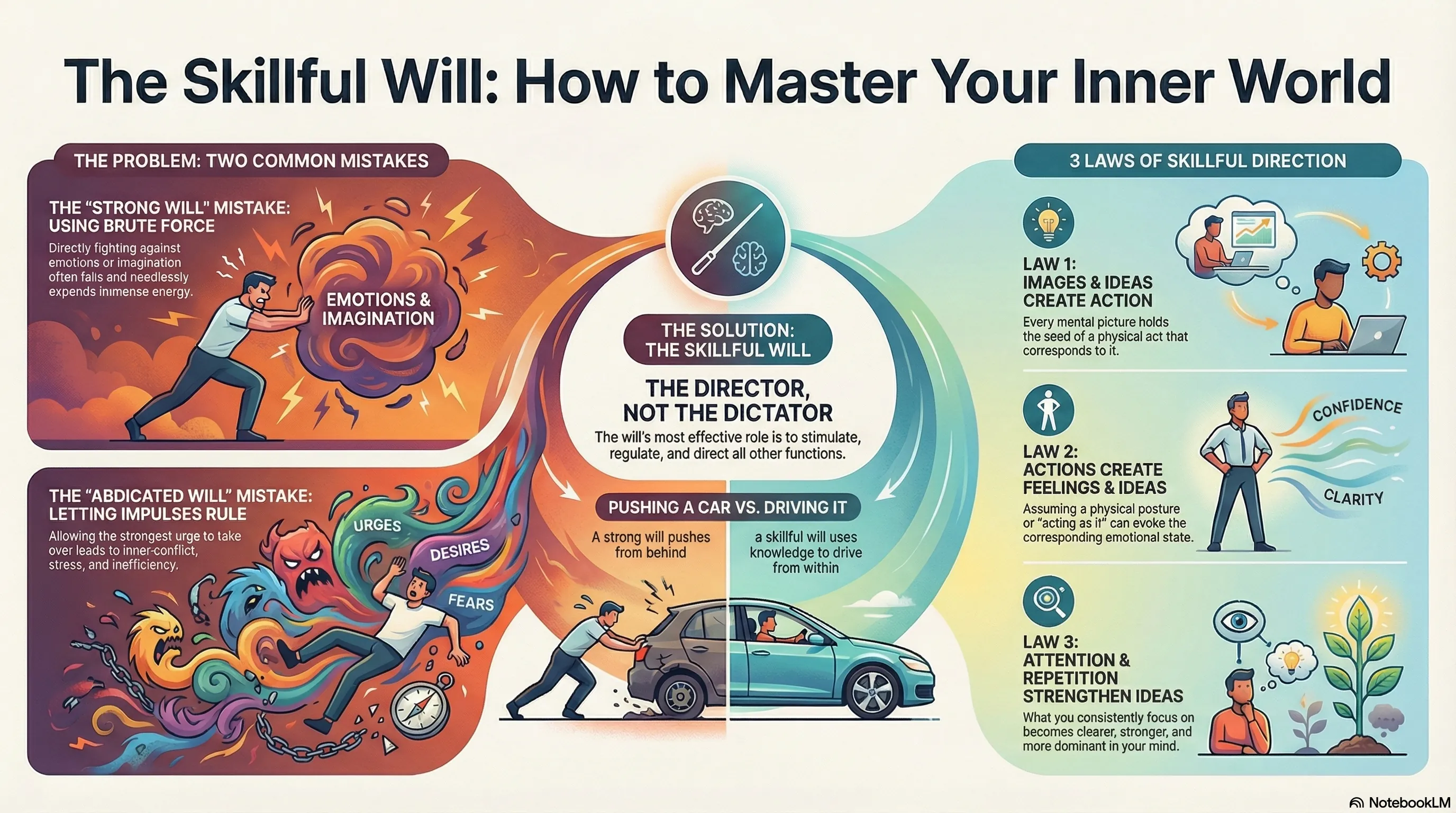
Effective willing requires skillful direction of other psychological functions (imagination, emotions, drives, thought), not direct force against them and not “letting things happen” without regulation.
- The chapter opens by naming two “general mistakes” (forcing by sheer power vs. abdicating the will) and positions “skillful will” as the way to avoid both.
- It defines skillful will as strategy with “economy of effort,” illustrated by the “pushing the car vs. driving it” analogy.
- Replaces clumsy/brutal self-opposition with directing and utilizing other functions toward a “predetermined goal.”
- Treats will-training as learning effective strategy and “effortsaving means,” not just increasing intensity.
Insight 2
To use the will skillfully, you need workable knowledge of the “psychological world” (functions, unconscious forces) and the laws that regulate how images, ideas, emotions, movements, attention, and repetition produce effects.
- The chapter states that will’s best role is to “stimulate, regulate, and direct” other forces, and that doing so requires “some understanding” of the field in which will operates.
- It explicitly argues that ignoring psychological laws wastes or risks misusing will’s “inherent power.”
- Shifts from guessing/forcing to selecting interventions based on predictable relations (e.g., images → acts; movements → ideas; attention/repetition → reinforcement).
- Treats will as central but law-governed: skill comes from aligning with laws, not overriding them.
Insight 3
Because urges, drives, desires, and emotions “tend and demand to be expressed,” skillful will focuses on giving them adequate, constructive, or at least harmless expression—directly, symbolically, or through transmutation—guided by observation, valuation, and deliberate choice.
- The chapter emphasizes the practical problem of expression vs. repression vs. uncontrolled discharge, and explicitly introduces methods of expression (Law X).
- It links this regulation to disidentification, awareness of the conscious “I,” and acts of will (observation → valuation → regulated expression).
- Replaces “deny/repress” (stress; psychosomatic risk) and “cult of spontaneity” (uncontrolled giving way) with regulated outlets and transformation.
- Makes “expression strategy” part of willing, requiring deliberation, choices, and decisions.
Key Quotes
“There are two general mistakes caused by extreme attitudes held toward the will and its relation to the other psychological functions. One is the traditional attempt to force these functions into operation by sheer power and direct imposition. The other mistake, which is prevalent today, is to abdicate the will: urges, drives, and desires are allowed to “happen, without any regulation or consistent direction. In such a situation, the function that is strongest at the moment will capture one’s attention and express itself, and in doing will inhibit or repress all the other less powerful functions. This produces inner conflict and stress, reduced effectiveness through dispersal of energies, and potentially harmful reactions within oneself and between oneself and others.”
“The essential function of the skillful will, which we need to cultivate, is the ability to develop that strategy which is most effective and which entails the greatest economy of effort, rather than the strategy that is most direct and obvious.”
Key Concepts
Skillful will: The will’s ability to develop the most effective, effort-saving strategy to reach a goal by directing other psychological functions rather than opposing them directly.
Economy of effort: Achieving a purpose with the least possible expenditure of energy, by choosing practical, effective means rather than the most direct approach.
Abdicate the will: Letting urges, drives, and desires “happen” without regulation or consistent direction, so the strongest function at the moment takes over.
Stimulate, regulate, and direct: The will’s most effective role: activating and governing other functions and forces so they lead toward a predetermined goal.
Psychological functions: A set of basic functions named here as: sensation, emotion-feeling, impulse-desire, imagination, thought, intuition, will (with “the I” as central point).
Two kinds of interactions: (1) interactions among functions that happen spontaneously/mechanically; (2) interactions that can be influenced/governed/directed by will.
Plastic unconscious: The portion of the unconscious not yet “conditioned,” highly susceptible to influence—likened to unexposed photographic film.
Conditioned (structured) unconscious: The portion shaped by prior impressions, repressions, complexes, and conflicts—likened to already exposed film.
Psychological laws: Definite regularities governing the dynamics of inner influences and the willed act; ignoring them wastes or risks misusing will’s power.
Ideomotor action: The process in which an idea/image releases and energizes the muscular system toward corresponding action.
Rationalization: A process where a strong desire influences the mind to produce “reasons,” actually “pseudoreasons,” for fulfilling the desire.
Attention / interest / affirmations / repetition: Reinforcing operations that make ideas/images clearer, more prominent, stronger, and more fixed; can also be withdrawn to de-energize an unwanted formation.
Marginal consciousness: The dim periphery of awareness around what attention centers on; described as semiconscious and intermediate between conscious and unconscious.
Law of Subconscious Finalism: A law describing how functions/complexes pursue aims without awareness and can work independently of or against conscious will.
Disidentification: Temporarily separating the conscious “I” from urges/drives/emotions to observe them objectively and then valuate them.
Catharsis (direct discharge): Direct expression/discharge of psychological energy to obtain gratification or release, though it still requires regulation among competing demands.
Symbolic action: Indirect expression where energy is discharged through actions involving a symbol (e.g., trouncing an object symbolizing a person).
Transmutation / sublimation: Transformation of energies horizontally within a level or vertically between levels (as sublimation or degradation), sometimes induced by deliberate acts of will.
Check Your Understanding
- In one paragraph, describe the difference between “strong” use of will and “skillful” use of will, using the car analogy without adding anything not in the chapter.
- Pick one goal you have and name which psychological functions (from the chapter’s list) are most likely to help or hinder it; then state one way the will can “direct their interpenetration and interaction.”
- Give a concrete example of rationalization as described here (urge → pseudoreasons) and write the will-centered counter-move the chapter recommends.
- Explain how attention and repetition can both energize and de-energize an image/idea/formation, using only the chapter’s explanation.
Reflection Questions
Choose one of the prompts below. Read through it and think about how it relates to your life or experiences. Spend some time writing about it in your journal or notebook.
- Where do you most often make the first mistake (direct imposition by sheer power) versus the second (abdication of will), and what is one “skillful will” alternative described in this chapter?
- Which psychological function (sensation, emotion/feeling, impulse/desire, imagination, thought, intuition) most often “captures your attention” in you, and how might the will regulate it toward a predetermined goal?
- What is one recurring vicious circle you recognize that matches the chapter’s pattern (emotion → images → effects → more emotion), and where could you intervene using the laws described?
- When have you seen “pseudoreasons” appear right before a demanding action (lecture-like situation), and what would it look like to decide from the “central vantage point” instead?
- For one persistent drive or desire, what form of expression (direct, symbolic, transmutation) seems most feasible and suitable right now, according to this chapter’s criteria?
Exercises
The following two exercises can be done separately or paired. If you want these to function as a paired routine, do the “Hammer” exercise first (build the desired formation), then the “Release” exercise (withdraw energy from the unwanted one).
“Hammer” (Repetition to Fix an Idea/Image)
Time: 5–8 minutes
Aim: Use repetition “like the blows of a hammer” to fix one chosen idea or image.
1) Grounding (60 seconds)
- Sit comfortably. Let your shoulders drop.
- Take 3 slow breaths.
- On the third breath, let your attention become steady and simple: “I will hold one thing clearly.”
2) Choose your target (30–60 seconds)
- Pick one short idea (a single sentence) or one clear image (a brief mental scene).
- Keep it specific and positive (what you intend, not what you want to avoid).
- Write it down in one line if helpful.
3) The hammering (3–5 minutes)
- Repeat the exact idea or recreate the exact image 30 times.
- If it’s an idea: repeat the same wording each time, evenly.
- If it’s an image: rebuild the same picture with the same key details.
- Keep attention on the target; when the mind wanders, return without commentary and continue counting.
4) Close (30 seconds)
- Stop and notice: is the idea/image clearer, stronger, more “present” than at the start?
- Write one sentence: “After 30 repetitions, the idea/image feels ____.”
Success criteria
- You completed 30 repetitions with minimal drift in wording/image.
- You returned to the target each time attention wandered.
“Release” (De-energising an Unwanted Formation)
Time: 5–10 minutes
Aim: Reduce the activity of one unwanted image/idea by deliberately withdrawing interest and attention.
1) Grounding (60 seconds)
- Sit comfortably.
- Take 3 slow breaths.
- Let your stance be observational: “I can notice thoughts without following them.”
2) Name the unwanted formation (30–60 seconds)
- Choose one recurring unwanted thought or image (keep it simple and specific).
- Write a brief label for it (e.g., “the criticism loop,” “the failure picture,” “the worry scene”).
3) Withdrawal practice (3–6 minutes)
- Let your mind be as it is. When the unwanted formation appears:
- Recognise: “That’s the [label].”
- Withdraw interest: don’t analyze, argue, justify, or elaborate it.
- Withdraw attention: gently move attention away from it to a neutral anchor:
- your breathing, or
- one spot of sensation (hands/feet), or
- a simple neutral phrase like “breathing in / breathing out.”
- Repeat this sequence every time it reappears: recognise → withdraw → return.
4) Close (60 seconds)
- Note what happened over the session:
- Did the unwanted formation become less vivid, less frequent, or less compelling?
- Write one line: “When I withdrew interest and attention, it ____.”
Success criteria
- You practiced withdrawal at least 3 times (each time it appeared).
- You did not engage in extended analysis of the unwanted formation during the exercise.
Review & Practice: Chapter 5: The Skillful Will - Psychological Laws
Test your understanding of the core ideas from this chapter and capture your personal reflections. Scored questions provide immediate feedback; reflections are stored privately on your device.
In this chapter, what does “skillful will” mean?
Which contrast best matches the chapter’s warning about “two extremes”?
The chapter suggests the will works best when it fights imagination, emotions, and drives directly.
Which option best corrects a common misunderstanding from this chapter?
Scenario: You plan to do a 10-minute task. You suddenly imagine it going badly and feel tense. You consider quitting “until you feel motivated.” What best fits the chapter’s approach?
Complete the following statement by filling in the missing term(s):
Which option best states what this chapter is trying to do?
Which option best summarises one central “law” from the chapter?
The chapter suggests that drives and emotions need some form of expression, and that expression can be direct, symbolic, or transformed.
In 3–5 sentences, describe one small way you could use “skillful will” this week instead of forcing yourself or giving up.