
Chapter 4: The Strong Will
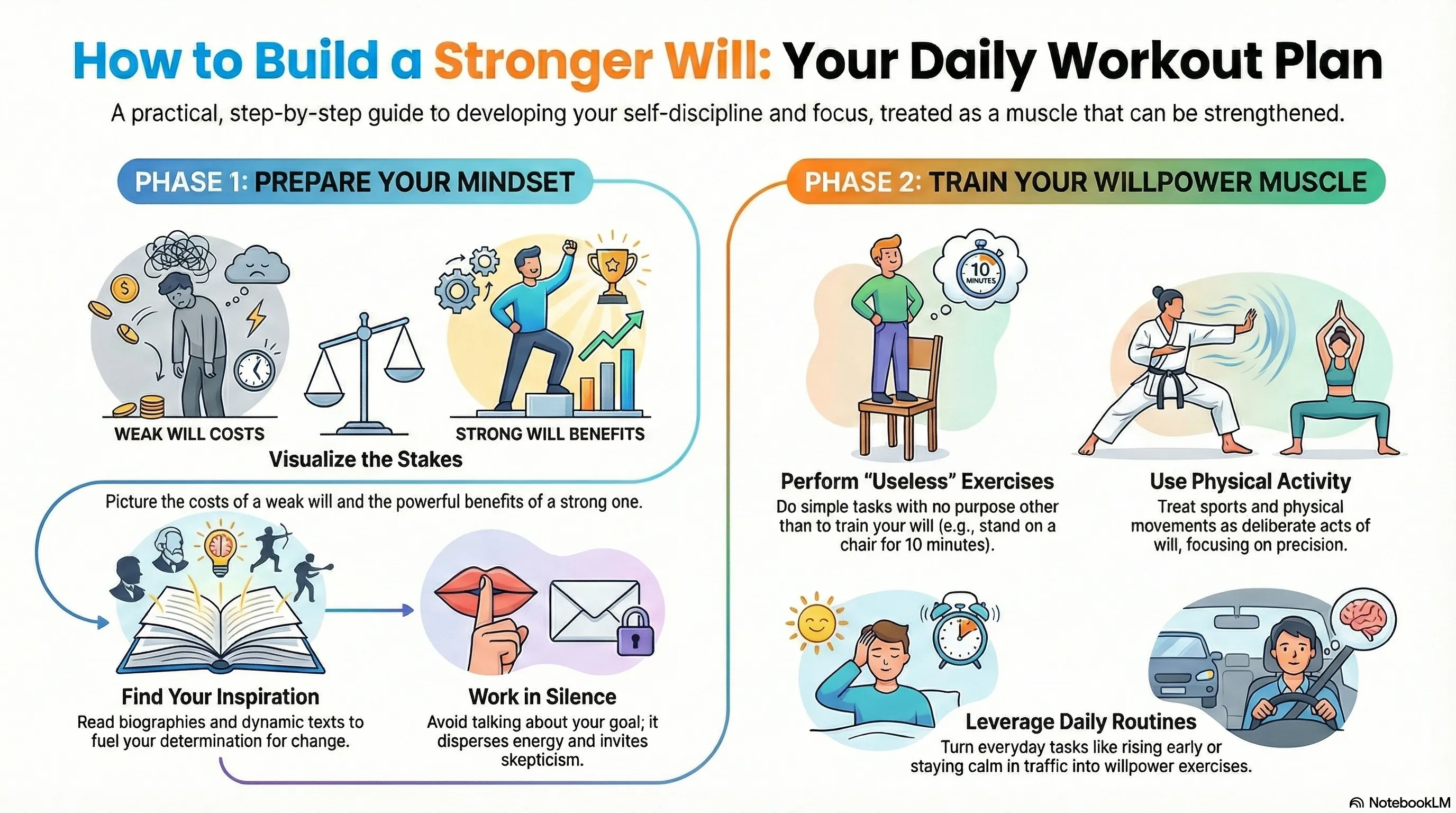
Purpose
Provide practical preparation and exercises to deliberately increase the strength (energy/intensity) of the will so a willed act has enough “fire” to carry out its purpose.
Learning Outcomes
By the end of this chapter, you should be able to:
- Define “strong will” as an aspect of will and explain why intensity (“fire”) is needed for a willed act to carry out purpose.
- Perform the chapter’s preparatory sequence (losses/benefits/self-visualization + written lists) to generate an urge and a firm decision to train.
- Design and execute a 7-day “useless exercise” plan (5–10 minutes/day) with rotation to avoid automaticity, including written introspective notes.
- Apply the “manner over task” rule by improving precision, interest, and willing attitude in a chosen exercise across repetitions.
- Convert one routine daily activity into a will exercise using “calm rapidity” and the dual attitude (actor + observer).
Identify and avoid the chapter’s warned failure modes (talking, overload, automaticity, mis-aimed exertion).
Core Insights
Insight 1
The strength of the will (its energy/intensity) can be increased through practice, and that strength is needed so a willed act contains enough “fire” to carry out its purpose.
- The chapter defines strong will as the most familiar aspect and ties its strength to “power… impetus… energy” and to having enough intensity to carry out purpose.
- It repeatedly frames everything that follows as “practical methods and exercises… for developing it.”
- You train strength deliberately rather than treating it as fixed (“can be developed and increased through practice and exercise”).
- You evaluate exercises by whether they increase “awareness and the energy of the will,” not by whether the task itself is important.
Insight 2
Effective will-training starts with a preparation that generates a lively desire and a firm decision to do what’s necessary; without this inner condition, training is less likely to succeed.
- The chapter explicitly says “To ensure success in training the will generally, a proper preparation is needed” and describes what it must produce (urge/impetus, intense desire, firm decision).
- The first two exercise sections are explicitly described as creating “the inner condition… needed for making the decision to devote the time, energy, and means.”
- You deliberately evoke consequences of weak will and benefits of effective will (and feel them intensely) to generate the urge to change.
- You protect this impetus by “work in silence” and avoiding talk that disperses energy or invites doubt.
Insight 3
“Useless” (purpose-free) deliberate acts—done willingly, with precision, and with self-observation—exercise the will independently and therefore strengthen it more directly than relying only on meaningful tasks.
- The chapter presents this as “The Gymnastics of the Will… the foundation of the method,” explicitly arguing for exercises with “no other purpose than the training of the will.”
- It emphasizes that the key variable is not the specific exercise but “the manner in which it is performed… willingly… with precision… with style,” plus written accounts and introspection.
- You pick small, controllable tasks and perform them daily (5–10 minutes), rotating them to avoid monotony and automatic habit.
- You treat training as a “sporting attitude” (contest with oneself), tracking successes/failures and improving quality.
Key Quotes
“In the strength of the will lies its power, its impetus, its energy. In developing the strength of the will we make sure that a willed act will contain enough intensity, enough ‘fire,’ to carry out its purpose.”
“To ensure success in training the will generally, a proper preparation is needed for arousing the initial urge and impetus; this preparation should produce a lively, fervid, and intense desire to develop the will, leading to the firm decision to do all that is necessary for attaining that end.”
“The important thing is not the doing of this or that exercise, but the manner in which it is performed. It should be done willingly, with interest, with precision, with style.”
Key Concepts
Strong will: The aspect of will whose strength consists in its power/impetus/energy and provides the intensity needed to carry out purpose.
Aspect of the will: A distinct facet of the will (e.g., strong, skillful, good, Transpersonal) that should be developed alongside the others.
Willed act: An act of will that must contain enough intensity to carry out its purpose. (Inferred (from context), conservative.)
Intensity (“fire”): The felt degree of energetic force in willing that enables purpose to be carried out.
Preparation for will training: A deliberate preliminary process to arouse an initial urge and impetus, producing intense desire and leading to a firm decision to train the will.
Urge and impetus: The energized drive produced by vivid realization of losses/benefits that pushes one toward decision and action.
Visualization: Using vivid mental imagery (including future scenarios and self-image) to evoke feelings and strengthen desire and resolve.
Work in silence: Avoid talking about one’s will-training intention to prevent dispersal of energy and to avoid doubt/discouragement from others.
Gymnastics of the will: A method of training will strength through deliberate acts designed for will-training itself, analogous to strengthening muscles by targeted contractions.
“Useless” exercises: Deliberate acts that have no purpose other than training the will (training will “independently” of other psychological functions).
Resolution (self-imposed): A clearly stated commitment to perform a specific task for a set time/days as will-training.
Introspection: Observing and noting one’s sensations and mental states during/after an exercise.
Sporting attitude: A contest-with-oneself approach that makes training interesting and avoids resistance to forceful imposition.
Calm rapidity: Performing actions swiftly but not hurriedly; a watchword for daily-life will practice.
Dual attitude (actor and observer): Simultaneously being “the one who acts” and “the observer” watching oneself act.
Courteous but firm refusal (“no”): A disciplined capacity to decline unnecessary conversations while remaining courteous.
Check Your Understanding
- In one sentence, what makes an act a training exercise for strong will: the task itself, or the manner and intention?
- Describe the preparation for will training as a sequence of 3–5 steps.
- Why does the chapter recommend “useless” exercises, and what rule does it give to prevent them becoming automatic?
- Give one example of turning an ordinary daily action into a will exercise, naming the inner attitude required.
- Name two pitfalls the chapter warns about and the specific harm each causes.
Reflection Questions
Choose one of the prompts below. Read through it and think about how it relates to your life or experiences. Spend some time writing about it in your journal or notebook.
- Which specific losses (to you or others) from weak will did you picture, and what exact urge did they evoke to change?
- Which benefits of an effective will felt most compelling, and what concrete “firm decision” followed from that feeling?
- In your “useless” exercise, what mental resistance or distraction appeared, and what did you do to keep the act “willingly… with precision”?
- Where did talking about your plan feel tempting, and how did “work in silence” affect your readiness to act?
- Which daily-life situation most reliably triggers impatience/hurry/bad temper for you, and how can it become a repeated will exercise without making life rigid and mechanical?
Exercises
Realising the Value of the Will
Set-up (30–60 seconds)
- Find a comfortable position. Let your shoulders drop and your jaw unclench.
- Take two slow breaths. On each out-breath, let your muscles soften a little more.
- Close your eyes (or lower your gaze).
- Intention (silently): “I’m doing this to strengthen my will.”
Have paper ready (or a notes app). You’ll be writing lists, not just thinking.
1) Look Back: Costs of Weak Will (3–6 minutes)
Goal: generate an honest emotional signal: this matters.
- Bring to mind 2–5 specific occasions where lack of will-strength led to:
- a missed opportunity,
- damage,
- or pain (to you and/or others).
- Take them one by one. For each occasion:
- See it vividly (what happened, what you did/didn’t do, the outcome).
Then write a short line in your list:- Event: …
- Cost: …
- See it vividly (what happened, what you did/didn’t do, the outcome).
- After you list them, pause for 10–20 seconds and let the feelings register.
- Write one sentence to finish this section:
- “Because of this, I feel an urge to change.”
- (If you feel little: write that plainly—don’t force it.)
2) Look Ahead: Benefits of Effective Will (3–6 minutes)
Goal: generate energized desire: this is worth doing.
- Imagine 2–5 concrete advantages that an effective will could bring:
- to you,
- and to others.
- Again, take them one by one:
- Picture each benefit as if it’s real (what changes, what becomes possible).
- Write each as a clear line:
- Benefit: …
- Who gains: me / others / both
- Pause and let the anticipation have “full sway” for a moment.
- Write one sentence:
- “I feel a strong urge to begin at once.”
3) Ideal Model: See Yourself With a Strong Will (2–4 minutes)
Goal: install a clear self-image to aim at.
- Picture yourself “in possession of a strong will.”
- Run a short “mental clip” of yourself:
- walking with a firm, determined step,
- acting with decision, focused intention, and persistence,
- resisting intimidation and enticement,
- embodying inner and outer mastery.
- Make it specific by choosing one real situation you’re likely to face soon and replay it with that stronger version of you.
- Write 3–5 lines titled “My Ideal Model (Strong Will)” describing what you saw.
4) Close: Convert Feeling into Decision (60–90 seconds)
Goal: turn urge into a commitment.
- Re-read your two lists quickly.
- Then write a simple decision statement:
- “I decide to develop the strength of my will, and I will do what is necessary to attain that end.”
- Add one practical next step (small and immediate):
- “Today / tomorrow, I will ______ for ______ minutes.”
5) Optional (but faithful to the chapter): Keep it private
- Don’t discuss this plan. The chapter’s warning is that talking can disperse energy and invite doubt.
- Just do the next step.
What to keep constant (the chapter’s “rules”)
- Vivid imagery + written lists (not vague reflection).
- Feelings are used on purpose: to create urge/impetus and a firm decision.
- The end-state is practical: begin at once, with one concrete action.
Evoking Feelings Toward the Will
What this is for (10 seconds)
Goal: reinforce the feelings and determination you already stirred up (from the previous exercise), so you can make—and keep—a firm decision to train your will.
Grounding (45–60 seconds)
- Sit comfortably. Let your shoulders drop.
- Take two slow breaths. On each exhale, relax your face and hands.
- Close your eyes (or lower your gaze).
- Silently set a simple intention: “I’m here to cultivate determination and self-reliance.”
- Open your eyes and have paper ready (or a notes app).
1) Choose the right reading (1 minute)
Pick a short passage (½–2 pages) that is:
- encouraging, positive, dynamic
- likely to arouse self-reliance
- likely to incite to action
Good sources within the chapter’s guidance:
- a biography of someone with great will
- a book/article aimed at awakening inner energies
Write one line before you start:
- Today’s reading source: ________
- Why I chose it (1 sentence): ________
2) Read in the “special way” (6–12 minutes)
This is not casual reading. Use the exact method the chapter prescribes.
- Read slowly, with undivided attention.
- As you go, mark (underline/highlight) any line that genuinely impresses you.
- When you find something that feels:
- most striking, or
- specially adapted to your case,
stop and copy it out by hand (or type it verbatim) into your notebook.
Keep going until you have 3–7 copied lines (short excerpts are fine).
3) Absorb the meaning (2–4 minutes)
Now do what the chapter explicitly recommends: reread to “absorb.”
- Re-read your copied excerpts slowly.
- After each one, pause for 5–10 seconds and ask:
- What is this asking of me?
- What does it awaken in me (self-reliance, resolve, energy)?
Then write one sentence per excerpt:
- Meaning for me: ________
4) Translate feeling into decision (60–90 seconds)
The chapter frames this as preparation for committing time/energy/means.
Write a brief commitment statement:
- “I will devote the time, energy, and means necessary for developing my will.”
Then add one concrete next step:
- “Next, I will ________ for ________ minutes/day for ________ days.”
(Keep it small enough that you can begin at once.)
5) Close (20–30 seconds)
Take one slow breath and read your commitment once more.
Important warning from the chapter: keep it private
The text is explicit:
- Don’t talk about this plan “even with the laudable intention” of inspiring others.
- Reason: talking can disperse the energies needed for action, and can invite skeptical/cynical remarks that inject doubt and discouragement.
- Simple rule: Work in silence.
Minimal template (copy/paste)
Source:
Why this:
Copied excerpts (3–7):
Meaning for me (1 sentence each):
Commitment:
Next step (what / minutes / days):
The Gymnastics of the Will: 7-Day “Useless Exercise” Plan (5–10 min/day)
What this is (15 seconds)
Goal: strengthen the will by practicing deliberate acts with no purpose except training the will, done with precision, regularity, persistence, and followed by written introspective notes.
Grounding (45–60 seconds)
- Sit or stand comfortably. Let your shoulders drop.
- Take two slow breaths.
- Silently set your intention: “This is will-training, nothing else.”
- Make sure you’re alone and undisturbed for 5–10 minutes.
- Open your notebook (or notes app) to today’s entry.
1) Choose today’s “useless” exercise (1 minute)
Pick one exercise for Days 1–7 (you’ll rotate after the week to avoid monotony/automaticity).
Choose from these or invent one of your own:
- Chair-stand (10 min): “stand on a chair… for ten consecutive minutes… try to do so contentedly.”
- Rhythmic affirmation (5 min): repeat quietly and aloud “I will do this,” keeping time with rhythmic movements of a stick or ruler.
- Touchpoints walk (5 min): walk to and fro, touching in turn (e.g.) a clock on the mantelpiece and a particular pane of glass.
- Fifth-tick movement (5 min): listen to a ticking clock/watch and make a definite movement at every fifth tick.
- Chair repetitions: get up and down from a chair thirty times.
- Slow match (or paper) placement: replace 100 matches/bits of paper very slowly and deliberately (noted as good for combatting impulsiveness).
Write your Resolution (verbatim structure, personalised):
“Each day, for the next seven days, I will _________ for _________ minutes (or _________ repetitions), and I will try to do so _________.”
Examples (adapt the blank only):
- “Each day, for the next seven days, I will repeat quietly and aloud ‘I will do this’ for five minutes, keeping time with rhythmic movements, and I will try to do so willingly and with interest.”
- “Each day, for the next seven days, I will replace one hundred matches in a box very slowly and deliberately, and I will try to do so with precision.”
2) Do the exercise (5–10 minutes)
Do it exactly as resolved, and treat the manner as the real training.
While doing it, keep three simple anchors in mind:
- Willingly: not submission or resignation—an active “I choose to do this.”
- Precision: measured, deliberate execution.
- Attention: keep bringing your focus back when distracted.
If you notice resistance (“I’d prefer not to”), treat that as the training moment: make the effort anyway, because the whole point is exercising the will.
3) Immediate introspective notes (2–3 minutes)
Right after finishing, write briefly. The chapter specifies: “write down the sensations and the mental states you have experienced.”
Use this structure (fast, factual):
- What I did (confirm completion):
- Sensations (body): (e.g., tension, restlessness, warmth, fatigue, ease)
- Mental states (mind): (e.g., distraction, irritation, calm, pride, boredom, satisfaction)
- Moments of resistance: what showed up, when
- How I responded: what effort/choice you made
- One thing to improve tomorrow (quality): (precision / attention / willingness / style)
Keep it short. The key is fidelity of the written account.
4) Daily quality upgrade (30 seconds)
The text’s rule: “Try always to improve… the quality of the work… the clearness of introspection… [and] the awareness and the energy of the will.”
Before you close your notebook, choose one upgrade target for tomorrow:
- more precise timing or counting
- fewer “automatic” movements (more deliberate)
- quicker return of attention after distraction
- a more genuinely “willing” inner attitude
- clearer notes (more accurate, less vague)
5) End-of-week rotation (to avoid automaticity)
On Day 7, add one final line:
- Did this begin to feel automatic? If yes, how?
Then, immediately decide your next 7-day block:
- Pick a different “useless” exercise from the list (or invent one in the same spirit).
- Write the next Resolution.
This is the chapter’s monotony/automaticity safeguard: exercises are done for several days (usually a week) and then replaced.
“Sporting attitude” option
If you like, add a simple score each day (0–2):
- Precision: 0/1/2
- Attention: 0/1/2
- Willingness/interest: 0/1/2
Then try to beat your own score—not harshly, but as a contest with yourself.
Success criteria (meets the learning outcome)
By the end of 7 days, you have:
- A written Resolution.
- 7 completed sessions (5–10 minutes each) done alone/undisturbed.
- 7 written notes recording sensations and mental states.
- Evidence of “manner” training: at least one explicit improvement you attempted (precision, attention, willingness, style).
- A planned rotation to a different exercise for the next week to prevent automaticity.
Physical Training as Will-Training (Optional)
If You Don’t Currently Exercise (Start Simple, Start Now)
Aim (from the chapter)
Use a very simple physical activity as a deliberate, repeatable act of will—“a command given to the body”—done with attention, effort, and endurance, but not too forceful or fatiguing.
Choose one “starter” option (5–10 minutes)
Pick one that feels doable today:
- Walk (indoors or outdoors)
- Push-ups (or wall push-ups)
- Skipping (or step-ups)
- Simple mobility (slow squats, arm circles, lunges)
- Any room-based movement you can repeat steadily
Do it as will-training (the chapter’s rules)
While you do it, apply these instructions:
- Primary objective: training the will (not fitness performance today).
- Measured precision and attention: keep movements deliberate and clear.
- Not too forceful / not too fatiguing: stop before you exhaust yourself.
- Liveliness and decision: each movement is executed cleanly, not lazily.
Close with a 30-second note (written)
Write 3 lines:
- What I did (duration):
- Organic sensations (body): (e.g., warmth, tension, steady breath)
- Sense of will: (inner strength / decision / mastery—if present)
Repetition plan: “I will do this again tomorrow for ___ minutes.”
If You Already Exercise (Make It Will-Training, Not Autopilot)
Aim (from the chapter)
Extract “fullest benefit” by shifting your session so the exclusive aim—or at least principal objective—is training the will, through precision, attention, effort, and endurance.
Before you start (30 seconds)
- Name today’s will objective in one phrase (write it):
- “Measured precision and attention.”
- “Liveliness and decision in every movement.”
- “Endurance with calmness.”
- Choose one small segment of your workout (5–10 minutes) to treat as the will-training block.
During the will-training block (5–10 minutes)
Apply the chapter’s constraints:
- Measured precision: slow down enough to make each rep/step clean.
- Attention: keep awareness on the movement as a deliberate command.
- Not too forceful or fatiguing: choose a manageable load/pace.
- Liveliness and decision: execute each movement decisively (no sloppy reps).
Prefer modes that allow endurance, calmness, dexterity, courage, with room for interruption and variety of movement (rather than “violent and exciting” intensity).
After the block: brief introspective note (1–2 minutes)
Write:
- What I trained (movement + minutes):
- Where attention wandered (when/why):
- Where will was clearest: (a moment of decision, mastery, steadiness)
- One refinement for next time: (precision / attention / pace / calmness)
Success criteria
- You performed movement with the principal objective of training the will.
- Your execution was precise and attentive, not forceful or exhausting.
- Movements were done with liveliness and decision.
- You recorded a short note capturing sensations and the felt tone of will (strength/decision/mastery).
Daily-Life Will Training (from Ordinary Tasks to “Definite Exercises”)
Safety valve (so it doesn’t become rigid)
- Don’t do everything at once.
- Start with a few, spread through the day, beginning with easier ones.
- Increase gradually; vary and alternate.
- Do them cheerfully and with interest; score successes and failures; keep it a contest with yourself.
The idea
Daily life becomes will-training through purpose, inner attitude, and the way you do the act.
Exercise 1: The “Dual Attitude” Micro-Rep (60–90 seconds, repeated)
Purpose: practice the chapter’s key requirement: being both the one who acts and the observer.
Steps
- Pause briefly before a routine action (standing up, opening a door, starting a task).
- Take one slow breath.
- Say inwardly:
- Actor: “I will do this.”
- Observer: “I will watch myself doing it.”
- Do the action once with clean attention.
- Afterward, write one line:
- “Observed: ________ (hurry / resistance / calm / precision / impatience).”
Success criteria
- You can clearly report what you observed (not what you wish had happened).
Exercise 2: Morning “Calm Rapidity” (3–7 minutes)
Purpose: train “swiftly but not hurriedly” while keeping the dual attitude.
Steps
- Choose one morning routine: getting dressed (as in the text) or another simple sequence.
- Set the watchword: calm rapidity.
- Perform the routine:
- Attention + precision
- Swiftly, not hurriedly
- When you notice rushing, don’t scold—just reset: one breath, resume.
- Write 2 lines:
- “Where I hurried: ________”
- “How I restored calm rapidity: ________”
Success criteria
- At least one conscious reset from hurry to calmness.
Exercise 3: The Annoyance Drill (2–5 minutes, “in the moment”)
Purpose: train will where it usually fails: minor difficulties and annoyances.
Choose one common situation:
- heavy traffic / being kept waiting
- noticing a colleague’s mistakes
- being unjustly treated by a manager or colleague
- another minor annoyance you encounter regularly
Steps
- When the annoyance appears, label it neutrally: “annoyance”.
- Apply the dual attitude:
- Actor: “I will remain serene.”
- Observer: “I notice impatience rising.”
- Make one deliberate act of control:
- reduce an impatient gesture,
- soften voice,
- pause before responding,
- choose a calm action.
- Afterward, write:
- “Trigger: ________”
- “My act of will: ________”
- “Result: ________”
Success criteria
- One observable change in behaviour (even small).
Exercise 4: The Homecoming Reset (2–4 minutes)
Purpose: prevent “giving vent to bad temper” and practise dealing serenely with what comes your way.
Steps
- On arriving home (or entering a personal space), stop for one breath.
- Name the risk the chapter highlights: “bad temper from vexations/worries.”
- Choose one deliberate response:
- speak more slowly,
- soften tone,
- pause before reacting,
- do one small act to “adjust disharmonies” rather than escalate them.
- Write one line:
- “I felt ________; I chose ________.”
Success criteria
- You interrupted the default impulse at least once.
Exercise 5: The Dinner Table Will Practice (5–15 minutes)
Purpose: train will through eating: resist the impulse to eat quickly while mentally elsewhere.
Steps
- Before eating, take two breaths.
- Set one rule for the meal:
- chew well
- keep a relaxed and calm mind
- If you catch yourself speeding up or thinking about business, reset:
- put utensils down for one breath; resume slowly.
- After the meal, write:
- “Impulse I noticed: ________”
- “How I trained instead: ________”
Success criteria
- At least two resets back to calm chewing.
Exercise 6: The Wise Stop + Short Rest (3–8 minutes, as needed)
Purpose: practise ceasing work when tired and taking rest “in time” (at the outset of fatigue).
Steps
- When fatigue begins, identify the competing impulse: “hurry to get it finished.”
- Make one resolute act: stop (or switch to a brief rest) without negotiating.
- Take a short rest:
- a few minutes’ relaxation with closed eyes, or
- a few simple muscular/physical movements.
- Resume work only if you’re not forcing it past exhaustion.
- Write 2 lines:
- “I stopped at: ________ (outset of fatigue / later than I should)”
- “Effect: ________ (impetus preserved / tension reduced / etc.)”
Success criteria
- You stop before exhaustion at least once.
Exercise 7: The “Sporting Attitude” Scorecard (60 seconds/day)
Purpose: use play/contest with oneself to avoid rebellion and to build consistency—without becoming rigid.
Steps
- Pick only 2–3 of the above exercises for this week (start easy).
- Each evening, score them:
- Success / Failure
Optional: set a “record” to beat tomorrow (e.g., number of calm resets).
- Success / Failure
- Keep it light: the aim is to make duties “interesting and colorful,” not mechanical.
Success criteria
- You can point to one small improvement across days.
Exercise 8: “Others as Cooperators” (in the moment)
Purpose: treat people/situations as training scenarios—“mental parallel bars.”
Pick one category mentioned:
- domineering manager / exacting partner
- delay in being served
- talkative friends / timewasters
Steps
- In the moment, silently reframe: “This is practice.”
- Choose the will-skill to train:
- patience and serenity,
- reading calmly while waiting,
- controlling speech,
- courteous but firm refusal (“no”).
- Do one concrete act consistent with that choice.
- Write one line afterward:
- “Cooperator: ________; Discipline trained: ________.”
Success criteria
- One courteous but firm boundary (or one patient response) enacted.
Review & Practice: Chapter 4: The Strong Will
Test your understanding of the core ideas from this chapter and capture your personal reflections. Scored questions provide immediate feedback; reflections are stored privately on your device.
In this chapter, “strong will” mainly refers to:
Which distinction best matches the chapter’s message?
The strength of the will can be developed and increased through practice and exercise.
Which option best corrects a common misunderstanding from this chapter?
Scenario: You decide to build a daily habit. On day three you feel bored and think, “This is pointless,” and you want to quit early. What response best fits the chapter’s approach to strengthening strong will?
Complete the following statement by filling in the missing term(s):
Which option best states what this chapter is trying to do?
Which option best summarises the chapter’s main contribution?
In will-training, it can help to treat practice like a friendly contest with yourself, rather than using harsh self-pressure.
Describe one small “will-training” exercise you could do for 5–10 minutes, and explain what makes it will-training rather than just a task.