
Chapter 3: The Qualities Of The Will
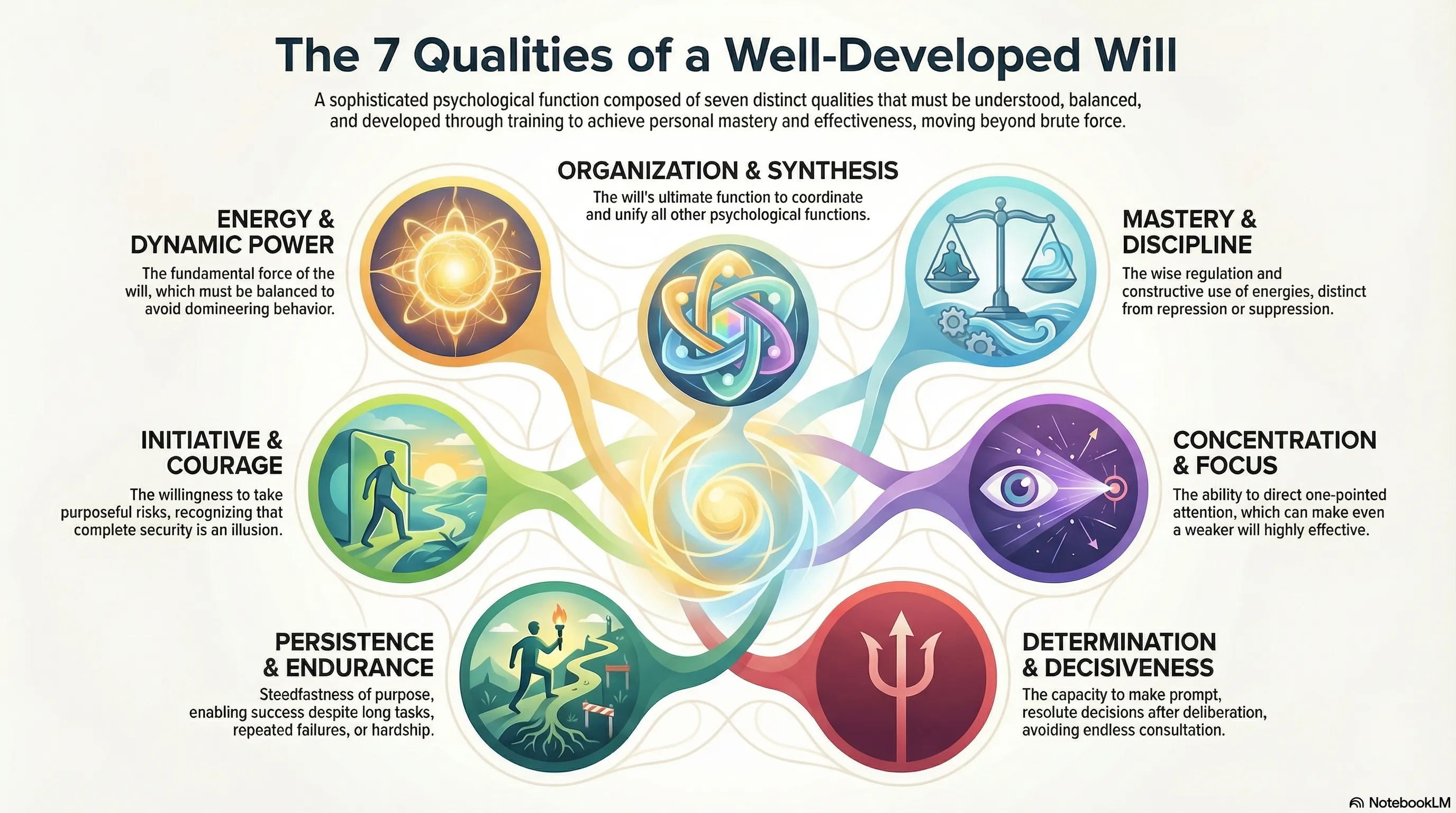
Purpose
Review the will’s key qualities so they can be clearly understood, deliberately evoked, and balanced in the right proportions during willing and will-training.
Learning Outcomes
By the end of this chapter, you should be able to:
- List the seven will-qualities named in the chapter and describe (in plain language) what each is for.
- Distinguish control from repression and suppression, and explain the function of inhibition as used in the chapter.
Explain the will’s two poles (power/effort and effortless volition) and identify which stages can be effortless (as stated here). - Apply the “right proportions” idea by selecting and balancing at least two qualities for a specific willed act.
Core Insights
Insight 1
Effective willing requires multiple distinct qualities that can be trained and must be balanced; relying on “energy” alone can be harmful or self-defeating.
- The chapter’s stated aim is to “review the qualities of the will” so they can be “clearly in view,” “understood thoroughly,” and “evoked as necessary in the right proportions.”
- It warns that the “power element” (Energy—Dynamic Power—Intensity) is often mistaken for the whole will and, “taken by itself,” can “defeat its own purposes” and have “harmful and even disastrous effects.”
- You treat will-training as learning to select and combine qualities per situation (e.g., “balancing of Decisiveness and Daring… and Discipline and Persistence”).
- You watch for extremes (domineering will vs. refusal of discipline as “unbridled ‘spontaneity’”) and aim for a “wise middle path.”
Insight 2
“Control” (Mastery—Control—Discipline), including inhibition, is not repression or suppression; it is regulation of expression that enables more intelligent, adapted responses and is essential to training and mastery.
- The chapter explicitly distinguishes control from repression/suppression and reframes inhibition as a “temporary check of reflex actions” that makes possible a “higher kind of response—intelligent, well adapted, and useful.”
- It argues discipline is foundational in all training (skills, art, potential) and will-training, and that training culminates in “mastery” with “maximum effectiveness” and enduring satisfaction/joy.
- You practice temporary checks (inhibition) to allow better responses rather than trying to “eliminate” inner material.
- You treat discipline as a skill-building tool (like practice in sport/art), not as punitive self-denial.
Insight 3
The will’s distinctive function includes organization/integration/synthesis—a unifying, coordinating activity that operates inwardly (psychological functions), in will’s later stages (planning and execution), and toward transpersonal unification (personal will cooperating with Transpersonal Will).
- The chapter calls Organization—Integration—Synthesis “the most important,” because it enables the will’s “unique and specific function.”
- It explicitly states this quality “demonstrates synergy” in “Planning and Programing (the fifth stage)” and in “Directing and Regulating… Execution (sixth stage),” and also in unifying “the ‘I’” with the Transpersonal Self.
- You evaluate will by its coordinating effect (inner functions aligned; outer actions organized through time).
- You treat later-stage failures as coordination failures (weak planning/programming; weak regulation of execution), not just lack of effort.
Key Quotes
“From the standpoint of training the will it is necessary first to have the various qualities clearly in view; to know them and understand them thoroughly. Then they can be evoked as necessary in the right proportions and in the proper mode as the situation demands.”
“[A] proper understanding of the will includes a clear and balanced view of its dual nature: two different but not contradictory poles. On one hand the ‘power element’ needs to be recognized, appreciated, if necessary strengthened, and then wisely applied. At the same time it must be recognized that there are volitional acts which do not necessarily require effort.”
Key Concepts
Qualities of the will: Characteristic ways the will shows itself “in action” (traits displayed by “willers”) that can be clarified, evoked, and trained.
Willers: People viewed in terms of how they express will in action (the observed “phenomenology” of willing).
Right proportions / proper mode: The deliberate selection and balancing of will-qualities as the situation requires.
“Victorian” will: Misuse of will-energy in a “domineering, oppressive, forbidding way,” especially noted in education; a model of harmful energy-only control.
Dual nature / two poles of the will: Two “different but not contradictory” poles: the effortful power element and forms of volition that can be effortless.
Effortless volition: Volition that may occur “absolutely effortless,” including cases where intention/evaluation/choice can be effortless, and higher cases tied to identification with Transpersonal/Universal Will.
Transpersonal Will / Universal Will: Higher levels with which the willer may be “so identified” that activity is accomplished with “free spontaneity,” feeling like a “willing channel.”
Repression: Unconscious condemnation/fear leading to preventing material from emerging into consciousness.
Suppression: Conscious, forceful elimination of unwanted material from awareness to prevent expression.
Regulation of expression (Right control): Guiding expression so energies are used constructively; often “opposite of repression and suppression.”
Inhibition: A temporary check on reflex action that enables wider association and a higher, intelligent response.
Three fields of concentration: Outward-directed (objects/issues/actions), inner-directed (subjective states), and upward-directed (toward superconscious processes and the Transpersonal Self).
Passive contemplation / orison of quiet: A state in which concentration can persist “without any effort or tension of the will,” often in contemplation of beauty.
Check Your Understanding
- Why can Energy—Dynamic Power—Intensity “defeat its own purposes” when isolated?
- Give one sentence each defining repression, suppression, and right control.
- What is inhibition, and what does it enable according to the neurophysiology example?
- Name the three fields of concentration and give one concrete example for each that fits the chapter’s descriptions.
- What is the reason for separating promptness from impulsiveness?
Reflection Questions
Choose one of the prompts below. Read through it and think about how it relates to your life or experiences. Spend some time writing about it in your journal or notebook.
- Where in your recent willing have you relied mainly on the “power element,” and what other quality would have needed to be associated or balanced with it?
- Describe one situation where “not to decide is also a decision.” What did (or would) endless deliberation cost?
- Which of the three fields of concentration (outward/inner/upward) do you neglect most, and what is one practice from this chapter you could use to develop it?
- What is one case where “control” would mean regulation of expression (not repression/suppression), and what would “wise control” look like in that case?
- In one ongoing project, what would Organization—Integration—Synthesis look like as (a) planning/programing and (b) directing/regulating execution?
Exercises
Self-Control Inventory
What you need: paper + pen.
1) Grounding (1–2 min)
- Sit comfortably, feet on the floor if possible, spine easy but upright.
- Take three slow breaths. On each exhale, let your shoulders and jaw soften.
- Close your eyes (or lower your gaze). For 20–30 seconds, simply notice: “I can pause before I act.”
2) Inventory (6–7 min)
You’ll rate how well you can regulate expression (not suppress) in four areas.
Use a 0–10 scale:
- 0–3: I’m usually carried by impulses/reactions.
- 4–6: I sometimes pause and choose, inconsistently.
- 7–10: I can reliably pause, delay, and respond deliberately.
Copy this and fill it in:
Body
- When there’s an impulse to act (move, speak, eat, scroll, etc.), how often can I pause and choose? __/10
- Note one pattern: ___________________________
Emotions
- When a feeling surges, how often can I hold it briefly and decide how (or whether) to express it? __/10
- Note one pattern: ___________________________
Imagination
- When images/fantasies/worries start running, how often can I redirect them rather than being pulled along? __/10
- Note one pattern: ___________________________
Mind
- When thinking loops or distractions appear, how often can I bring attention back to what I choose to think/do? __/10
- Note one pattern: ___________________________
3) Choose your training target (1 min)
Circle the lowest score. That’s your current weak link.
Write:
- Target area: __________________
- One typical trigger situation: __________________
4) Focused practice plan (2–3 min)
Design one small practice you can repeat daily. Keep it as regulation of expression with a temporary check before responding.
Fill this in:
- My “temporary check” (3–10 seconds):
(e.g., one slow breath; relax hands; count to three) - My chosen response (the regulated expression):
(what you will do instead of the reflex reaction) - When I’ll practice (one specific daily moment):
5) Close (30 sec)
Take one breath and write a single sentence:
- “In this area, I’m training mastery by practicing a brief pause and a chosen response.”
“Little and Often” Persistence Ladder
Grounding (1 min)
Sit down, shoulders soft. Take two breaths.
On the exhale, relax your hands.
Write: “Small installments. Early rests.”
1) Pick a repeated failure domain that is “too big” (2 min)
Choose something you avoid because it feels long or draining, e.g., a cleaning or decluttering task you’ve been putting off, reading a book, or studying.
Write:
- Domain: __________________________
- Where I usually quit (the moment): __________________________
2) Define the “installment” (2 min)
One installment must be so small you can’t argue with it:
- Installment size: __ minutes (recommended: 3–8)
- Rest size: __ minutes (recommended: 1–3)
- Total installments today: __ (recommended: 3–6)
Rule: I stop each installment early enough that I could do one more.
3) Run the ladder (10–20 min total, or split across the day)
For each installment, record:
- Installment #: __
- Did I start on time? (Y/N)
- Did I stop at the planned time? (Y/N)
- One factual note: __________________
4) Tenacity score (1 min)
- I completed __ / __ installments.
- Tomorrow I keep the same / reduce / increase by one installment (circle one).
Key idea the learner should feel: Tenacity can “replace energy” by steady recurrence, not intensity.
Review & Practice: Chapter 3: The Qualities Of The Will
Test your understanding of the core ideas from this chapter and capture your personal reflections. Scored questions provide immediate feedback; reflections are stored privately on your device.
In this chapter, what are “qualities of the will”?
Which contrast best matches the chapter’s meaning of “right control”?
In this chapter, repression and suppression are treated as the same thing as healthy self-control.
Which option best corrects a common misunderstanding about decisiveness?
Scenario: You keep “meaning to” send an important email. You open drafts, reread, tweak, and postpone for days because you want the perfect wording. Which quality (or emphasis) best fits what’s missing in the chapter’s terms?
Complete the following statement by filling in the missing term(s):
Which option best states what this chapter is trying to do?
Which option best summarises the chapter’s main contribution?
The chapter suggests that persistence can sometimes replace high energy by using a “little and often” approach.
Pick one quality from the chapter (e.g., concentration, persistence, discipline). In 3–5 sentences, describe what it looks like in an ordinary situation and name one common “look-alike” it can be confused with.