
Chapter 2: The Existential Experience of the Will
Purpose
Establish the lived discovery of the will (and the “I” that wills) as the foundation and incentive for training, while clearing key misunderstandings and resistances that obstruct that training.
Learning Outcomes
By the end of this chapter, you should be able to:
- Distinguish recognizing that the will exists vs having a will vs being a will.
- Explain the correction of the “Victorian conception” and restate the will’s “directive and regulatory” function using the helmsman analogy.
- Identify the two named forms of resistance to will-training and describe how each disrupts training.
- Describe why self-consciousness is often implicit, and what “spurious identification” means in this context.
- Describe what disidentification is for, and how it relates to the “I” and to willing.
- Name the three categories of the will and list the four principal aspects.
Core Insights
Insight 1
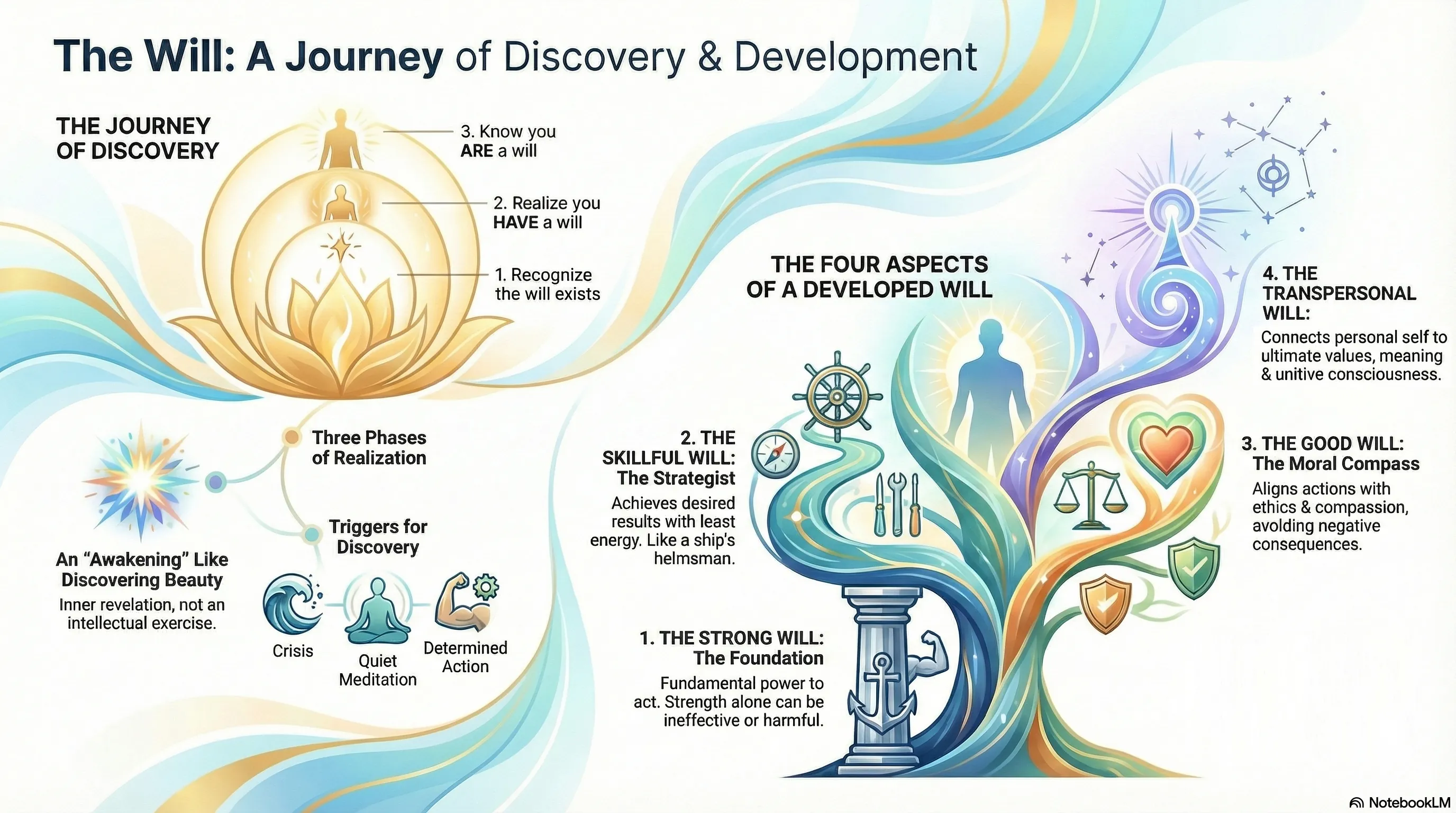
The will is discovered through direct inner experience—often in phases (recognizing it exists, realizing one has it, and finally being a will)—and this discovery must be protected and cultivated to become stable rather than intermittent.
- The chapter frames the “experience of the will” as the “firm foundation” and “strong incentive” for the “task of its training,” and describes a three-phase discovery that “renders it complete and effective.”
- It warns the initial revelation can “grow dim” and be “submerged” by drives and outer impressions, creating a need to “protect, cultivate, and strengthen” it.
- Shifts training from “intellectual consideration and study” (insufficient by itself) toward arranging conditions that support an “awakening” and then repeating and stabilizing it.
- Focuses effort on making the discovery “a constant possession” rather than a rare peak event.
Insight 2
The will’s proper role is directive and regulatory—like a helmsman steering a ship—balancing and constructively utilizing inner energies rather than repressing them; training is commonly blocked by misunderstanding and inertia, and requires sustained effort and persistence.
- The chapter explicitly rejects the “Victorian conception” (stern, repressive) as a “caricature,” and states the will “balances and constructively utilizes” activities “without repressing any of them.”
- It identifies two resistances: conceptual misunderstanding and a tendency toward inertia (“unwillingness to ‘take the trouble’”), and argues will-training requires “effort and persistence.”
- Replaces “force the personality” thinking with “steer and regulate” thinking (course-setting vs propulsion).
- Treats effort/persistence as normal training costs, justified because will “is at the basis of every activity,” improving “all future endeavors.”
Insight 3
Claim (plain language): Effective willing depends on realizing the intimate connection between the will and the self (“I”): to make self-consciousness clear, one must disidentify from changing contents of consciousness and identify with the self; the will is the “distinctive and autonomous activity” of the “I.”
- The chapter presents the culmination as “pure self-consciousness…the discovery of the ‘I,’” and argues self-consciousness is usually “implicit” because it is “mixed with…contents of consciousness.”
- It states “I and will are correlated terms,” defining will as the “activity of the I…which stands above the multiplicity of its contents.”
- Makes training concrete: disidentify from sensations/drives/emotions/thoughts so the “I” can direct them through will.
- Reframes inner life from “spurious identification” with contents to acting as a “living subject” able “to choose…to bring about changes.”
Key Quotes
“The experience of the will constitutes both a firm foundation and a strong incentive for starting the exacting but most rewarding task of its training. It occurs in three phases: the first is the recognition that the will exists; the second concerns the realization of having a will.”
“The true function of the will is not to act against the personality drives to force the accomplishment of one’s purposes. The will has a directive and regulatory function; it balances and constructively utilizes! all the other activities and energies of the human being without repressing any of them.”
“I and will are correlated terms; the I exists in so far as it has its own specific capacity for action which is the will; and the will exists only as a distinctive and autonomous activity of the I. It is well to become aware of the relationships between the self and the will on one hand and the various other psychological functions on the other.”
Key Concepts
Experience of the will: A direct inner discovery of the will’s reality and nature that becomes the foundation and incentive for training.
Three phases (of the discovery of the will): The progression of discovery: recognizing the will exists; realizing one has a will; and being a will (not merely having one).
Revelation / awakening: A sudden, experiential recognition (not fully producible by study alone) that initiates discovery and can later be deepened by repetition.
Inner experience of “willing”: The felt “specific power…inner energy” that arises in effort, struggle, crisis, or certain quiet inner moments.
Willing self: The self understood not just as someone who possesses will, but as essentially a self that wills.
Victorian conception of the will: An outdated view of will as stern, forbidding, and primarily repressive toward other human aspects.
Directive and regulatory function: The will’s true role: guiding, balancing, and constructively utilizing psychological energies rather than repressing them.
Helmsman analogy: A metaphor for will as steering the course (direction) while propulsion comes from other energies and functions.
Inertia (tendency): The tendency to let ease, impulses, or external influences dominate rather than taking the trouble required for training.
Self-consciousness: Awareness of the self; in humans it exists but is often implicit and unclear because mixed with changing contents.
Contents of consciousness: The variable stream of sensations, drives, emotions, thoughts, etc., that can veil the clarity of self-awareness.
Spurious identification: Mistakenly identifying the self with transient contents of consciousness because their constant impact veils clarity.
Disidentification: The act of separating one’s sense of self from the contents of consciousness in order to identify with the self (“I”).
The “I” (conscious I / personal self): The directly known self as an active and unifying center; the point in awareness in close contact with will.
I–will correlation: The claim that will is the specific capacity-for-action of the “I,” and exists only as the “I’s” autonomous activity.
Three categories (aspects, qualities, stages): The organizing dimensions for describing will: facets (aspects), modes of expression (qualities), and the unfolding process (stages).
Aspects of the will: The principal facets recognized in the fully developed will; each can be trained in specific ways: strong will, skillful will, good will, Transpersonal Will.
Transpersonal Self: The Higher Self of which the “I” is a “reflection or projection,” associated with the “vertical” dimension.
Check Your Understanding
- In one paragraph, explain the difference between “having a will” and “being a will,” and why that difference matters for training.
- What, exactly, is wrong with the “Victorian conception” of will, and what function replaces?
- Define “spurious identification” and describe what is required to make self-consciousness “explicit, clear, and vivid.”
Reflection Questions
Choose one of the prompts below. Read through it and think about how it relates to your life or experiences. Spend some time writing about it in your journal or notebook.
- Which of the three phases (recognizing / having / being) best describes your current relationship to will, and what in this chapter’s description makes you say that?
- Where do you notice the “initial revelation” of will or self-awareness becoming “submerged” in daily life, and what would “protect, cultivate, and strengthen” it look like for you?
- Which part of the “Victorian conception of the will” shows up most in your assumptions about will, and how does the helmsman analogy revise it?
- Where do you most often identify with changing contents (sensations, drives, emotions, thoughts), and what practical difference would disidentification make in your willing?
- What is one “price demanded by a worthwhile undertaking” (effort/persistence) that you tend to avoid, and how does the chapter justify paying it?
Exercises
Distinguishing the willer from the Drives
Grounding (1 minute)
- Sit comfortably with your feet on the floor and your hands resting loosely.
- Take two slow breaths. On each exhale, let your shoulders drop.
- Gently close your eyes (or soften your gaze).
Step 1 — Notice a “content” (1–2 minutes)
4. Bring to mind a current urge (impulse, desire, temptation, emotional push)—something small is fine.
5. Locate it in experience: body sensation, emotion, and/or thought-image.
- Mentally label it: “This is a content of consciousness.”
Step 2 — Disidentify (1 minute)
6. Say (silently or aloud), slowly:
- “I am aware of this urge.”
- “This urge is a drive; it is not me.”
- “I am the willer (the ‘I’) who can accept or reject it.”
Step 3 — Reclaim direction (1–2 minutes)
7. Ask: “If I were steering like a helmsman, what course would I choose right now?”
- Choose one of these two deliberate responses (keep it simple):
- Accept (with regulation): “I will allow this urge in awareness without acting on it yet.”
- Reject (with regulation): “I will not follow this urge; I will choose another action.”
Step 4 — One small act (1–2 minutes)
9. Do one small action consistent with your choice (20–60 seconds):
- If rejecting: take one step away (stand up, move the object, open a different tab, drink water).
- If accepting without acting: keep still and let the urge rise/fall while staying aware: “I am; I can will.”
Close (10 seconds)
10. Open your eyes. Write one line:
- “Urge (drive): ________. Choice (I/will): ________.”
Self-identification Exercise
Aim to complete at least the short-form version 2 or 3 times during the coming week. Assagioli recommended performing this shortly after waking, as a symbolic second awakening.
- Refer to The Act of Will — Appendix One: Self-identification Exercise for this exercise. Optionally, you can also complete Lesson 19 — Self-identification Exercise
- Alternatively, you can listen to a recorded version online: Disidentification Exercise (playlist)
7-Day Challenge: Self-vs-Contents Micro-Disidentification
Goal: make self-consciousness more explicit, clear, and vivid by repeatedly distinguishing the “I” (observer) from the contents of consciousness (observed).
What to do this week
A) One “quiet contemplation” session (15 minutes, once this week)
- Grounding (20 seconds): sit or stand comfortably; take two slow breaths.
- Choose one:
- Natural scenery (sky, trees, sea, hills), or
- A work of art (in a gallery/book/print), or
- Music (listen without doing anything else).
- For 15 minutes, do only this loop:
- Observed: name what you notice (a colour, shape, sound, sensation, emotion, thought).
Observer: say silently: “I am aware of this.” - Add: “This is a content; it is not the I.”
- Observed: name what you notice (a colour, shape, sound, sensation, emotion, thought).
B) Daily micro-marks (7 days): 3 times per day, 10–20 seconds each
Pick three routine moments (e.g., first drink, lunch, before bed). Each time:
- Two breaths.
- Identify what’s loudest right now: sensation / drive / emotion / thought.
Say silently:- “I am aware of this.”
- “This is the observed; I am the observer (‘I’).”
- Make a tiny record: one tally mark on paper (aim: 21 marks by week’s end).
If you want a stronger version (optional)
When the “observed” is a strong urge/impulse:
- Add: “I can choose my course.”
(Keep it at the level of recognition; no need to force a change in the moment.)
Finish-of-week check (2 minutes)
Write two lines:
- Most common ‘contents’ I noticed: ________
- What changed (even slightly) when I separated observer/observed: ________
Review & Practice: Chapter 2: The Existential Experience of the Will
Test your understanding of the core ideas from this chapter and capture your personal reflections. Scored questions provide immediate feedback; reflections are stored privately on your device.
In this chapter, what is the will mainly described as?
Which sequence best matches the chapter’s three phases of discovering the will?
The chapter suggests that reading and thinking about the will can fully replace an initial lived experience of it.
Which option best corrects a common misunderstanding about the will in this chapter?
Scenario: You plan to do 10 minutes of reading, but you feel like checking your phone. You pause, notice the pull, and choose to read for 2 minutes first. What best fits the chapter’s emphasis?
Complete the following statement by filling in the missing term(s):
Which option best states what this chapter is trying to do?
Which option best summarises the chapter’s main contribution?
In 3–5 sentences, describe one ordinary moment when you experienced “willing” (a small choice counts). Explain how it differed from a passing impulse or emotion.