
Chapter 1: Introduction
Purpose
Diagnose the modern “inner–outer” power gap and justify training the will through direct experience rather than theory.
Learning Outcomes
By the end of this chapter, you should be able to:
- Explain, in your own words, what the chapter means by the “fatal gap” between external power and inner power.
- Distinguish the chapter’s two remedy-directions and state why simplification alone is “only partially” sufficient.
- List the chapter’s two reasons for prioritizing will-training and paraphrase the will’s three functions (deciding, applying means, persisting).
- Identify at least two failure modes the chapter warns about when inner powers are underdeveloped in modern life.
- State the chapter’s recommended method for approaching the will and why it rejects theory-first approaches.
Key Insights
Insight 1
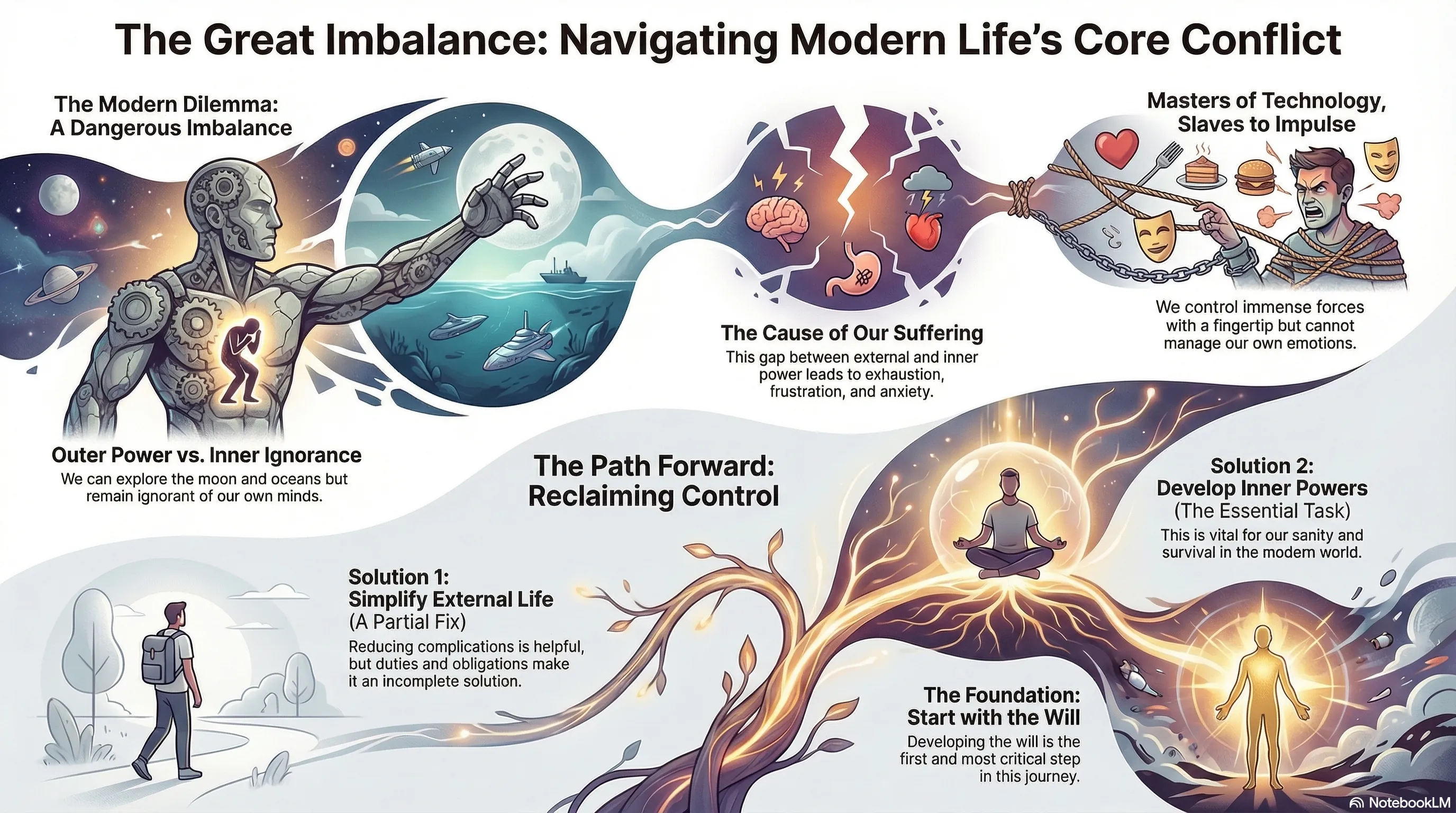
Modern life amplifies external power and complexity faster than inner capacity, and this mismatch produces personal and collective harm unless inner powers are developed (not just outer life simplified).
- The chapter’s main diagnosis is the “wide gulf between man’s external and inner powers” and treats it as a “profound cause” of modern evils.
- It frames the “remedy” explicitly as two-directional, then argues simplification alone cannot solve the whole problem.
- It shifts the learner from blaming technology itself to focusing on “uses” and on not being overwhelmed and enslaved by modern life.
- It prioritizes deliberate development of inner resources to meet modern demands on energy, mental functions, emotions, and will.”
Insight 2
Training the will should be given priority because the will is central to the self and is the function that decides actions, mobilizes means, and persists through obstacles.
- The chapter calls will a “fundamental” inner power and says priority should be given to its “tremendous, unrealized potency.”
- It provides two explicit reasons: the will’s “central position… connection with… self,” and its role in deciding, applying means, and persisting against difficulties.
- It reframes will as the foundation of “all endeavors,” not a minor trait.
- It directs attention to strengthening follow-through under “obstacles and difficulties,” not only setting goals.
Insight 3
To understand the will correctly, begin with direct existential experience and postpone abstract theorizing, because purely intellectual approaches tend to produce contradiction and confusion.
- The chapter warns that historical, theoretical attempts “lead… not only to no solution, but to contradiction; confusion, and bewilderment.”
- It states the “right procedure” is to postpone theories and start from “direct existential experience.”
- It establishes a method for the learner: start from lived experience of willing, not debate.
- It positions the next step in the book as experiential discovery rather than conceptual argument.
Key Quotes
"[The] wide gulf between man’s external and inner powers is one of the most important and profound causes of the individual and collective evils which afflict our civilization and gravely menace its future. Man has had to pay dearly for his material achievements. His life has become richer, broader, and more stimulating, but at the same time more complicated and exhausting. Its rapidly increasing tempo, the opportunities it offers for gratifying his desires, and the intricate economic and social machinery in which it has enmeshed him make ever more insistent demands on his energy, his mental functions, his emotions, and his will."
"The remedy for these evils—the narrowing and eventual closing of the fatal gap between man’s external and his inner powers—has been and should be sought in two directions: the simplification of his outer life and the development of his inner powers."
"I believe that the right procedure is to postpone all intellectual discussions and theories on the subject, and begin by discovering the reality and the nature of the will through its direct existential experience."
Key Concepts
External powers: Technological/material capacities through which humans gain control over nature.
Inner powers: Capacities for self-knowledge and self-control needed to manage inner life and direct action.
Will: A fundamental inner power with “tremendous, unrealized potency” whose training and use is foundational.
Training and use of the will: The deliberate development of the will as the “foundation of all endeavors.”
Central position of the will: The will’s central place in personality and its close connection with the core of one’s being—one’s self.
The fatal gap (between external and inner powers): The mismatch between strong external capabilities and weak inner knowledge/control, treated as a major cause of modern harms.
Simplification of the external life: The first solution for narrowing the fatal gap between external and inner powers is reducing outer complications and resisting modern pace/attractions.
Development of man’s inner powers: The second solution for narrowing the fatal gap between external and inner powers is strengthening inner capacities to meet modern demands and dangers.
Negative trends of modern life: Pressures and patterns of modern living (tempo, enticements, demands) that strain inner resources.
Determination: An inner quality needed to resist negative trends and sustain effective action under modern pressures.
Firmness: An inner quality needed to hold one’s course against modern pressures and distractions.
Persistence: An inner quality needed to continue efforts despite difficulties and demands.
Direct existential experience: The recommended starting method: discovering the will’s reality and nature through lived experience rather than theory.
Unconscious: The “depths” of the psyche that modern man is largely unaware of.
Superconscious levels: Higher “luminous” levels of the psyche that modern man fails to reach and become aware through.
Self: The “true Self” (capital S) that modern man is said to be unable to become aware of without reaching higher inner levels. The ‘Transpersonal’ or ‘Higher’ Self.
Check Your Understanding
- What is the “fatal gap” and what does the chapter claim it causes?
- Name the two solutions (directions) for closing the “fatal gap” and give one reason the chapter gives for why the first solution can’t fully solve the problem.
- What two reasons does the chapter give for prioritizing the will, and what “right procedure” does it recommend for studying it?
Reflection Questions
Choose one of the prompts below. Read through it and think about how it relates to your life or experiences. Spend some time writing about it in your journal or notebook.
- Where in your life do you see the biggest mismatch between external capability and inner control?
- If you simplified your outer life substantially, what part of the problem would still remain, according to the chapter?
- Which of the will’s functions (deciding, applying means, persisting) is currently your weakest under modern demands, and what makes you say that?
- In what ways might your current approach to “understanding will” be too theoretical, and what would it look like to begin from direct existential experience instead?
Exercises
Simplification of Outer Life — “Unnecessary Complications” Audit
Grounding (1 min)
- Sit comfortably. Let your shoulders drop.
- Take 2 slow breaths.
- Close your eyes for 10 seconds and recall the chapter’s phrase: “unnecessary complications”. Open your eyes.
Steps (4–7 min)
- Inventory (2 min): Write 8–12 quick items that currently add avoidable complexity or “hurried pace” to your day (tasks, habits, commitments, routines, information inputs).
- Mark what’s removable (2 min): Put a ✓ beside anything you could realistically eliminate or simplify without breaking essential duties (“family ties, professional obligations”).
- Choose one change (1–2 min): Circle one ✓ item to remove or replace this week.
- Define the replacement (optional, 1 min): If you can’t remove it, write a simpler version (fewer steps, fewer times, less scope).
Success criteria (30 sec)
- You end with one specific “unnecessary complication” to eliminate or simplify this week, stated in one sentence.
Development of Inner Powers — Will-Function Resource Inventory
Grounding (1 min)
- Sit comfortably. Take 2 slow breaths.
- Close your eyes and remember one recent moment when you had to decide, apply means, or persist (the chapter’s three will-functions). Open your eyes.
Steps (4–7 min)
- Pick one real task (1 min): Choose one current goal/task that matters and has some resistance (an obstacle, difficulty, or delay).
- Map the will-functions (2 min): Write three short lines:
- Deciding: What exactly must I decide here?
- Applying means: What means/resources must I bring to bear?
- Persisting: What obstacle/difficulty will likely test persistence?
- Resource inventory (2–3 min): Under “means/resources,” list 4–8 inner resources you already have but may be underusing for this task (keep it general; the chapter calls for “development of inner powers”).
Examples you may include if they fit: attention, imagination, concentration, emotional regulation, clear-sightedness, wisdom, persistence, determination. - One training action (1–2 min): Choose one resource from your list and write a single “training” action you can do in the next 24 hours that strengthens it in practice (e.g., a brief focusing period before the task; a deliberate persistence block; a moment of clear decision).
Success criteria (30 sec)
- You end with one underused inner resource and one concrete training action tied to a real task’s deciding/means/persisting demands.
7-Day Challenge: Aesthetic Immersion (Nature or Art) to “Awaken” the Will
Aim (for the next week): Do 3 short sessions of quiet, repeated contemplation of either natural scenery or one work of art, with the specific intent of noticing any “awakening” (a clearer inner impulse, aspiration, or sense of direction)—not merely relaxing.
Set-up (2 minutes, once)
- Schedule three 12–15 minute slots in the next 7 days (e.g., two nature, one art — or vice versa).
- Pick your “objects” in advance:
- Nature: one place you can return to (tree line, shoreline, park, hill view).
- Art: one piece you can revisit (museum piece, a print/book plate, or a single high-quality reproduction).
Each session (12–15 minutes)
Grounding (1 minute)
- Get comfortable (sitting or standing still).
- Take two slow breaths.
- Close your eyes for 5–10 seconds and set a single intention: “I am here to receive, not to solve.”
Contemplation (10–12 minutes)
- Look at one scene or one artwork only.
- Keep attention simple and receptive: shapes, light, colour, form, space, movement, detail.
- When your mind drifts to analysis, planning, or judgment, gently return to direct seeing.
- Stay with it even if it feels “nothing is happening” (the “repeated” part matters).
Immediate record (2 minutes)
Write 3 short lines:
- What held my attention most? (one concrete detail)
- What shifted inside, if anything? (energy, clarity, mood, sense of meaning)
- Did any impulse to act appear? (even faint) If yes: write it as a plain sentence starting with “I will…”
Optional “bridge” (3 minutes, same day)
If you wrote an “I will…” sentence, do a 3-minute micro-act that expresses it (a first step only). Keep it concrete and small—just enough to begin turning “awakening” into willing-in-action.
Review & Practice: Chapter 1: Introduction
Test your understanding of the core ideas from this chapter and capture your personal reflections. Scored questions provide immediate feedback; reflections are stored privately on your device.
In this chapter, what does “inner powers” most nearly mean?
What is the chapter’s main contrast between “outer power” and “inner power”?
Simplifying one’s outer life can help, but it cannot fully replace developing inner strength.
According to this chapter, what is a likely problem if someone starts by arguing about the will in abstract theory?
Scenario: Lee feels overwhelmed by constant notifications. Lee says, “The problem is technology itself. If I get rid of all devices, I will be fine.” Which response best matches the chapter?
Complete the following statement by filling in the missing term(s):
Which option best states what this chapter is trying to do?
In 3–5 sentences, explain what the chapter means by the “gap” between outer ability and inner ability, using one simple example from everyday life.