
Chapter 10: The Universal Will
Purpose
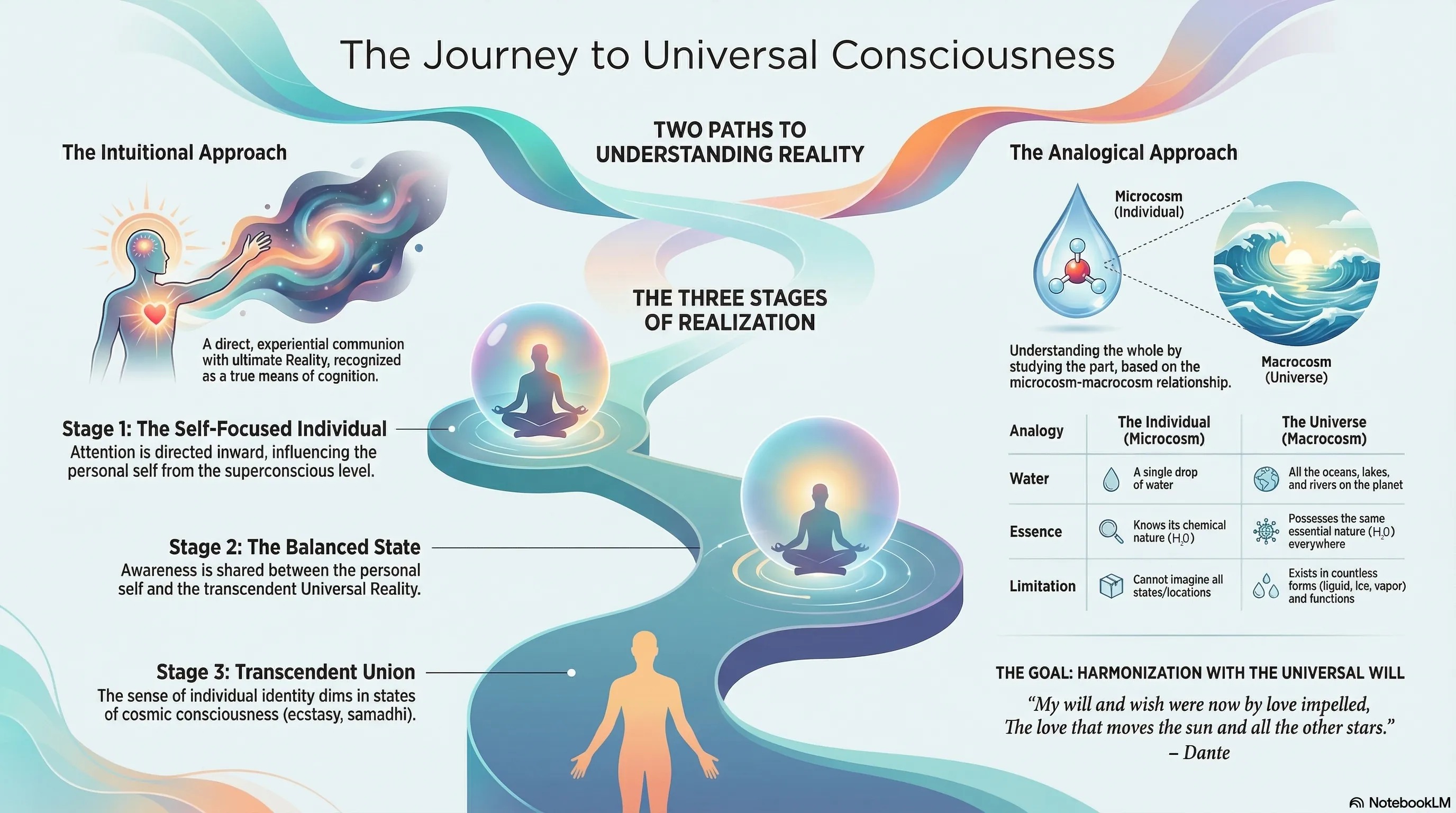
Clarify the idea of a Universal Will, how it relates to individual will, and why intuition and analogy (not anthropomorphic theology or purely analytic “proofs”) best support experiential understanding of that relationship.
Learning Outcomes
By the end of this chapter, you should be able to:
- Explain the chapter’s argument for the plausibility of a Universal Will using the microcosm–macrocosm analogy.
- Distinguish the chapter’s three approaches to ultimate Reality and state what each can and cannot do.
- Describe the chapter’s view of unification of individual and Universal Will, including why individuality remains necessary.
- Identify at least two failure modes the chapter warns about.
Core Insights
Insight 1
If individual will exists, it is reasonable (by analogy) to posit a Universal Will that individual will partially expresses; denying this implies an implausible “microcosm superior to macrocosm” conceit.
- The chapter explicitly treats the existence of a Universal Will and its relation to individual wills as “fundamental.”
- It argues by analogy from microcosm/macrocosm and from the intimate relation between self and will “at all levels.”
- Reorients willing from isolated self-assertion toward relation/participation in a larger order (“Universal Life”).
- Makes “unification of the two wills” a coherent ultimate aim rather than a purely religious assertion.
Insight 2
Understanding ultimate Reality (and thus Universal Will) is better approached through intuition and analogy than through anthropomorphic images or purely analytical attempts to “prove” God.
- The chapter diagnoses why religious formulations have lost appeal (anthropomorphic images; theological models attempting to conceptualize what transcends formulation).
- It proposes “the intuitional approach” and “the perception of analogies,” and clarifies two philosophical meanings of “reason.”
- Shifts the learner from debating concepts to seeking “direct experience of communion” and using analogy to orient the mind without overreaching it.
- Encourages precision about what “reason” is doing (analytic vs Logos/Transcendental Reason) when thinking about ultimate matters.
Insight 3
Unification with the Universal Will is an aspiration expressed across traditions, but genuine universality is experienced through (not by suppressing) individuality; higher states may dim identity, yet individuality remains a necessary “focal point.”
- The chapter presents unification as a “deep aspiration” and “highest…need,” expressed in varied cultural forms.
- It explicitly warns (via quoted testimony) against “suppression of individuality” as leading to “indifference and dissolution,” and describes degrees of transcendence in which identity may be “dimmed” but not wholly lost.
- Prevents confusing “merging” with annihilation/avoidance; frames unification as participation plus preserved (and sometimes sharpened) selfhood.
- Provides a practical target: “tuning in and willingly participating” rather than forcing outcomes by personal will alone.
Key Quotes
“The question of the existence of a Universal Will and its relation to individual wills is fundamental because it is closely connected with the larger problem of the relation between man and the ultimate Universal Reality.”
“The intuition has been recognized by many, both in the East and in the West, as a true and higher means of cognition. It has been considered by Jung and others as a psychological function in its own right, as real and legitimate as any of the others. The difference can be said to consist between the attempts to ‘prove’ the existence of God through intellectual and rational means—as has been attempted by certain schools of theology—and the intuitive, direct experience of communion with the ultimate Reality.”
“The approach of analogy is based on the essential unity of all the aspects of Reality, from the smallest to the largest. Thus there is a close correspondence between the microcosm and the macrocosm in general, and specifically between man and the universe. But this basic identity of nature does not mean that man in his normal state of consciousness can mentally understand, ‘comprehend,’ the immense scope and meaning of the ultimate Reality.?”
Key Concepts
Universal Will: A will operating at the level of Universal Life/ultimate Reality, to which individual will is intimately related by analogy and existential experience.
Ultimate Universal Reality: The transcendent Reality to which human beings and the universe relate; historically framed in religious terms but presented as knowable through other approaches.
Anthropomorphic images of God: Human-shaped conceptions attributing human qualities/limitations to God, which the chapter says provoke rejection and are “dying.”
Theological models: Conceptual/theoretical formulations attempting to define transcendent Reality; treated as limited and often refused.
Intuitional approach: A way of knowing through intuition as a “higher means of cognition,” involving “direct experience of communion” with ultimate Reality.
Intuition: A psychological function and “means of cognition” recognized as legitimate, enabling direct apprehension rather than analytic proof.
Reason (two meanings): (a) Mental, analytical reason (“Aristotelean”); (b) Reason as Logos/Transcendental Reason (Plato/Kant), a distinct philosophical conception.
Approach of analogy: Understanding reality via correspondences grounded in the “essential unity” of Reality; especially microcosm–macrocosm correspondences.
Microcosm and macrocosm: The small-scale (human) and large-scale (universe) domains whose “close correspondence” supports analogical insight.
Expansions of consciousness: Successive enlargements of awareness by which a person may gradually experience “wondrous mysteries” beyond normal consciousness.
Universal SELF or Being: The Universal dimension of “Being” of which the individual self’s conscious “Being” is an aspect.
Transpersonal Self: The “SELF” symbolized by a star in described diagrams, whose “radiation” relates to both the personality and transcendent Reality.
Individuality and universality: Complementary opposites; individuality is described (in quoted testimony) as the focal point through which universality can be experienced.
Harmonization / unification / fusion (of the two wills): The relationship and eventual unity between individual will and Universal Will, presented as a deep aspiration and highest need.
Rhythms of Universal Life: The dynamic order of Universal Life with which one can “tune in” and “willingly participate” as an expression of unification.
Check Your Understanding
- In one paragraph, restate the “ridiculous conceit” argument and name the assumption it relies on.
- What does the drop-of-water analogy show, and what does it explicitly not justify?
- According to the chapter (and its quoted testimony), why is “suppression of individuality” a problem for universality?
Reflection Questions
Choose one of the prompts below. Read through it and think about how it relates to your life or experiences. Spend some time writing about it in your journal or notebook.
- Which is your default stance toward ultimate Reality described here: treating it as abstraction, rejecting anthropomorphic images, or seeking intuition/analogy—and what in your life shows that?
- Where might you be demanding mental “comprehension” of something the chapter says can only be approached through expansions of consciousness?
- What would “preserving a vivid sense of individual identity” while sensing participation in a larger Being look like in one real decision you face?
- When you feel drawn toward “merging into the whole,” how can you tell (using only this chapter) whether it is genuine universality or avoidance/annihilation?
Exercises
My beliefs about Universal Will
Goal: Make your current belief-position explicit, using only the chapter’s categories (image/theology vs Reality; intuition/analogy; limits of comprehension).
Steps
- Write 6–10 lines beginning with: “When I hear ‘Universal Will’ (or ‘ultimate Reality’), I usually…”
- Include: whether you treat it as abstraction, reject it, or feel open to it.
- Add 3 lines titled “What I reject”: be precise (e.g., “anthropomorphic images,” “theological models,” “blind belief”) rather than rejecting everything.
- Add 3 lines titled “What I do not claim”: state the chapter’s “drop” limitation in your own words (what your mind cannot fully comprehend).
- Finish with 1–2 lines titled “What I can tentatively affirm (by analogy)”: identity-in-nature without overreach.
Success criteria
- You clearly separate rejecting images/models from rejecting Reality.
- You include at least one explicit “limit of comprehension.”
- You make one cautious affirmation grounded in analogy (not proof).
Reasoning: microcosm vs macrocosm
Goal: Challenge your position with the chapter’s reasoning and see where it holds, breaks, or needs refinement.
Steps
- State your claim in one sentence:
- Option A: “There is a Universal Will.”
- Option B: “I doubt/deny there is a Universal Will.”
- Option C: “I suspend judgment.”
- Build a 6–10 line argument using this scaffold (fill each line):
- Premise: The chapter says the self and will are intimately related “at all levels.”
- Premise: The chapter claims a microcosm–macrocosm correspondence (analogy).
- Inference: Therefore, individual will can be viewed as a partial expression/reflection of a wider Reality.
- Counter-stance: If there were no Universal Will, then… (use the chapter’s “microcosm superior” point).
- Constraint: Yet analogy does not grant full comprehension (drop-of-water limit).
- Conclusion: So my position is… (A/B/C), with this level of confidence…
- Now write the strongest 4–6 line objection to your own argument, but only using the chapter’s allowable moves (e.g., limits of reason, rejection of anthropomorphic images, “reason” meaning ambiguity, limits of comprehension).
- Resolve (3–5 lines): revise your original claim to survive the objection—either narrow it, reframe it, or keep it suspended but clearer.
Success criteria
- You explicitly distinguish analytic proof vs intuition vs analogy (even if briefly).
- Your objection doesn’t import outside ideas; it uses chapter-allowed constraints.
Your revised claim is more precise (narrower, clearer limits, or better defined terms).
Review & Practice: Chapter 10: The Universal Will
Test your understanding of the core ideas from this chapter and capture your personal reflections. Scored questions provide immediate feedback; reflections are stored privately on your device.
In this chapter, “Universal Will” most closely means:
Which contrast best fits the chapter’s point about “God” language?
The chapter suggests that trying to prove ultimate Reality by analysis is the same as knowing it through direct intuition.
Which option best corrects a common misunderstanding from this chapter?
Scenario: You feel annoyed by a delay that disrupts your plan. You can either complain, or use the time to do a small task you’ve been avoiding and arrive calmer. What best fits the chapter’s emphasis?
Complete the following statement by filling in the missing term(s):
Which option best states what this chapter is trying to do?
Which option best summarises the chapter’s main contribution?
In 3–5 sentences, explain how the chapter says individuality and universality can relate without “erasing” the self.