
Chapter 11: From Intention To Realization
Purpose
Present the act of will as a six-stage sequence and show how understanding these stages reveals why willing succeeds or fails.
Learning Outcomes
By the end of this chapter, you should be able to:
- Identify and correctly name the six stages of the act of will in order.
- Distinguish Stage 1 (goal + valuation + motives + intention) from merely imagining or contemplating a goal.
- Explain the functional difference between deliberation and choice/decision.
- Describe what “affirmation (Fiat)” adds after decision and why it matters.
- Diagnose a personal example of willing by locating which stage was the weakest link
- Explain Stage 6 as direction + supervision + adaptation, using the “director” analogy.
Core Insights
Insight 1
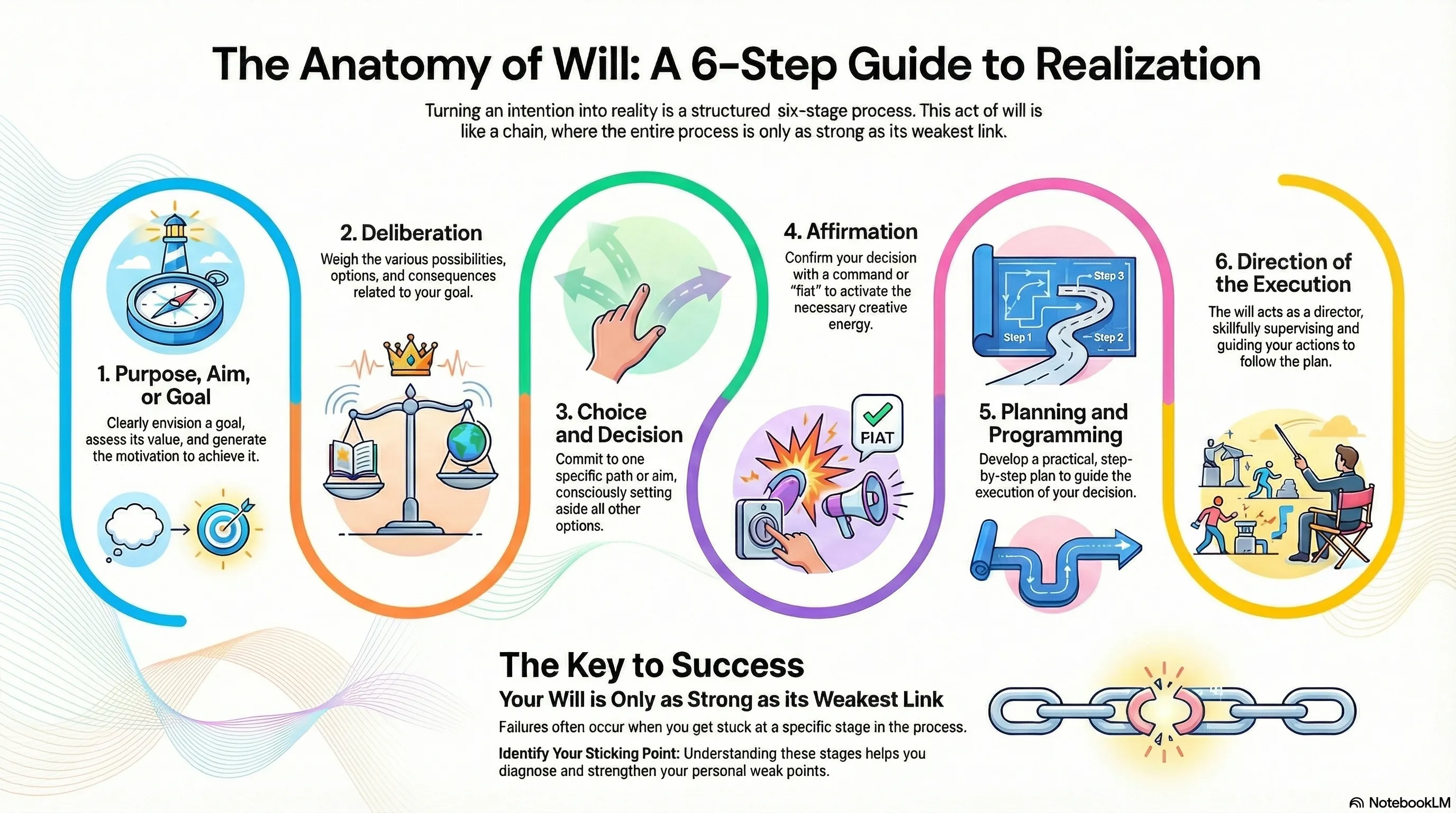
A complete act of will unfolds through six sequential stages, and the success of willing depends on how well each stage is carried out.
- The chapter explicitly defines the act of will as “six sequential phases or stages” and uses the “links in a chain” model to define effectiveness.
- It states that failures commonly occur because people have difficulty with “one or another specific stage” and get “stuck.”
- You stop treating “willpower” as one undifferentiated force and instead locate the weak stage that limits the whole act.
- You aim to become “proficient in all the stages” to act effectively across different circumstances.
Insight 2
Having a goal is necessary but not sufficient; it becomes will-in-action only when the goal is evaluated, generates motives, and produces intention.
- The chapter emphasizes that the “clear vision” of a goal can remain “imagination, or contemplation,” and is “not as yet will in action.”
- It directly connects valuation → motives → urge and intention as the functional activation of Stage 1.
- You test whether your “goal” is still only contemplation by checking for valuation and motive-based intention.
- You treat “motive” as something “active, dynamic,” linked to the values attached to the goal.
Insight 3
In execution, the will’s function is primarily directive and supervisory—coordinating other functions—rather than “carrying out” actions directly.
- The chapter states that direction of execution is a “specific task of the will” and corrects the common belief that will directly performs execution.
- It adds that direction includes “constant supervision,” “subordination” of means to purpose, and “constant adaptation” to changing conditions.
- You shift from forcing action to directing and supervising thinking, imagination, feelings, impulses, and bodily functions toward the purpose.
- You treat supervision and adaptation as part of willing, especially when activity becomes “almost automatic.”
Key Quotes
“The act of will consists of six sequential phases or stages… These six stages are like the links in a chain; therefore the chain itself—that is, the act of willing—is only as strong as its weakest link.”
“It has been my observation—and one easy to confirm—that the principal cause of failure in completing an act of will is that people often have difficulty carrying out one or another specific stage: in other words, they get stuck at a particular point in the sequence.”
“Finally comes the direction of the execution… the proper function of which is not to carry out the execution directly, as is commonly supposed… To employ an analogy from the theater, the will is the director of the entire production but normally he is not himself one of the actors.”
Key Concepts
Act of will: The complete process of volition unfolding through six sequential stages.
Six stages (six phases): The sequential links that make up a complete act of willing.
Links in a chain / weakest link: A model stating that overall effectiveness equals the strength of the least well-performed stage.
Ideal and complete state: The act of will described as a guiding model of complete purposive action, not a literal copy of every willed act.
Purpose / aim / goal: The intended end that defines a volitional act; a “clear vision” of what is to be achieved.
Valuation / evaluation (of the aim): The assessment of a goal that precedes and supports motivation; a necessary step before will-in-action.
Motive / motivation: The active, dynamic “urge” generated by values attached to a goal, helping form intention.
Intention: The formed resolve/urge to achieve the goal, generated by motives aroused through valuation.
Deliberation: The stage of examining possible goals (and ways to realize them), including desirability and consequences, to determine what is preferable.
Choice and decision: Selecting one aim and setting aside others as the consequence of deliberation.
Affirmation (Fiat): Confirmation of the decision that activates and fosters energies needed to achieve the goal.
Planning and program: Careful working out of means and phases of execution through time, aligned with circumstances and possibilities.
Direction of the execution: The will’s task of directing other functions and energies toward the goal rather than executing directly.
Will as director (theater analogy): An analogy: the will coordinates the whole “production” without being one of the actors.
Supervision: Ongoing oversight to ensure the program follows the right course and remains subordinate to the purpose.
Adaptation (to changing conditions): Adjusting the use of means as circumstances change while maintaining subordination to the underlying purpose.
Check Your Understanding
- In your own words, why is a clear goal “indispensable” yet “not sufficient” for will-in-action (as stated here)?
- What is the difference between deliberation and choice/decision in this chapter’s definitions?
- What does affirmation (Fiat) do after a decision, according to the text?
- In Stage 6, what does it mean that the will is a “director” rather than an “actor,” and what must direction include?
Reflection Questions
Choose one of the prompts below. Read through it and think about how it relates to your life or experiences. Spend some time writing about it in your journal or notebook.
- In a current goal, which part is still “imagination or contemplation,” and what valuation/motive would turn it into intention?
- Where do you most often get “stuck” in the six-stage sequence (based on your own examples), and what does that imply is your weakest link right now?
- In a recent interruption or sidetrack, what would “affirmation” have sounded like internally to resume the decided aim?
- When your execution becomes “almost automatic,” what specific supervision would keep it subordinate to the underlying purpose?
Exercises
Six-Stage Replay (Completed Action)
Grounding (30–45 sec)
- Sit comfortably. Let your shoulders drop.
- Take 2 slow breaths.
- Close your eyes for a moment and recall one ordinary action you completed today (small is fine).
Steps (5–8 min)
- Name the action in one line (e.g., “sent the email,” “made lunch,” “went for a walk”).
- Create six short lines labelled 1–6 and write 1–2 sentences for each, describing what actually happened:
- Aim/Goal + evaluation/motives/intention: What was the aim? What value did you attach? What motive/urge formed?
- Deliberation: What options did you consider (even briefly)? What factors did you “keep in mind” (desirability, consequences, etc.)?
- Choice/Decision: What did you choose, and what did you set aside?
- Affirmation (Fiat): What confirmed it? (Even a subtle “Right—do it now.”)
- Plan/Program: What program or sequence did you form (even minimal)?
- Direction of execution: How did you direct and supervise the doing? Did you adapt to conditions?
- Next to each stage, mark P if it was prominent (took noticeable time/effort) or M if it was minimal/automatic.
Success criteria
- You can describe all six stages without “filling them in” with theory—only what happened.
- At least one stage is clearly marked prominent, and at least one is marked minimal/automatic (showing how stages vary in prominence).
Weakest-Link Autopsy (Unfinished Intention)
Grounding (30–60 sec)
- Get comfortable. Unclench your jaw.
Take 2 slow breaths. - Briefly recall one intention from the last few days that you didn’t carry through (keep it mild—no heavy self-judgment; just information).
Steps (6–10 min)
- Write the intention in one sentence (what you meant to do).
- Walk the chain in order (1→6), and stop at the first stage where the sequence broke—the point where you got “stuck,” drifted, or never truly started.
- In 3–6 lines, explain the failure in the chapter’s terms, using only what fits:
- Stage 1 failure: goal stayed in imagination/contemplation; valuation/motives/intention never became active.
- Stage 2 failure: no real deliberation; options/factors weren’t examined.
- Stage 3 failure: no clear choice; competing aims not set aside/discarded.
- Stage 4 failure: decision not confirmed; no “Fiat” to activate the energies.
- Stage 5 failure: no workable plan/program through time/conditions.
- Stage 6 failure: will didn’t direct/supervise execution; drifted into interruption or automaticity without supervision/adaptation.
- Write one closing line: “My weakest link here was Stage __ because __.”
Success criteria
- You identify a single earliest break-point stage (not “everything failed”).
- Your explanation uses the chapter’s functions of that stage (e.g., valuation → motives → intention; supervision + adaptation), not vague labels like “lack of willpower.”
Review & Practice: Chapter 11: From Intention To Realization
Test your understanding of the core ideas from this chapter and capture your personal reflections. Scored questions provide immediate feedback; reflections are stored privately on your device.
In this chapter, what is the “act of will”?
Which option best fits the chapter’s contrast between imagining a goal and “will in action”?
The six stages are presented as an ideal guide for purposive action, not as a perfect description of every single willed act.
Which option best corrects a common misunderstanding about “direction of execution”?
Scenario: You decide to go for a short walk. On the way, you stop to chat and then drift into checking your phone. Ten minutes later, you remember you had decided to walk and you say to yourself, “Right—back to it.” Which stage is most clearly happening at that moment?
Complete the following statement by filling in the missing term(s):
Which option best states what this chapter is trying to do?
Which option best summarises the chapter’s main contribution?
Scenario: You choose a meal to cook for friends. You decide what to make, then spend time organising ingredients and steps. While cooking, you keep checking that you’re following the sequence and adjust when something changes. Which pair of stages is most prominent after the decision?
Think of a small everyday goal (e.g., a short walk, a quick message, a simple chore). Which stage of the act of will is most likely to be your “weak link,” and what would help you strengthen it in a low-effort way?