
Chapter 12: Purpose, Evaluation, Motivation, Intention
Purpose
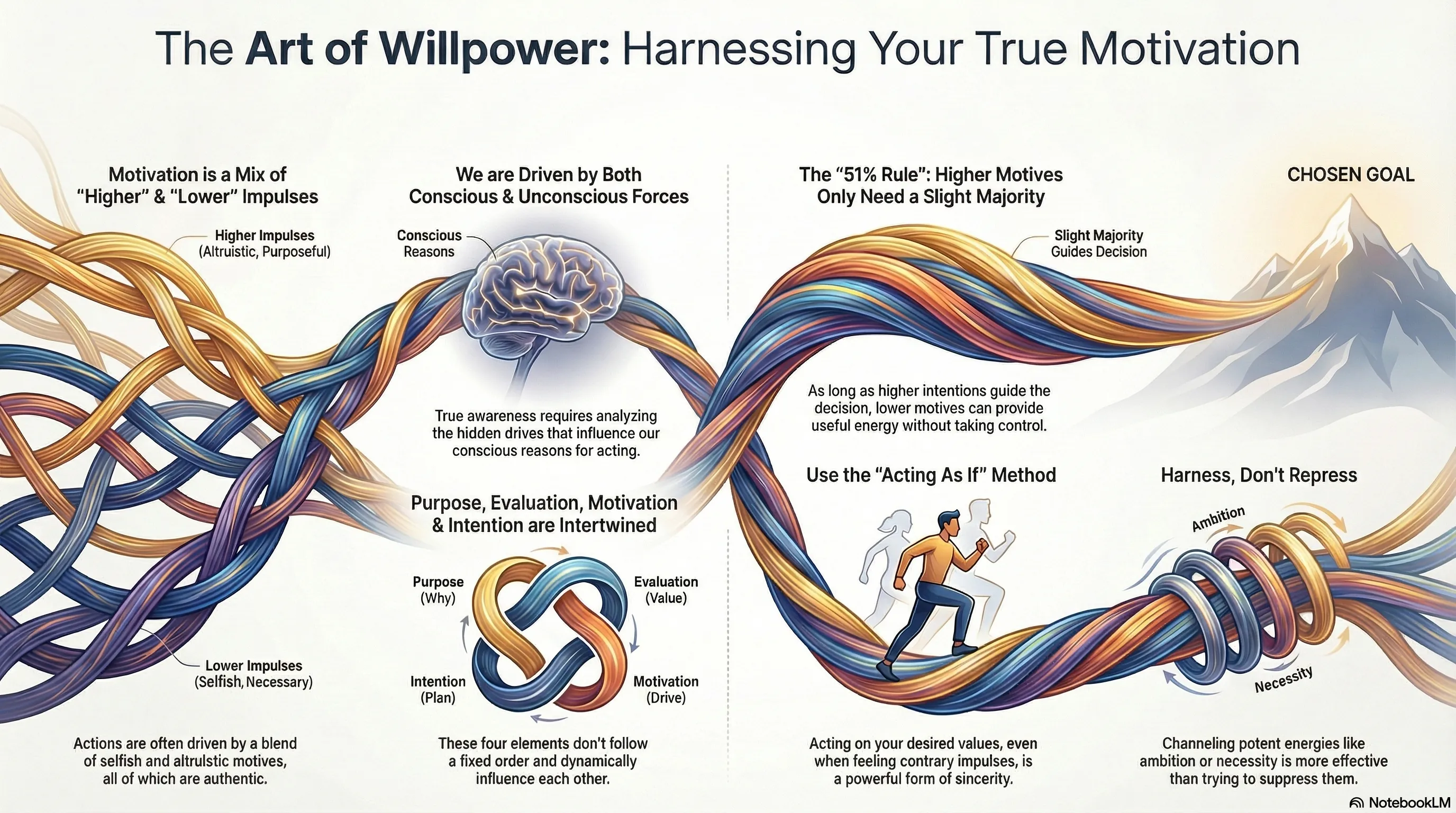
Clarify the interrelated elements that start a willed act and show how accurate motivation-work (including unconscious motives) is necessary to move from “goal in imagination” to effective action.
Learning Outcomes
By the end of this chapter, you should be able to:
- Map a chosen aim into the four interrelated elements: purpose/goal, evaluation, motivation, and intention.
- Explain (with an example) how the four elements can appear in different orders while remaining part of the same stage.
- Identify at least two possible unconscious motives/rationalizations behind an action and distinguish them from stated conscious reasons.
- Apply the chapter’s definition of authenticity to a real impulse (decide whether to accept or refuse it and why).
- Distinguish “drives and urges” from “reasons,” and rewrite a drive/urge as a conscious reason consistent with a valued goal.
- Propose one way to align and utilize a “lower” motive in service of a higher aim while naming the vigilance risk.
Core Insights
Insight 1
A successful willed act begins when an aim is clearly seen, evaluated as valuable, and supported by motives that actually “move,” forming a usable intention; these elements interact dynamically rather than in a fixed order.
- The chapter opens by grouping the four elements precisely because they are “interrelated” and “should not be treated as different stages,” and it explicitly describes multiple possible sequences among them.
- It ends by summarizing the required sequence of tasks for “the first stage of the act of will” and warns that without motive-dynamism one remains “only a dreamer.”
- You stop treating “having a goal” as sufficient; you explicitly evaluate worth and mobilize motives so intention becomes operational.
- You expect non-linear emergence (motive first, value first, vision first) and learn to organize them into an actionable beginning.
Insight 2
Motivation is usually mixed (conscious and unconscious); effective willing requires analyzing motives to reduce rationalization and then choosing which motives to “give free course,” including using “acting as if” when it expresses the chosen better motive rather than denial or deception.
- A large portion of the chapter is devoted to unconscious motivations, rationalization, and the need for “true awareness” via accurate analysis.
- The chapter directly addresses the authenticity objection to “acting as if,” defining when it is hypocrisy and when it is a genuine act of will (refusal to identify with a hostile impulse).
- You treat “my reasons” as a hypothesis that may include unconscious drivers; you test for rationalization (“inner attorney”).
- You redefine authenticity as alignment with what you will to be, not automatic expression of whatever impulse exists.
Insight 3
Multiple motives at different “levels” can coexist and even converge; lower motives can be aligned, regulated, and redirected toward higher purposes, but the will must stay vigilant so lower motives do not prevail and divert the original aim.
- The chapter repeatedly argues against absolute labeling of motives as simply good/bad and explains multiplicity, cooperation, and the practical advantages of directing energies to higher ends.
- It explicitly adds cautions: risks of repression, risks of lower motives strengthening and causing “illusion, compromise, and deviation.”
- Instead of frontal opposition to “lower” tendencies, you channel, balance, and “maneuver skillfully,” using attention and opposite tendencies as regulators.
- You adopt a governance criterion (higher motives “in control” / “supremacy”) while monitoring drift over time.
Key Quotes
“[A] purpose is the will to reach a goal, an objective; but a goal is not such if it is not regarded as valuable. Similarly, a motive is not a motive if it does not “move,” if it does not impel toward a goal. And the direction of the motive is given by intention.”
“Psychoanalysis has laid great emphasis upon the fact that unconscious motivations exist, and that often we act in the belief that we do so from a given conscious motive when in reality we are also, or principally, impelled by drives of which we are not aware. These overcome the censorship of the ego by means of rationalization.”
“With this initial zest, a person can proceed to the deliberate examination of the ways in which he can actually achieve a given aim. Without the dynamism of his motives, no matter how clear his aims or worthwhile they may be, a person can lack the drive to go on and remain only a dreamer instead of the doer of willed action.”
Key Concepts
Purpose: The will to reach a goal or objective.
Goal: A target to be achieved; it functions as a goal only if regarded as valuable.
Evaluation: Assessing a goal’s value and worthwhileness as part of putting the will into operation.
Motive / motivation: A force that impels toward a goal; it is not a motive if it does not “move.”
Intention: The directedness of motivation toward achieving a goal; involves deciding whether to accept an impulse and act on it.
Meaning (of life): The broader meaning attributed to life that underlies evaluations and motives.
Unconscious motivations: Motives/drives influencing action without awareness; can masquerade as conscious motives through rationalization.
Rationalization: Producing apparently good justifications that conceal less acceptable motives.
Inner attorney (metaphor): The part that defends the cause of intense unconscious urges with plausible arguments.
Psychological multiplicity: The coexistence of different impulses and motives within a person, enabling choice among them.
“Acting as if”: Acting as if a desired psychological attitude existed; not hypocrisy when it expresses the chosen better motive without deception or denial.
Drives and urges: Spontaneous tendencies (conscious or unconscious) that move or tend to move us.
Reasons: Conscious motives with a cognitive aspect; require clear vision of goal, recognition of value, and intention.
Discrimination: Objective, rational evaluation (distinct from moral condemnation) used in Stage 1 and deliberation.
Transmutation and sublimation: Redirecting psychological energies to higher ends so the energies themselves become transformed.
Catharsis (harmless “discharge”): A method to use before “acting as if” when hostile tendencies are very intense. (Inferred (from context): named but not taught here.)
Feeding power of attention: Using attention to strengthen selected tendencies and support skillful maneuvering rather than frontal attack.
Vigilance: Ongoing watchfulness so lower motives do not become strengthened and prevail, diverting action.
Check Your Understanding
- Why does the chapter group purpose, evaluation, motivation, and intention together rather than treating them as separate stages?
- Give one example of rationalization as described here (the “inner attorney”) and explain why it matters for willing.
- According to the chapter, when is “acting as if” hypocrisy, and when can it be “the highest form of sincerity”?
- What is the difference in this chapter between moral “judgment” and clear “discrimination,” and where does each belong in the stage-chain?
Reflection Questions
Choose one of the prompts below. Read through it and think about how it relates to your life or experiences. Spend some time writing about it in your journal or notebook.
- In your recent willing, where did you treat a goal as sufficient without clarifying its value (evaluation)?
- What is one “inner attorney” argument you tend to use, and what unconscious drive might it be defending?
- In what situations do you confuse moral condemnation with rational discrimination—and what does that do to your ability to evaluate and act?
- Where might “acting as if” be sincere for you (chosen better motive), and where might it be premature or evasive?
- What lower motive could you align to support a higher aim right now, and what vigilance check would prevent drift?
Exercises
“Acting As If”
See the Lesson 6 — Practical Applications of the Skillful Will for this exercise.
Goal vs Contemplation
Purpose: Tell whether a “goal” is still imagination/contemplation, or has become the start of a willed act (evaluation → motives that move → intention).
Grounding (30–45 sec)
- Sit comfortably.
- Take 2 slow breaths.
- Silently name the theme: “I’m clarifying what I actually will.”
Steps (6–8 min)
- Pick one current “goal” you’ve been thinking about (write it in 1 sentence).
- Contemplation check: Complete the sentence (write 2–4 bullets):
- “This is still contemplation because…”
(e.g., it’s only an image/idea; no clear value; no motive-energy; no next act chosen.)
- “This is still contemplation because…”
- Valuation (evaluation): Write 2 bullets answering:
- “What makes this goal valuable / worthwhile to me?”
- Motive test (“does it move?”): Write 2–3 motives as urges (not reasons), each starting with:
- “I feel pulled to…” / “I want to…” / “I’m driven to…”
- “I feel pulled to…” / “I want to…” / “I’m driven to…”
- Intention: Write one sentence:
- “I intend to ________ (specific next act) because ________ (the value), starting ________ (when).”
- Stage-1 completeness check: Circle what’s still missing, if anything:
- clear goal / clear value / motive-energy / intention-next-act
Success criteria
- You can point to at least one value, at least one motive that actually feels like an urge, and one specific intended next act (not just “try” or “think about it”).
Values-to-Motives Drill
Purpose: Build the Stage-1 chain by converting evaluation (values) into motives that move, then into a single, operational intention.
Grounding (30–45 sec)
- Get comfortable.
- Take 2 breaths.
- Briefly picture your chosen aim as already completed, then let the image go.
Steps (8–10 min)
- Choose one aim (write it as a concrete outcome in 1 sentence).
- List 3 values you attach to this aim (one line each).
Use plain language (e.g., “stability,” “integrity,” “learning,” “service,” “beauty,” “freedom”). - For each value, generate a motive as an urge.
Create a 3-row mini-table in your notes:- Value: ______
Motive (urge): “Because I value ___, I feel moved to ___.” - Value: ______
Motive (urge): “Because I value ___, I feel moved to ___.” - Value: ______
Motive (urge): “Because I value ___, I feel moved to ___.”
- Value: ______
- Choose the strongest motive (the one with the most “push” or “pull” right now).
- Write one sentence of intention that uses that motive and names an immediate next act:
- “I intend to ________ today/this week by ________, in order to honor ________ (value).”
- Reality check (optional, 30 sec):
- If your intention feels flat, adjust either the value (make it truer) or the next act (make it smaller and more definite).
Success criteria
- You produce three value → urge links (not moral labels), and one intention sentence that names a specific next act you can actually do.
Review & Practice: Chapter 12: Purpose, Evaluation, Motivation, Intention
Test your understanding of the core ideas from this chapter and capture your personal reflections. Scored questions provide immediate feedback; reflections are stored privately on your device.
In this chapter, what is an \'intention\'?
Which contrast best fits the chapter?
Purpose, evaluation, motive, and intention always appear in a fixed order.
Which option best corrects a common misunderstanding about “authenticity” in this chapter?
Scenario: You plan to exercise after work because you value health. Later you notice you also want praise from others, and you also fear feeling guilty if you skip it. What best fits the chapter’s approach to this situation?
Complete the following statement by filling in the missing term(s):
Which option best states what this chapter is trying to do?
Think of one small goal you could do in the next day. In 3–5 sentences, describe (1) why it matters to you, (2) two possible motives (they can be mixed), and (3) one clear intention sentence that states what you will do.