
Chapter 13: Deliberation, Choice, And Decision
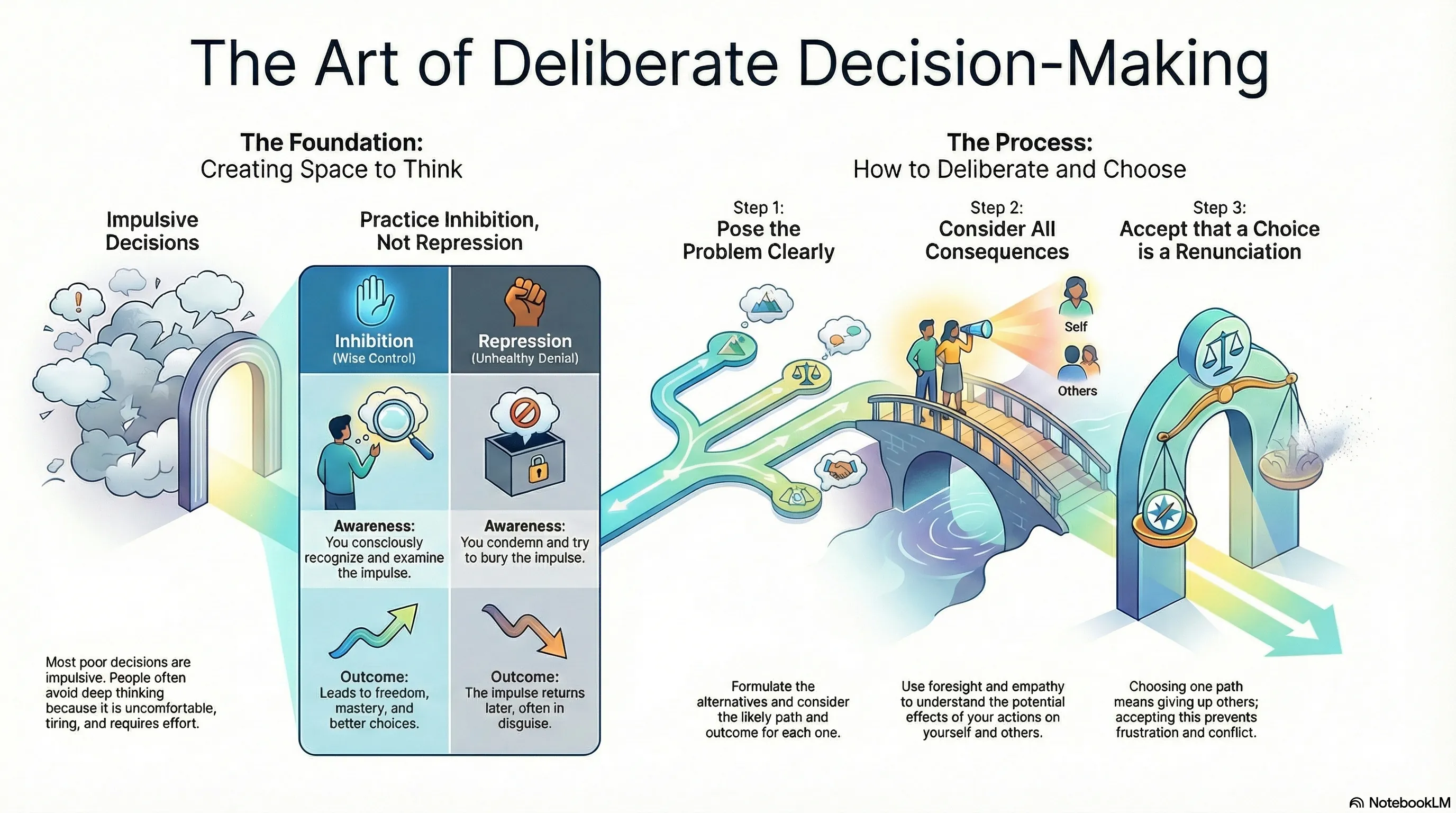
Purpose
Train the learner to make sound decisions by deliberate thinking, willed inhibition (restraint), realistic appraisal of possibilities, and responsible choosing (including renunciation).
Learning Outcomes
By the end of this chapter, you should be able to:
- Explain why deliberation is required for sound decisions and identify the risks of skipping it.
- Distinguish repression from inhibition and describe how inhibition supports deliberation and later stages.
Apply the chapter’s deliberation sequence to a real choice: problem, alternatives, feasibility/timing, consequences. - Add empathic foresight to a decision involving others by anticipating reactions and unintended effects.
- Use a balanced approach to inspiration/intuition: welcome, scrutinize, interpret, and avoid impulsive action.
- Use consultation (with self or others) to improve clarity while maintaining responsibility for the final decision.
Core Insights
Insight 1
Sound decisions require deliberate thinking that examines motives, alternatives, feasibility, timing, and consequences; skipping deliberation produces impulsive, ill-advised action.
- The chapter frames deliberation as necessary because we cannot pursue all urges/goals; we must choose the “most worthwhile” and renounce or postpone others.
- It explicitly warns that decisions “without deliberation” lead to “impulsive, unconsidered, and ill-advised action,” often causing damaging blunders.
- You slow down long enough to pose the problem plainly, formulate alternatives, and consider likely outcomes (including long-term effects).
- You treat “thinking properly” (concentration, reflection, meditation) as a practical prerequisite for deciding well.
Insight 2
Deliberation depends on a willed act of inhibition (restraint) that holds impulses in abeyance; this differs from repression and is needed across all stages of willing.
- The chapter states that to have the “space needed to think” we must inhibit drives toward immediate action; it presents inhibition as the prerequisite for deliberation.
- It distinguishes inhibition (conscious control while deciding what to do) from repression (condemning/denying and pushing impulses into the unconscious).
- You practice “holding back” as a temporary check that creates freedom and mastery, rather than trying to obliterate impulses.
- You deliberately use inhibition both before action (to deliberate) and during later stages (to stay aligned with the chosen aim).
Insight 3
Good decisions require balanced discrimination: welcome higher promptings (inspiration/intuition) and also scrutinize them; consult others without surrendering responsibility.
- The chapter says inspirations should be welcomed but not followed without careful scrutiny; genuine intuitions can still be misinterpreted and executed wrongly without mental development and self-control.
- It presents consulting others as helpful (objectifying the problem, widening viewpoints, reducing emotion), but warns against evading responsibility and being swayed by prestige/authority.
- You apply inhibition to intuitive urges: pause, examine source/quality, test advisability, avoid both impulsive action and “excessively critical” stifling.
- You use consultation as a method to improve thinking and information, while retaining responsibility for the final decision.
Key Quotes
“A decision reached without deliberation, without examining and evaluating all aspects of the question or choice that confronts us, can lead to impulsive, unconsidered, and ill-advised action.”
“To repress an impulse is to condemn it, to try to obliterate it or to ‘bottle it up’ in the unconscious and pretend that it doesn’t exist… Inhibition, on the other hand, consists in resolutely holding back an impulse or tendency while deliberating on how best to deal with it.”
“Do not let yourself be drawn immediately into action, but by an act of will exercise the inhibition that will give time for a thorough examination of the inspiration and for determining whether it is genuine and its adoption advisable.”
Key Concepts
Deliberation: The considered examination of goals/alternatives and relevant factors in order to reach the best possible decision.
Impulsive action: Acting without prior deliberation and evaluation of consequences; tends to be unconsidered and ill-advised.
Thinking properly: Sustained reflective mental work (concentration, reflection, meditation) needed to evaluate and decide soundly.
Inhibition (willed restraint): A deliberate holding back of impulses/drives to create the space for deliberation and to support chosen aims.
Repression: Condemning/denying an impulse and pushing it into the unconscious as if it does not exist; it tends to return later.
Conscious control: Recognizing an impulse, examining it, and directing/transmuting/expressing it appropriately rather than denying it.
Unconscious motives: Motives not initially in awareness that should be brought to light and examined as part of deliberation.
Foresight: Considering not only immediate effects but also long-term consequences of proposed actions.
Psychological discrimination: Careful discernment about motives, influences, and likely reactions/effects, especially involving others.
Empathy: Entering imaginatively into another’s standpoint to anticipate how words/acts may affect them.
Inspiration / intuition: Promptings/illuminations that may arise from the higher unconscious (superconscious), but require scrutiny and correct interpretation.
Superconscious (higher unconscious): A higher level of unconscious processes from which inspirations and altruistic/creative impulses may emerge.
Consulting the Higher Self: A deliberation aid consisting of asking (aloud, silently, or in writing) for inner guidance and awaiting an answer “from the highest part of us.”
Consulting with others: Seeking another’s help to clarify, reframe, and cool emotion; useful but risky if used to avoid responsibility.
Counseling / consultant: A consultative role that helps clarify the problem, widen viewpoints, foresee consequences, and interpret inner indications without “pontificating.”
Renunciation / sacrifice (in choosing): The necessary discarding of alternatives implied by preference; often resisted but unavoidable in real choice.
Check Your Understanding
- In one paragraph, define deliberation and list the minimum elements it must include .
- Give a concrete example that shows the difference between repression and inhibition.
- When an “inspiration” urges immediate action, what two opposite errors does the chapter warn against, and what is the recommended middle way?
- Name two benefits of consulting others and two risks if it is used poorly.
- Why does choosing necessarily involve renunciation, and what training method does the chapter propose to build this capacity?
Reflection Questions
Choose one of the prompts below. Read through it and think about how it relates to your life or experiences. Spend some time writing about it in your journal or notebook.
- Where do you most often skip deliberation—because of discomfort, fatigue, or conflict with inclinations—and what would a deliberate inhibition step look like there?
- In a decision you regret, which was missing: explicit alternatives, feasibility/timing realism, consequences foresight, or empathic imagination?
- When you “consult” others, do you gain clarity and responsibility—or do you drift toward leaning on prestige/authority? What evidence shows which is happening?
- Do you tend more toward impulsiveness or indecision in this chapter’s sense, and which practice (calm deliberation vs seizing the right moment) is the corrective?
- What choice are you refusing because you resist renunciation—and what is the real cost of that refusal (frustration, inner conflict, lost opportunity)?
Exercises
Micro-Choice Reps (low-stakes training)
Grounding (30–45 sec)
Sit comfortably. Take 2 slow breaths. Let your attention settle on one simple question: “What will I choose, on purpose?”
Steps (5–8 min)
- Pick one trivial choice you will make today (or tomorrow): route, meal option, order of tasks, which shop, which message to send first.
- Write 2–4 concrete alternatives (real options you could actually take).
- For each alternative, write one consequence (even small): time, effort, comfort, cost, effect on someone else.
- Choose one option and write: “I choose X; I give up Y.” (name at least one relinquished option).
- Take the chosen action as soon as practical (or schedule it with a specific time).
Success criteria
- You explicitly named an alternative you relinquished.
- The choice was made deliberately (not drifting into it).
“Worth the Effort” Means-Willing (cheerful renunciation)
Grounding (45 sec)
Get comfortable. Take 2 breaths. On the exhale, relax your jaw/shoulders. Bring to mind one aim you already value.
Steps (6–10 min)
- Write one valued aim in a single line (keep it modest and real).
- List 3 means required to pursue it (at least one should be mildly unpleasant or inconvenient).
- Circle one mean you are most likely to resist.
- Write the associated renunciation in plain terms: “If I do this, I give up ___ (time/comfort/another option).”
- Now write and repeat three times (silently or aloud): “It is worth the effort.”
- Immediately choose a tiny first step of that mean (2–5 minutes) and do it now (or set a specific time today).
- After doing it, write one line: “How did it feel to renounce ___?” and one line: “What changed after the first step?”
Success criteria
- You named the unpleasant mean and the renunciation it implies.
- You took a real first step while holding the affirmation.
Consulting the Higher Self (question → silence → capture)
Grounding (1 min)
Sit quietly. 2 slow breaths. Let your attention become still. Choose a tone of inquiry rather than urgency.
Steps (8–12 min)
- Pick one decision you’re genuinely unsure about (not trivial, not overwhelming).
- Write the question in one sentence, ending with a question mark.
- Ask for guidance in one of these ways (choose one):
- Aloud: speak the question once, slowly.
- Silently: repeat it once internally.
- In writing: write it at the top of a page and underline it.
- Sit in inner silence for 2–4 minutes. No forcing. If thoughts arise, let them pass and return to quiet.
- Then write whatever comes as an “answer,” without editing, for 3 minutes:
- a phrase, image, next step, warning, clarification, or a reframe of the question.
- Add one deliberate check line: “What would be the next small action if this is right?”
- Choose one small action (or one piece of information to gather) and note when you will do it.
Success criteria
- You captured a response in writing (even if it’s partial or indirect).
- You translated it into a next step (action or information-gathering), rather than treating it as a vague feeling.
Deliberation Table
Grounding (30–45 sec)
Sit comfortably. Take 2 slow breaths. Let your attention settle on one decision you’ve been postponing. Say silently: “For a few minutes, I will examine—then decide.”
Steps (7–10 min)
- Write the decision as a plain question (one sentence).
- List 3 options: either 3 different goals, or 3 ways to realize one goal.
- For each option, fill these prompts (short bullet notes are fine):
- Desirability: what attracts you to it (1–2 points).
- Consequences: likely immediate effects + likely longer-term effects (at least one of each).
- Feasibility & timing: is it realistically doable now; if not, when?
- Other relevant factors: anything you can “keep in mind and examine” (e.g., needed cooperation, risks, information gaps).
- Circle the option that looks most preferable overall based on what you wrote.
- Write one final line: “My preferable option is ___ because ___.”
Success criteria
- Each option has at least one immediate and one longer-term consequence noted.
- Your choice is justified by factors you examined (not just the strongest urge).
Choice as Discarding
Grounding (30–45 sec)
Get comfortable. Take 2 breaths. On the exhale, relax your shoulders. Bring to mind the option you marked as preferable. Say silently: “To choose is to set aside.”
Steps (5–8 min)
- Write your chosen aim in one sentence: “I choose ___.”
- Write what you will explicitly set aside (name at least 2 items if possible):
- “I set aside/discard ___.”
- “I set aside/discard ___.”
- For each discarded option, write one sentence on the cost of not choosing it (what you lose, postpone, or miss out on).
- Write one sentence that acknowledges the trade cleanly:
- “I accept this renunciation in order to pursue ___.”
- “I accept this renunciation in order to pursue ___.”
- Optional (if you feel resistance): write once, then repeat once: “It is worth the effort.”
Success criteria
- You named what you are discarding (not vaguely).
- You can state a real cost of not choosing the other options without arguing with it.
Review & Practice: Chapter 13: Deliberation, Choice, And Decision
Test your understanding of the core ideas from this chapter and capture your personal reflections. Scored questions provide immediate feedback; reflections are stored privately on your device.
In this chapter, what does “deliberation” mainly mean?
Which contrast best matches the chapter’s meaning of inhibition vs repression?
Inhibition is described as a separate stage of the will.
Which option best corrects a common misunderstanding from this chapter?
Scenario: You feel a strong urge to send an angry message after a misunderstanding. You notice your body is tense and you want to hit “send” immediately. What best fits the chapter’s emphasis?
Complete the following statement by filling in the missing term(s):
Which option best states what this chapter is trying to do?
Which option best summarises the chapter’s main contribution?
“Not deciding” can function as a decision, and it may be the worst option in some situations.
Describe a small decision you could make today using “pause → consider two options → choose,” and name one consequence you would check before acting.