
Chapter 14: Affirmation
Purpose
Explain why affirmation is the pivotal “activating” moment after decision, and teach practical techniques for making affirmation effective without common misuses.
Learning Outcomes
By the end of this chapter, you should be able to:
- Explain why affirmation is necessary after decision and what fails without it.
Distinguish faith, conviction, and certainty, and describe their role in effective affirmation. - Create a concise verbal affirmation (“words of power”) that is clear, exact, and aligned with an intended objective.
- Select and apply at least one additional affirmation technique (image or physical attitude) while keeping the underlying purpose in mind.
- Design and run a short repetition plan (time-based, interval-based, or varied-form) and evaluate which form seems more effective for the aim.
- Identify at least two caution points (motive-check, calm manner, impatience/contrary effects, inner distance) and apply them in practice.
Core Insights
Insight 1
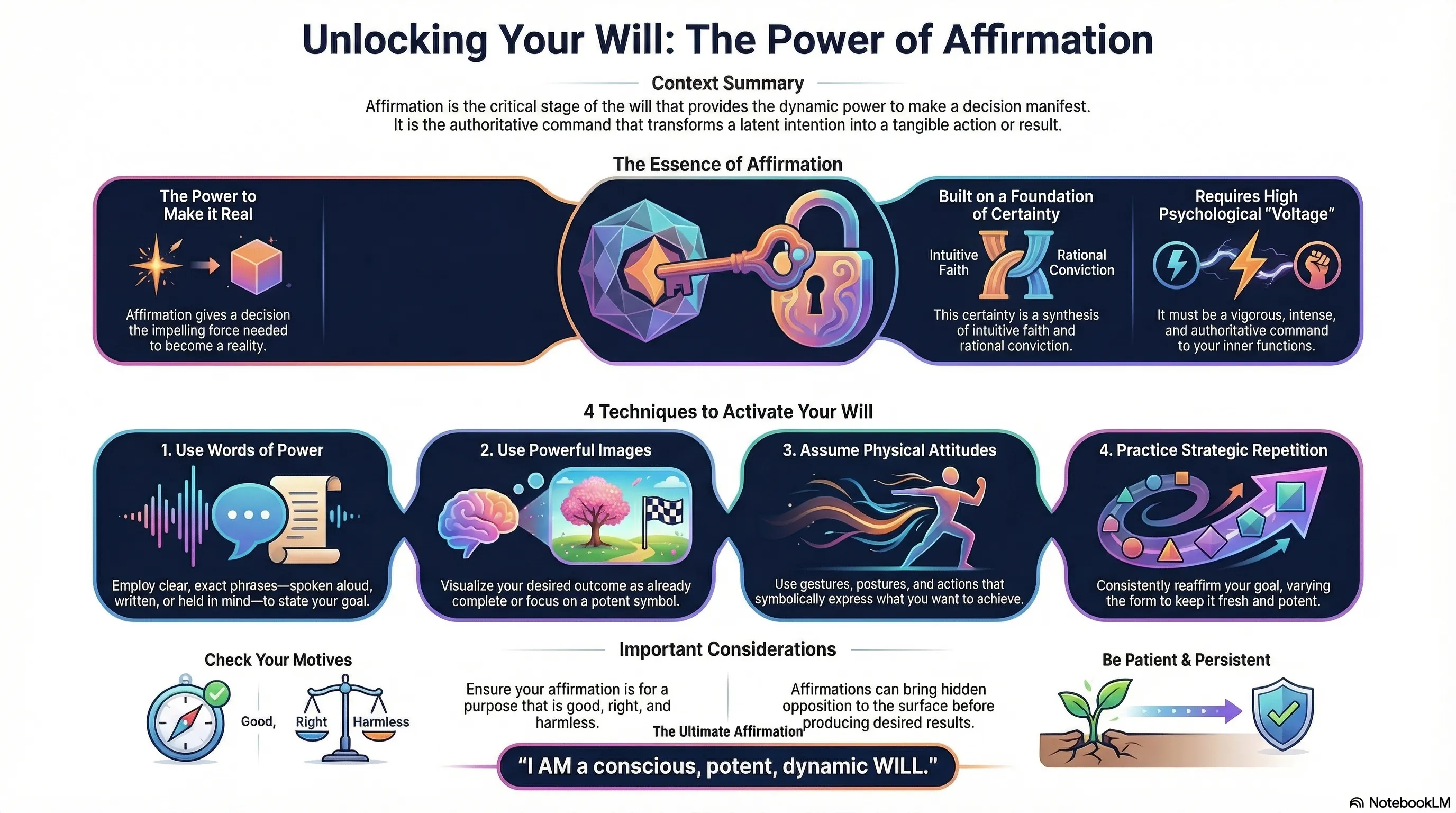
After deliberation and decision, an explicit affirmation is required; without it the decision stays inert and lacks driving power.
- The chapter calls affirmation “pivotal” and says it is an essential “moment” because otherwise “the decision remains latent, lacking a dynamic impelling power.”
- It frames affirmation as the first step of the “phase of achievement,” bridging decision to manifestation.
- You treat “I decided” as incomplete until you add a commanded affirmation that carries potency/energy.
- You look for failures in intermediate actions as stage-specific weaknesses, including weak or absent affirmation.
Insight 2
Effective affirmation depends on inner certainty—formed by faith and conviction—and must be vigorous (high “psychological voltage”) expressed as an authoritative command.
- The chapter defines volitional affirmation as a “state of mind” of certainty arising from the synthesis of faith (intuitive) and conviction (mental).
- It states affirmation must be “vigorous,” likened to high psychological “voltage,” and function as a command “given with authority,” especially directed inwardly to the energies/functions needed for the purpose.
- You distinguish mere wishing or mental agreement from an authoritative inner command backed by certainty and intensity.
- You use affirmation to mobilize and regulate your own functions (thought, imagination, etc.) toward achievement.
Insight 3
Affirmation can be made effective through specific techniques (words, images, physical attitudes, repetition), but must be used with caution: check motives, avoid provoking opposition, avoid impatience, and maintain “inner distance” from psychological functions.
- The chapter explicitly lists techniques and gives practical guidance on selecting, repeating, varying, and experimenting with them.
- It repeatedly warns about misapplication (wrong motive, aggressive manner, impatience, mechanical repetition) and notes affirmations may first expose “hidden opposing forces.”
- You deliberately choose and test techniques rather than relying on vague resolve.
- You interpret initial “contrary effects” as the surfacing of resistance to be faced and mastered, not as proof the method failed.
Key Quotes
“Affirmation is a pivotal stage in the act of willing. Once the stages of deliberation, choice, and decision have been carried through, there comes the phase of achievement, so that what is willed shall be, happen, or manifest itself. The first step or act of this phase consists in affirmation. Without it, the decision remains latent, lacking a dynamic impelling power. Affirmation is therefore an essential “moment,” or stage, of the will.”
“To be effective, affirmation must be vigorous; it must possess a strong dynamic potential, or intensity. To employ an analogy taken from electricity, this might be called a high psychological ‘voltage.’”
“In the use of the technique of affirmation, all hurry and impatience to see results are to be avoided. Affirmations… can produce at first contrary effects by bringing to light hidden opposing forces.”
Key Concepts
Affirmation: The essential volitional “moment” after decision that activates achievement by supplying impelling power.
Phase of achievement: The phase after deliberation/decision in which what is willed is to “be, happen, or manifest itself,” beginning with affirmation.
Volitional affirmation / affirmative will: Affirmation as an act of will requiring certainty and vigor, functioning as a command.
Certainty: A state of mind required for affirmation, produced by the blend of faith and conviction.
Faith: An intuitive acceptance of a reality “not evident, not manifested,” foundationally including faith in the real Self.
Conviction: A mental certainty reached by reason or by intellectual adherence to an intuition recognized as in harmony with truth.
Dynamic potential / intensity: The energizing potency an affirmation must possess to be effective.
Psychological “voltage”: An analogy for the intensity required in affirmation.
Command (Fiat): Affirmation functioning as a command given with authority.
Authority (inner): Primarily an inner quality/reality that is directly felt/known by the one who exercises it and perceived by those it is directed to.
Words of power: Clear, exact verbal formulas (sometimes a single word) used to make affirmation effective, inwardly or aloud or in writing.
Images (in affirmation): Visualizations or external pictures used to focus affirmation—either the vision of what is wanted as already accomplished or a symbol of what is willed.
Assuming physical attitudes: Gestures or acts that directly or symbolically express what is to be achieved.
Repetition (in affirmation): Reaffirming the command (and/or images/acts) many times, in forms chosen according to aim/situation; may require persistence over time.
Inner distance: Addressing commands to psychological functions from “above,” without identifying with them; identifying with the will instead.
Check Your Understanding
- What does affirmation add that a decision alone lacks?
- Define certainty as the chapter defines it, and name its two components.
- Give one example of how to use an image for affirmation and one pitfall the chapter warns about.
- Name three ways to do repetition and why “variations of form” can matter.
- What does “inner distance” mean here, and what does the chapter recommend identifying with instead?
Reflection Questions
Choose one of the prompts below. Read through it and think about how it relates to your life or experiences. Spend some time writing about it in your journal or notebook.
- Where in your own willing do decisions tend to remain “latent,” and what would a genuine affirmation add?
- For your chosen aim, what proportion of your certainty feels like faith vs conviction, and what strengthens each (as described in the chapter)?
- How do you know when your affirmation is a “command given with authority” rather than mere self-suggestion?
- What “contrary effects” or “hidden opposing forces” might be revealed when you affirm—what would it mean to confront and master them?
- What does “inner distance” look like in your case—what function(s) do you most need to command without identifying with?
Exercises
Word of Power
Grounding (45–60 sec)
- Sit comfortably. Loosen your jaw and shoulders.
- Take 2 slow breaths.
- On the second exhale, silently note: “Now I decide.”
- Open your eyes and take a pen.
Steps (5–8 min)
- Pick one intermediate-importance action you’ve already decided to do today (meaningful, but not life-overhaul).
- Write one line: Decision: “Today I will ________.”
- Write a word of power (single word or short phrase) that expresses the decision clearly and exactly.
- Phrase: “________.”
- Choose one mode and do it once: inwardly / aloud / written and observed intently.
- Do it a second time, aiming for:
- certainty (a settled inner “yes”), and
- vigor (dynamic potential; “voltage”).
- Write two quick ratings (0–10):
- Certainty: __/10
- Dynamic potential: __/10
Success criteria
- Your phrase is specific and exact (not vague), and you can report whether it carried certainty and dynamic potential.
Keep the Purpose Present
Grounding (45–60 sec)
- Sit upright, feet on the floor.
- Take 2 slow breaths.
- Briefly recall your chosen decision and your phrase of power (without changing it).
Steps (5–12 min)
Choose one image route:
A) As-if-accomplished image
- Close your eyes for 10–15 seconds and picture the action completed as intended.
B) Symbolic image
- Pick a symbol that represents what you will to realize.
- Write one sentence:
Purpose behind the symbol: “This stands for ________.”
(This is the anchor that prevents drifting into the symbol alone.)
- Use the image in one form:
- Internal: visualize it for 10–15 seconds, or
- External: select any existing picture/drawing and observe it closely for 10–15 seconds.
- Add a physical attitude/gesture/act that expresses the same aim (directly or symbolically). Hold/do it for 10 seconds.
- While holding the attitude, deliver your word of power once (inwardly or aloud).
- Write one line: How the image/gesture expresses the aim: “________.”
Success criteria
- You can state how the image/gesture expresses the aim, and (if symbolic) you can clearly restate the purpose it stands for.
Repetition Without Routine
Grounding (45–60 sec)
- Sit comfortably.
- Take 2 slow breaths.
- Adopt a calm, quiet, nonaggressive tone internally (no forcing).
Steps (5–10 min)
Choose one repetition method for today:
A) Definite times
- Pick 2 moments: ________ and ________ (e.g., on waking / before sleep).
B) Series at intervals
- Choose 3 times within the next few hours: ________, ________, ________.
C) Variations of form
- Write 3 versions that keep the same meaning (not new goals):
- V1: “________”
- V2: “________”
- V3: “________”
- Do a small series right now (3 repetitions total):
- If you chose A or B: repeat the same phrase three times.
- If you chose C: repeat V1, then V2, then V3.
- Check: did it feel alive or start to feel mechanical?
- If mechanical, immediately switch to variations of form (even if you didn’t choose C).
- If you notice impatience or any contrary effect (doubt, irritation, resistance), write one line:
- “Opposition noticed: ________. I will not hurry; I will let this come to light.”
- Write a one-sentence takeaway:
- What I learned about repetition today: “________.”
Success criteria
- You can name the method you used and one concrete thing you learned about its effectiveness (and you adjusted if it became routine).
Review & Practice: Chapter 14: Affirmation
Test your understanding of the core ideas from this chapter and capture your personal reflections. Scored questions provide immediate feedback; reflections are stored privately on your device.
In this chapter, what is “affirmation”?
Which contrast best matches the chapter’s meaning?
Without affirmation, a decision can remain “latent” and lack an impelling force.
Which option best corrects a common misunderstanding from this chapter?
Scenario: You decided yesterday to start a small task today. This morning you keep drifting to other things. You feel stuck even though the decision is made. What best fits the chapter’s guidance?
Complete the following statement by filling in the missing term(s):
Which option best states what this chapter is trying to do?
Which option best summarises the chapter’s main contribution?
Affirmations should be done with hurry and impatience so results appear quickly.
In 3–5 sentences, describe one small decision that needs affirmation, and give one simple technique you could use (words, image, posture, or repetition).