
Chapter 15: Planning And Programing
Purpose
Teach the rules and phases of planning/programing so willing can move from decision into effective execution without losing the goal.
Learning Outcomes
By the end of this chapter, you should be able to:
- Formulate a goal clearly and produce a short “means-check” rule that keeps tools subordinate to purpose.
- Assess a draft plan for feasibility by identifying required capacities/resources and revising ambitions accordingly.
- Map a goal into the chapter’s planning phases (formulation → programing → structuring → project → pilot project) with one concrete output per phase.
- Apply “trifocal vision” to a current program by writing the distant purpose, intermediate stages, and next step in one page.
- Identify where flexibility and timing are needed in an ongoing plan and specify what would trigger a revision.
- Describe the conformity–rebellion polarity and state what “transformation” would look like in one real role (family/work/community), while maintaining inner independence.
Core Insights
Insight 1
A plan fails when the goal is not held clearly and continuously, causing “means” to replace “ends,” so will must stay vigilant to keep instruments (technology, money, methods) in their proper place.
- This is “the most important rule”: formulate the goal clearly and “retain it unswervingly in mind throughout all the stages of the execution.”
- It repeats the danger (means becoming ends) across multiple examples and names the required remedy: “a vigilant and energetic will.”
- You periodically re-check whether what you are doing still serves the original purpose, instead of being “enslaved by the means.”
- You select and use means “only” to the extent they “truly serve the intended purpose.”
Insight 2
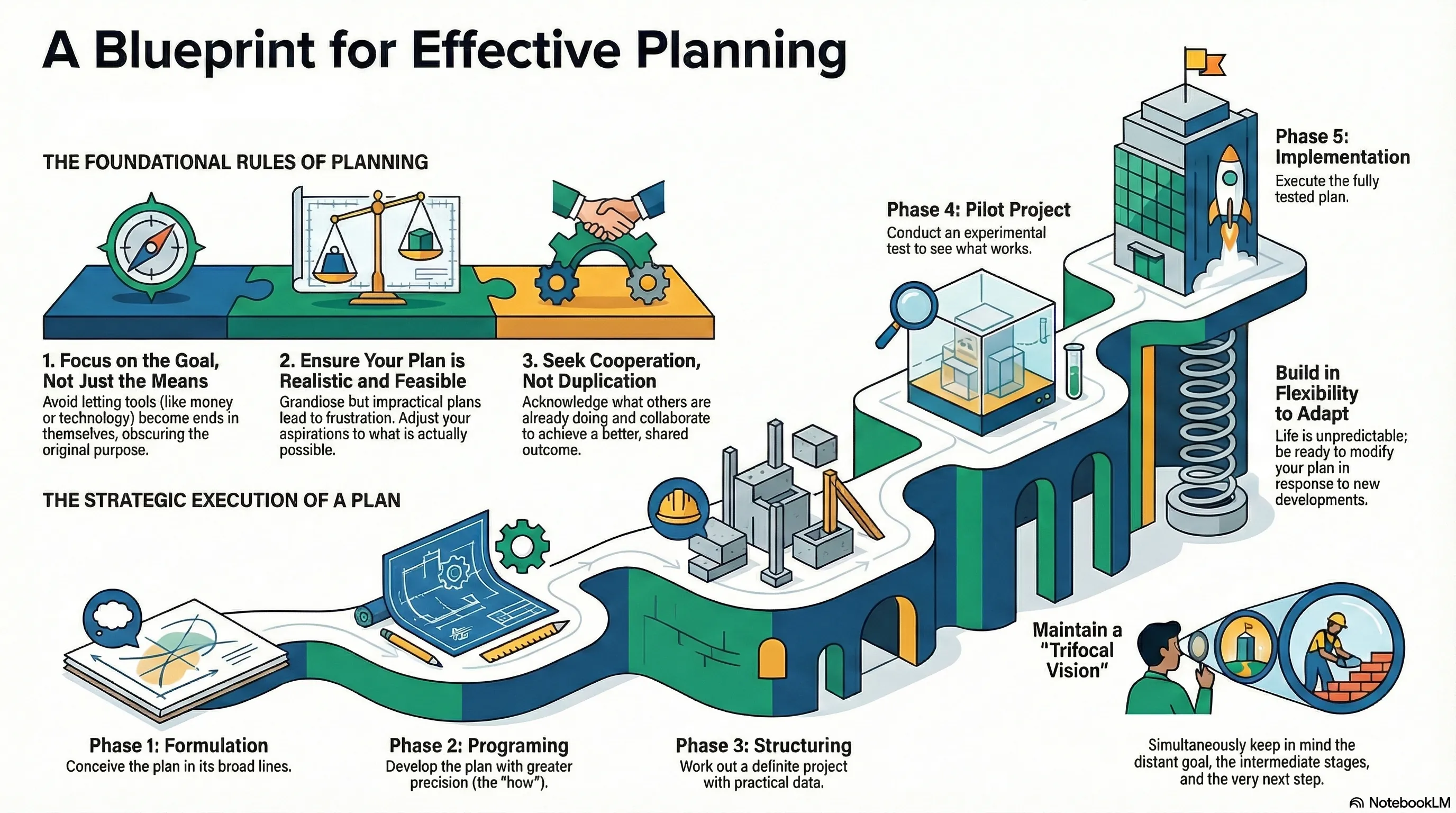
Effective planning requires feasibility, cooperation, and correct sequencing of phases (from broad formulation through programing and structuring to projects and pilot testing), held together by “trifocal vision” (goal, intermediate stages, next step).
- It identifies common planning errors: “grandiose plans” beyond capacities/resources, and duplicating others’ work by refusing cooperation.
- It explicitly lists phases—“formulation; programing; structuring; project-making; model, or pilot project”—and explains their distinctions and function (including pilot projects as tests that teach).
- You scale plans to realistic possibilities and revise ambitions when testing shows they are “too ambitious.”
- You design plans with phase-appropriate detail (broad lines → tactical early steps → concrete project → pilot test), while keeping the whole in view.
Insight 3
Planning is integrative: individual plans must be coordinated with relationships/groups (social psychosynthesis), and at the broadest level the individual plan is “interwoven” with a Universal Plan, requiring inner independence and constructive participation rather than conformity, rebellion, or withdrawal.
Why it’s central (1–2 bullets, grounded in chapter):
- Planning extends from personal life to family/work/community roles, then to “Social Psychosynthesis,” and finally to “integrating the individual plan in the Universal Plan.”
- It presents a specific “triangular relationship” (conformity–rebellion–a higher point of transformation) as the resolution of the individual-versus-society polarity.
- You plan roles and cooperation with others deliberately (affection/goodwill are “not sufficient” for family-as-entity planning).
- You protect “integrity and independence” while acting as “a constructive force for improving” society, using available “inner space” and “temporal space.”
Key Quotes
“The most important rule is to formulate, clearly and precisely, the goal to be reached, and then to retain it unswervingly in mind throughout all the stages of the execution, which are often long and complex.”
“The means ever tend to become ends in themselves, and when this happens, man becomes enslaved by the means he has chosen to employ.”
“It may be said that a ‘trifocal vision’ is required; that is, the perception and retention in mind of the distant goal and purpose; the survey of the intermediate stages which extend from the point of departure to the arrival; and the awareness of the next step to be taken.”
Key Concepts
Planning and programing: Deliberately working out goals, means, phases, timing, and supervision so execution can be effective over time.
Personal life program: A consciously formed plan for one’s life, “primarily in a psychological sense.”
Goal (to be reached): The clearly formulated aim that must remain primary throughout execution.
Means becoming ends: The drift where tools/instruments take over attention and value, displacing the original purpose and enslaving the person.
Instrumental value: The value of a tool (e.g., a machine) as relative to the purpose it serves, not as a purpose itself.
Vigilant and energetic will: The active will required to keep means “in their place” and remain master of them during long/complex execution.
Feasibility: The realistic possibility that a program can be realized given actual capacities, circumstances, and resources.
Grandiose plans: Overly ambitious programs whose magnitude exceeds available resources/capacities and thus invite frustration.
Cooperation (right cooperation): Aligning with and joining others’ existing or parallel work rather than duplicating it to remain central.
Phases of planning: The distinct steps to move from broad conception to tested action.
Formulation: The initial broad conception of a plan in general lines.
Structuring: Arranging steps in a proper order so earlier phases support later ones (e.g., awareness before choice).
Project: A definite working-out of practical data and methods to execute the program.
Pilot project (model): An experimental test of the project intended to check results and instruct by experience.
Trifocal vision: Holding together the distant goal, the intermediate stages, and the next immediate step.
Temporal factor (timing and duration): Implementing each stage at the right time and for the necessary period; recognizing favorable moments for execution.
Flexibility of the plan: The plan’s capacity to be modified when unforeseen developments arise.
Social psychosynthesis: Planning and integrating individual life with roles, groups, and society, treating individual vs society as a polarity needing synthesis.
Transformation (higher point beyond conformity/rebellion): A stance “above” the two poles that allows full independence while being an effective member who acts to improve society.
Check Your Understanding
- In one paragraph, explain how “means” can become “ends,” and name one sign that this shift has happened in a plan.
- Given a goal, list the five phases (as named in the chapter) and write one sentence distinguishing “formulation” from “programming.”
- What is “trifocal vision”? Provide the three elements and show them for a plan you are currently executing.
- Define feasibility in the chapter’s terms and describe what the chapter says you should do when a program is “too ambitious.”
- Using the triangle (conformity–rebellion–higher point), state what the “higher point” represents and how it differs from compromise.
Reflection Questions
Choose one of the prompts below. Read through it and think about how it relates to your life or experiences. Spend some time writing about it in your journal or notebook.
- Where in your current life do you see “means” becoming “ends,” and what would it look like to put the means “in their place”?
- Name one plan you secretly know is “too ambitious.” What specific capacities/resources are missing, and what would a revised, feasible version be?
- What cooperation are you avoiding because you want to be “at the center”? What would humility and “right cooperation” change in outcomes?
- Which phase do you habitually skip (formulation, programming, structuring, project-making, pilot)? What failure does that skipping produce?
- In one role (family/work/community), where do you feel pulled between conformity and rebellion? What would “the point above” (transformative action with independence) be in that role?
- What would it mean, in your own words drawn from the chapter, to “place yourself in the right current” while still keeping “firm control of the rudder”?
Exercises
Goal-and-Means Audit + One Rule
Grounding (30 sec): Sit comfortably. Take 2 slow breaths. Bring to mind one plan you’re currently “in the middle of.”
Steps
- Name the plan in 1 line (work/personal/relational).
- Write the goal clearly and precisely in 1–2 sentences.
- List 3–5 means you’re using (tools, routines, resources, methods).
- For each mean, complete one sentence:
- “Serves the goal by ___” or
- “Has become an end because ___”.
- Write one “vigilance rule” you’ll repeat during execution (e.g., a weekly 2-minute check: “Is this still serving the goal?”).
Success criteria
- Your goal is specific enough that each mean can be judged as serving it or displacing it.
- You either reaffirm at least one mean as strictly instrumental or limit/change at least one mean to restore the goal’s primacy.
Phase Map + Pilot Test
Grounding (45 sec): Close your eyes briefly and picture the distant goal as if it were already achieved. Open your eyes and write the goal in one clear sentence.
Steps
- Choose one goal you want to implement over the next weeks/months.
- Draft the five phases as distinct outputs (not rewordings):
- Formulation: the broad lines (what you’re trying to do, at a high level).
- Programing: concrete early steps and their sequence.
- Structuring: why the order is correct (what must come first, second, third).
- Project-making: practical data/resources/actions required (what must be in place).
Pilot project: a small experiment designed specifically to test assumptions.
- Write:
- “I expect the pilot to show ___.”
“One way results could differ is ___.”
- “I expect the pilot to show ___.”
- Decide what you’ll do if the pilot contradicts expectations: “If ___ happens, I will adjust by ___.”
Success criteria
- Each phase produces a clearly different kind of output.
- The pilot is written as a test that can teach (and potentially change the plan), not as the start of full execution.
Trifocal Vision
Grounding (30 sec): Take 2 breaths. Say silently: “Goal, route, next step.” (Then begin.)
Steps
- On one page, write three headings:
- Distant goal / purpose
- Intermediate stages (route)
- Next step
- Fill them for a real plan you’re executing:
- Distant goal: 1–2 sentences.
- Intermediate stages: 3–7 bullets (major phases from where you are to completion).
- Next step: one action you can take in the next 24–72 hours.
- Add a timing and duration note:
- Which intermediate stage is “due” now?
- How long should it realistically take?
- What would make “now” the wrong time (and what would be the right condition)?
Success criteria
- The next step is actionable and clearly connected to the route and the distant goal.
- You identify at least one timing/duration constraint that affects sequencing (what must happen now vs later, and for how long).
Review & Practice: Chapter 15: Planning And Programing
Test your understanding of the core ideas from this chapter and capture your personal reflections. Scored questions provide immediate feedback; reflections are stored privately on your device.
In this chapter, what is the most important rule of planning?
What does the chapter mean by “means becoming ends”?
A “pilot project” is mainly a small test designed to check a plan in real conditions and learn what needs adjusting.
Which option best corrects a common misunderstanding from this chapter?
Scenario: You start a health goal. Soon you spend most of your time researching apps, buying gear, and comparing routines. You feel busy, but the goal isn’t happening. What best fits the chapter’s emphasis?
Complete the following statement by filling in the missing term(s):
Which option best states what this chapter is trying to do?
Which option best summarises the chapter’s main contribution?
Describe one small goal you could plan for the next week using “trifocal vision” (goal, intermediate stages, next step). Keep it practical and simple.