
Chapter 16: The Direction Of The Execution
Purpose
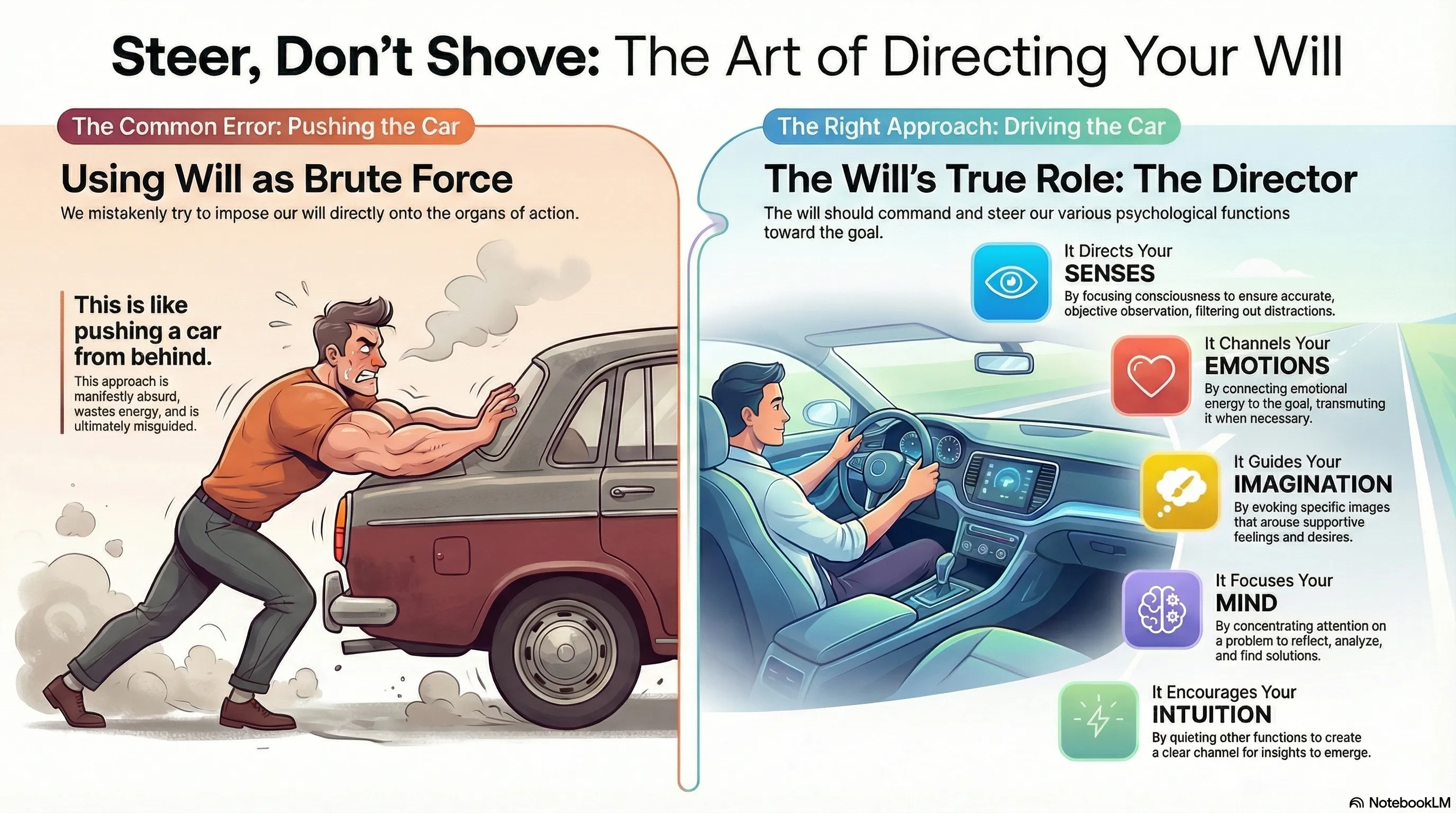
Correct a common misuse of will at the execution stage by defining the will’s proper function as direction—coordinating and supervising the other psychophysical functions that actually carry out action.
Learning Outcomes
By the end of this chapter, you should be able to:
Core Insights
Insight 1
In execution, the will’s proper job is not to force action directly, but to direct and coordinate the functions that produce action.
- The chapter opens by naming a “fundamental error” at the final stage: trying to impose willpower directly on the organs of action.
- It repeatedly frames the will as a director/driver that “takes command of” and guides psychophysical functions toward the objective.
- You shift from “pushing” yourself to selecting and operating the right inner controls (attention, observation, emotional channeling, imagination, thinking) to reach the goal.
- You judge success partly by how well you supervise and adjust the process—not by how much strain you apply.
Insight 2
Skilled execution includes a deliberate shift from full conscious control to delegated (unconscious) control—without becoming rigid; conscious control can be resumed at will.
- The driving analogy distinguishes “automatic” performance from fixed, rigid processes, emphasizing ongoing intelligent adjustment to incoming information.
- The skill-learning example (musical instrument) shows how conscious direction first builds “mechanisms of action,” then frees attention for higher-order quality of execution.
- You train procedures consciously at first, then let them run with supervision—ready to intervene consciously whenever needed.
- You focus conscious attention where it matters most (quality, meaning, expression) rather than micromanaging mechanics once patterns are established.
Insight 3
Directing execution means guiding specific functions—senses, emotions/desires, imagination, mind, and intuition—often by indirect regulation (attention, inhibition, channel-clearing) rather than coercion.
- The chapter walks function-by-function, showing how each contributes to execution and how the will can direct each according to its nature.
- It explicitly warns that direct opposition to intense emotional/impulsive energies often fails or creates wasteful conflict, and that intuition is hindered by coercive will.
- You choose methods based on the function involved: sustained observation for perception, channeling/transmutation for emotions, training imagination, reflective problem-solving for mind, and “channel clearing” for intuition.
- You treat intensity and resistance as variables to manage (sometimes by first reducing tension) before attempting direction toward the goal.
Key Quotes
“An examination of this final stage of volitional action will reveal the fundamental error generally committed in the use of the will, an error based upon a mistaken conception of its nature and way of functioning. This error consists in attempting to act by imposing the power of the will on the organs of action. Instead, the true and natural function of the will at this stage is to direct the execution, to put into operation the necessary and appropriate means for reaching the proposed objective. It does so by taking command of and directing the various psychophysical functions.”
“This subconscious control is usually described as an automatic process. But this is misleading if the term ‘automatic’ is taken to mean something fixed and rigid; on the contrary, in this case we have intelligent action continuously being modified in accordance with information received by sight, hearing, and kinesthetic data. And fully conscious action can be resumed at any moment, at will, if needed.”
“The will must intervene in order to direct, regulate, and use the sensory functions to best advantage.”
Key Concepts
Direction of the execution: The final stage where the will guides, supervises, and adjusts the functioning of the psychological and bodily capacities used to reach the objective.
Imposition of will (on organs of action): The mistaken attempt to act by applying willpower directly to the organs/mechanisms of action rather than directing the means of action.
Psychophysical functions: The combined psychological and bodily functions that the will can “take command of” and direct during execution.
Servicing (preparatory work): Preparation of the “vehicle” for action—getting needed conditions/resources in order before execution.
Subconscious control: Performance guided with reduced conscious intervention after learning, while remaining intelligently adjustable and reversible to conscious control.
“Automatic” (misleading sense): A label often applied to skilled performance; misleading if taken to mean fixed and rigid rather than continuously modified intelligent action.
Delegation to the unconscious: The gradual transfer of responsibility from the conscious “I” to the unconscious in execution, without losing the capacity for conscious resumption.
Mechanisms of action: New learned patterns (e.g., neuromuscular) formed through practice that reduce the need for conscious attention to execution mechanics.
Apperception / apperceived: Sensory perception becoming truly conscious by remaining in the field of consciousness long enough to be assimilated by the conscious “I.”
Field of consciousness: The limited conscious space that can be cluttered by sensations, emotions, thoughts, etc., interfering with accurate perception.
Power of observation: A trained capacity to perceive accurately and objectively, promoted and sustained by the will through observation exercises.
Channeling (emotions/feelings): Orienting emotional energy toward a predetermined goal by connecting feelings to the objective to be reached.
Transmutation / sublimation: Redirecting emotional/drive energies toward constructive and higher objectives, often by engaging them toward future activities.
Ventilating techniques (catharsis): Methods used to discharge excessive emotional/impulsive tension so opposition is reduced and energies can be directed constructively.
Symbolic satisfaction: A means (alongside catharsis and possible gratification) to reduce opposition by satisfying drives/emotions in symbolic form.
Imagination (as intermediary): A function strongly linked with emotions/desires, serving as a necessary intermediary between will and other psychological functions via images.
Reproductive imagination: Imaginative training that reproduces sensory material (visualizations, sounds, and other sensory memories).
Self-directed creative imagination: Creative imaginative work initiated from a symbol or selected situation, directed by the subject’s will rather than a therapist.
Deep thinking / reflective meditation: Sustained reflective use of mind to solve a problem: focus, examine, reflect, form hypotheses, and test them.
Intuition (indirectly supported by will): A mental function the will cannot control directly and may hamper, but can support indirectly by keeping a clear channel and posing precise questions.
Check Your Understanding
- In one paragraph, explain the “fundamental error” this chapter targets and restate the will’s proper role in Stage 6.
- Using the driving analogy, explain why “automatic” is a misleading term if taken as rigid and what correct meaning the chapter gives it.
- If a goal is blocked by strong emotional rebellion, what should the will do first—and why?
Reflection Questions
Choose one of the prompts below. Read through it and think about how it relates to your life or experiences. Spend some time writing about it in your journal or notebook.
- Where do you most often confuse “direction” with “imposition” in execution—and what would change if you treated the will as a director instead?
- What parts of your current work would benefit from delegation to the unconscious, and what supervision would prevent rigidity or drift?
- In what situations do your emotions most distort perception or decision during execution, and how could you keep observation objective?
- When you seek intuitive input, do you tend to coerce it or clear a channel and ask precise questions? What evidence do you have from your experience of time-lag answers?
Exercises
The Director’s Switch
Grounding (30–45 sec): Sit comfortably. Take 2 slow breaths. Silently say: “In execution, I direct.”
Steps (5–7 min):
- Pick one goal you’re already executing this week.
- Write one sentence: “If I push, I tend to…”
- Draw a line underneath and write: “If I direct, I will…”
- Make a Direction menu with 3 items (choose any three): senses, emotions, imagination, mind, intuition.
- For each chosen function, write one directive sentence starting with a verb:
- Senses: “I will keep attention on… and temporarily ignore…”
- Emotions: “I will channel feeling X toward…”
- Imagination: “I will evoke an image of… to support…”
- Mind: “I will think through… / test one hypothesis: …”
- Intuition: “I will pose one precise question: … and clear distractions for 1 minute.”
Success criteria: You produce a 3-item direction plan (function → directive) and can state the “push vs direct” difference in your own words.
Delegation Ladder
Grounding (30–45 sec): Take 2 breaths. Recall a task you can do “on autopilot” sometimes. Notice it can still be adjusted.
Steps (5–10 min):
- Choose one skill/task you’re learning or can do competently.
- Make three headings:
- Conscious control (now): what needs full attention?
- Delegated control (later): what can run with less conscious intervention?
- Supervision: what cues tell you to adjust course?
- Add a Resume trigger: write one clear “If X happens, I return to full conscious control” rule.
- Write one sentence completing: “My ‘automatic’ performance is not rigid because…”
Success criteria: You clearly separate conscious vs delegated elements and define a specific resume trigger plus a non-rigid “automatic” sentence.
Apperception Narrow-Beam
Grounding (30–45 sec): Take 2 breaths. Let your attention settle on one sensory channel (sight, hearing, touch).
Steps (5–8 min):
- Pick a brief observation task that matters (e.g., reading a paragraph carefully, checking a detail, inspecting an object).
- For 2 minutes, hold attention on the sensory data needed for the task.
On paper, list at least two intrusions that crowd the field of consciousness (other sensations, emotions, thoughts). - For each intrusion, write a temporary refusal statement:
- “For the next 2 minutes, I will not acknowledge ___.”
- Finish with one line: “What I actually observed (objective details) was…”
Success criteria: You name at least two interfering contents and write specific refusal statements that helped you keep the observation objective.
Exercise 4: Emotional Energy Re-Route
Grounding (45–60 sec): Take 3 slow breaths. Name the emotion/drive you’re working with (one word). Note its intensity.
Steps (8–15 min):
- Choose one execution situation where emotion/drive is helping or hindering.
- Rate intensity: low / medium / excessive (based on introspection + spontaneous signs).
- If low/medium: write a 3-line channeling plan:
- “This emotion is energy for…”
- “I connect it to the goal by…”
- “I direct it into the next action: …”
- If excessive: pick ONE first-step method to reduce opposition and write what you will do:
- Ventilating/catharsis: “I will discharge tension by…”
- Symbolic satisfaction: “I will give symbolic expression by…”
- Appropriate gratification (measure): “I will allow a limited, chosen gratification by…”
Then write how you will redirect the energy toward the goal.
- Add one sentence: “The resistance is ___; my will’s energy relative to it is ___; one experiment I will try is ___.”
Success criteria: Your plan follows the rule: don’t oppose excessive intensity directly—reduce tension first, then direct the energy toward the chosen aim.
Review & Practice: Chapter 16: The Direction Of The Execution
Test your understanding of the core ideas from this chapter and capture your personal reflections. Scored questions provide immediate feedback; reflections are stored privately on your device.
In this chapter, what does “direction of the execution” mean?
Which contrast best matches the chapter’s main correction?
In skilled performance, the process can become more “automatic,” but it remains flexible and can return to full conscious control when needed.
Which option best corrects a common misunderstanding from this chapter?
Scenario: You sit down to write a short email. You feel distracted and slightly irritated. You try to “power through” by tensing up and pushing yourself, but you keep stopping and scrolling. What best fits the chapter’s approach?
Complete the following statement by filling in the missing term(s):
Which option best states what this chapter is trying to do?
Which option best summarises the chapter’s main contribution?
Think of a small task you often “force” (e.g., starting work, tidying, making a call). In 3–5 sentences, describe how you could “steer” the execution instead—what would you direct first?