
Chapter 17: The Joyous Will
Purpose
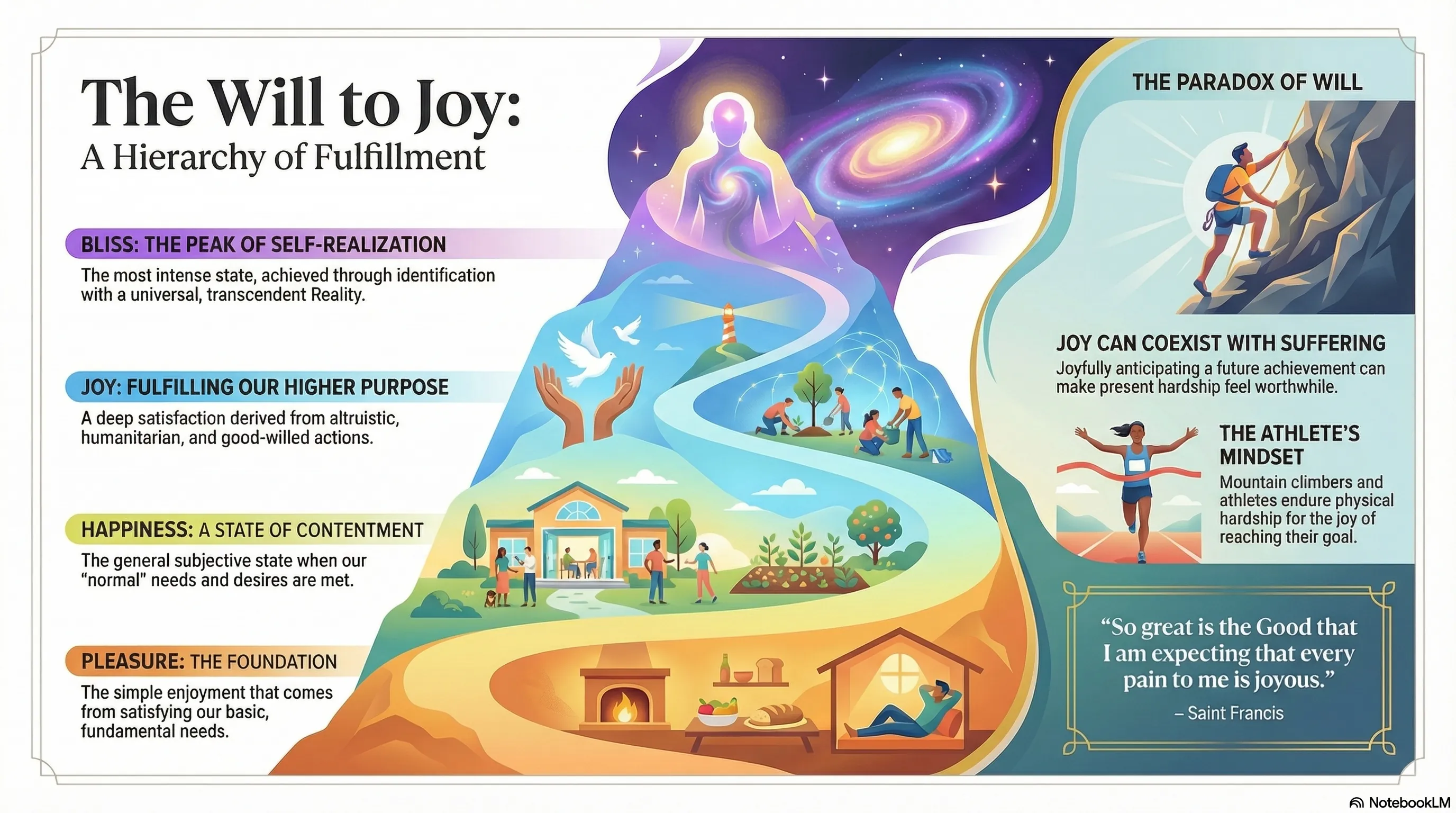
Clarify what “joy” means in relation to willing, and argue that successful willing is intrinsically joyous across multiple levels of human needs.
Learning Outcomes
By the end of this chapter, you should be able to:
- Distinguish (in writing) pleasure, happiness, joy, and bliss as used in this chapter and link each to the needs-level it corresponds to.
- Explain the chapter’s argument for why successful willing is essentially joyous.
- Identify how joy can coexist with suffering via subpersonalities or different “levels.”
- Describe one instance where anticipation of a willed achievement produced joy amid difficulty, using the chapter’s language.
- Map one chosen act of good will to the kinds of enjoyment the chapter associates with it.
Core Insights
Insight 1
The act of willing is essentially joyous because successful willing satisfies needs, and need-satisfaction produces corresponding forms of enjoyment.
- The chapter explicitly defines enjoyment as the result of satisfying any need, then concludes from this that willing is essentially joyous.
- The argument depends on the need → enjoyment mapping as the bridge between willing and joy.
- You evaluate willing not only as effort/discipline but as a pathway to enjoyment through need-fulfillment.
- You treat joy as a legitimate concomitant of willing—even when willing involves hardship.
Insight 2
“Enjoyment” has distinguishable forms (pleasure, happiness, joy, bliss) corresponding to different levels of needs, and higher enjoyment does not fundamentally exclude enjoyment at other levels.
- The chapter’s “preliminary clarification” is organized around distinguishing types of enjoyment by needs-level.
- It explicitly states there is no fundamental incompatibility between satisfying needs at all these levels.
- You stop treating joy (higher needs) as requiring rejection of pleasure/happiness (basic/normal needs).
- You interpret conflicts as “temporary stages” in growth rather than proof that joy and suffering cannot coexist.
Insight 3
Joy can coexist with suffering because different “levels” and subpersonalities in a person can experience different feelings at the same time; anticipation of a willed achievement can generate joy even amid pain.
- The chapter explicitly explains coexistence (joy in mastering a subpersonality while the subpersonality experiences pain).
- It gives the anticipation mechanism (joyous prospect of intended achievement outweighing hardships) as a concrete example.
- You don’t treat pain during willing as evidence that willing cannot be joyous.
- You use anticipated achievement (the “intended” willed outcome) as a source of joy during demanding execution.
Key Quotes
“Yet the ‘act of willing’ can be and often is intrinsically joyous. In order to realize this, it is necessary to have a clear conception of the nature and the various aspects and manifestations of joy.”
“It would be well worth while to develop a science and technique of ‘enjoyment.’ Maslow hinted at this when, speaking of the Being-values, he said, ‘Why not a technology of joy, of happiness?’ Elsewhere, he lists among the Being-values fun, joy, gaiety, and humor.”
“The result of the fulfillment of the higher needs is joy. The good will is joyous! It creates a harmonious, joyful atmosphere, and acts of good will have rich and sometimes amazing results.”
Key Concepts
Act of willing: The act/process of will in action, understood here as capable of being intrinsically joyous.
Joy of willing: Joy that accompanies and/or results from willing, especially when willing fulfills higher needs.
Enjoyment: The concomitant and result of satisfying a need (any need).
Needs: Levels of human needs (as described by Maslow in the chapter’s framing) whose satisfaction yields corresponding enjoyment.
Pleasure: The result of satisfying basic needs.
Happiness: The general subjective state when “normal” needs and desires are temporarily satisfied.
Higher needs: Needs above basic/normal whose fulfillment yields joy (and, in its fullest form, bliss).
Good will: A will-aspect characterized here by joy, harmonious atmosphere, and deep satisfaction from altruistic/humanitarian activity.
Being-values (Maslow): Values associated (in the chapter’s usage) with “the farther reaches of human nature,” including “fun, joy, gaiety, and humor.”
Technology of joy: The proposed development of a science and technique of enjoyment/joy.
Self-actualization: A growth process mentioned as involving temporary conflicts/crises of adjustment and growth.
Self-Realization: A higher realization discussed as yielding joy; at its fullest transpersonal expression it becomes blissful.
Subpersonalities: Various and often conflicting parts within a person; their multiplicity allows joy at one level to coexist with suffering at another.
Anticipation (of a future willed achievement): Vivid expectation of a future intended achievement that can generate joy even while one feels pain.
Personal self: The level of self at which realization of being a self yields joy (freedom, power, mastery).
Transpersonal Will: Realization/expression linked with intense joy described as blissful; associated with union between personal and Transpersonal Will.
Universal Will: The highest identification described, associated with bliss and union of the individual will with transcendent Reality.
Check Your Understanding
- What is “enjoyment,” and why does that matter for how willing is experienced?
- Give one sentence each defining pleasure, happiness, joy, and bliss as used here.
- How can joy and suffering coexist? Provide one example matching the text.
Reflection Questions
Choose one of the prompts below. Read through it and think about how it relates to your life or experiences. Spend some time writing about it in your journal or notebook.
- Where have you inherited the view of will as “stern… forbidding,” and how does the chapter challenge that view?
- Which kind of enjoyment (pleasure, happiness, joy) do you most often pursue through willing, and what does that suggest about which needs are most active for you?
- Describe a time when “joy at some level” coexisted with suffering at another; what were the “levels” or parts in conflict?
- What does the chapter imply about the relationship between good will and joy in everyday life?
- If “successful willing” is essentially joyous, what would count (in your experience) as a “successful” act of will—and why?
Exercises
Pleasure–Happiness–Joy–Bliss Sorting Grid
Steps
- Draw a 2×2 grid (or four boxes) and label them: Pleasure / Happiness / Joy / Bliss.
- Under each label, write the chapter’s condition in one clean line (basic needs / “normal” needs & desires / higher needs / transpersonal Self-Realization → universal identification).
- Add one example from your life for each box (one sentence).
- Under each example, add a quick tag: “need satisfied = ____” (keep it short).
Success criteria
- Each label is matched to the chapter’s needs-level distinction (no mixing “joy” with basic pleasures, etc.).
- Every example clearly shows a satisfaction/fulfillment consistent with that label and names the need it satisfies.
One Act, Two Feelings (Coexistence Test)
Steps
- Choose one recent act of willing (in progress or completed). Write it as: “I willed ____.”
- Write two lines:
- Need satisfied (level): basic / normal / higher / transpersonal (pick one; if unsure, pick the best fit).
- Enjoyment present: pleasure / happiness / joy (circle one or two).
- Now check for mixed experience: Was there any pain, cost, strain, or disappointment at the same time? (yes/no).
- If yes, explain coexistence using one of the chapter’s mechanisms (one sentence only):
- Different levels (joy at one level, suffering at another), or
- Subpersonality conflict (one part resists while another rejoices), or
- Anticipation (joy from the prospect of intended achievement).
Success criteria
- You produce a coherent need → enjoyment mapping for the act.
- If suffering is present, the explanation uses one chapter mechanism (not generic “mixed emotions” talk).
Intended Achievement → Joyous Prospect (Execution Booster)
Steps
- Pick one current difficulty you’re enduring in order to achieve something (physical, emotional, or practical). Name it plainly.
- Write the intended achievement as a single sentence: “When this is complete, I will have ____.”
- Write the “joyous prospect” as a second sentence that highlights the outweighed hardship:
- “The prospect that makes this worth it is ____.”
- Write one sentence describing the shift right now (if any): “As I hold this prospect in mind, the hardship feels ____.”
Success criteria
- The intended achievement is specific and future-directed (not vague).
- The “joyous prospect” is clearly about the anticipated achievement, not denial or minimization of hardship.
Review & Practice: Chapter 17: The Joyous Will
Test your understanding of the core ideas from this chapter and capture your personal reflections. Scored questions provide immediate feedback; reflections are stored privately on your device.
In this chapter, what does “enjoyment” most closely mean?
Which pairing best fits the chapter’s distinctions?
Enjoyment of higher needs excludes enjoyment of basic needs.
Which option best corrects a common misunderstanding from this chapter?
Scenario: You are training for a long hike. The training sessions are tiring, but you feel energised because you strongly want the future achievement. What best fits the chapter’s meaning / emphasis?
Complete the following statement by filling in the missing term(s):
Which option best states what this chapter is trying to do?
Which option best summarises the chapter’s main contribution?
In 3–5 sentences, describe a small everyday example of “joy in willing” (not just joy after success). Keep it simple and non-personal if you prefer.