Chapter 18: Introduction to the Will Project
Purpose
To frame the book as a beginning and propose a research-and-application programme (“The Will Project”) with an urgent focus on peace through good will.
Learning Outcomes
By the end of this chapter, you should be able to:
- Explain, in the chapter’s terms, why external political agreements alone cannot ensure lasting peace.
- State the proposed effective means for changing inner attitudes and describe what “constant application” implies.
- Summarize the Will Project’s purpose and why the chapter calls the book a “beginning.”
Core Insights
Insight 1
Lasting peace cannot be secured by political agreements alone; it requires changing inner attitudes, and the chapter claims the effective means for that change is the constant application of good will.
- The chapter explicitly contrasts “political agreements and treaties” (insufficient) with “change [of] men’s inner attitude” (necessary) and then names “constant application of good will” as the effective means.
- It calls this application “very important and urgent,” tying it to “peace and war.”
- Shifts effort from relying on external arrangements to deliberately cultivating and expressing good will.
- Treats good will as something to apply continuously and to promote widely (a “campaign… in schools and everywhere”).
Insight 2
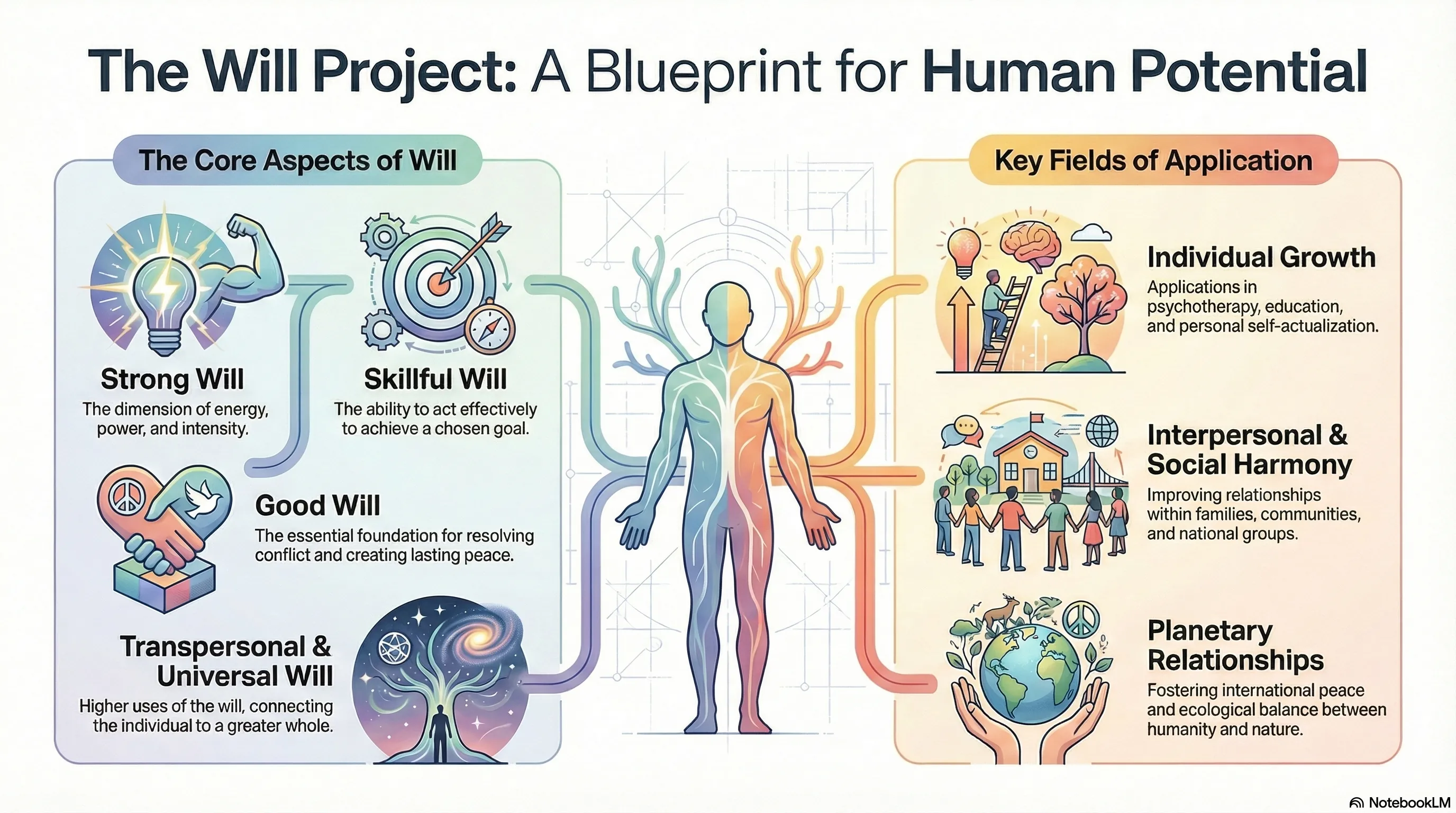
The book is presented as a starting point for a broader, modifiable programme of research, experimentation, and application of the will (the “Will Project”), including collaboration to pool experiences for future work.
- The chapter says the volume is “a beginning” and presents “the following program” as a “preliminary map” that “can be expanded and modified.”
- It describes an “international group” being formed to “pool the responses and experiences” and says this will be used in a planned later book on practical applications.
- Encourages structured exploration (a mapped programme) rather than isolated effort.
- Emphasizes reporting and pooling results (“experimentation… reports of result”) to build a shared body of practical knowledge.
Insight 3
Beyond good will, the chapter states there are “higher uses of the will,” including the Transpersonal Will and unification with the Universal Will, which can further support the achieving of true peace.
- It explicitly introduces these “higher uses” immediately after recommending good will as the strategic method for peace.
- Broadens the motivational horizon of the project beyond social-good campaigns to include transpersonal/universal aims.
- Positions “true peace” as supported by more than one level/use of will.
Key Quotes
“A very important and urgent application of the use of the will is that concerning the great issue of peace and war. In my view, no amount of political agreements and treaties or of external manipulation can by itself ensure a lasting peace. Many such political agreements and treaties have proved futile. As it is stated so aptly in the Preamble to the constitution of UNESCO, ‘Since wars begin in the minds of men, it is in the minds of men that the defenses of peace must be constructed.’”
“The effective means to change men’s inner attitude, both individual and collective, is the constant application of good will. It would have the effect of a magic wand. Expressed and applied, good will automatically excludes violent conflicts and wars. It would be well to realize this strategic point and to make a campaign for good will, in schools and everywhere, a major concern.”
Key Concepts
Inner attitude (individual and collective): The internal stance of people that must be changed to build the “defenses of peace.”
Good will: A will-based attitude the chapter treats as the effective means for changing inner attitude toward peace; to be expressed and applied constantly.
Constant application (of good will): Definition: Continuous expression and practice of good will, presented as strategically decisive for preventing violent conflict.
Campaign for good will: Definition: An organized effort to promote good will widely (“in schools and everywhere”) as a “major concern.”
Check Your Understanding
- In one sentence, what does the chapter say is insufficient for lasting peace, and why?
- What does the chapter name as the effective means to change inner attitude, and what two levels does it apply to?
- What does “preliminary map” mean here, and what two properties does the chapter attribute to the programme (about how it can change)?
Reflection Questions
Choose one of the prompts below. Read through it and think about how it relates to your life or experiences. Spend some time writing about it in your journal or notebook.
- Where in your own life do you rely on “external manipulation” (broadly construed) when the chapter would push you toward inner attitude change?
- What would “constant application of good will” look like in one relationship and in one group context you belong to?
- If you were contributing to the Will Project, what experience could you realistically “report” as a result of experimentation?
- The chapter mentions “higher uses of the will.” What incentive (motivation) does that add for you, according to the chapter’s framing?
Exercises
Questionnaire on the Will
If you’re willing, complete and submit the Questionnaire on the Will (Google Form).
Contribute to The Will Project
Are you willing to get involved with The Will Project? If so, check out the page: Contribute to The Will Project
You can also fill out the survey to help us get to know a little more about learner demographics, whether you’d like to be involved with The Will Project, and if there are ways an online community could help support you.