
Appendix 1: Self-identification Exercise
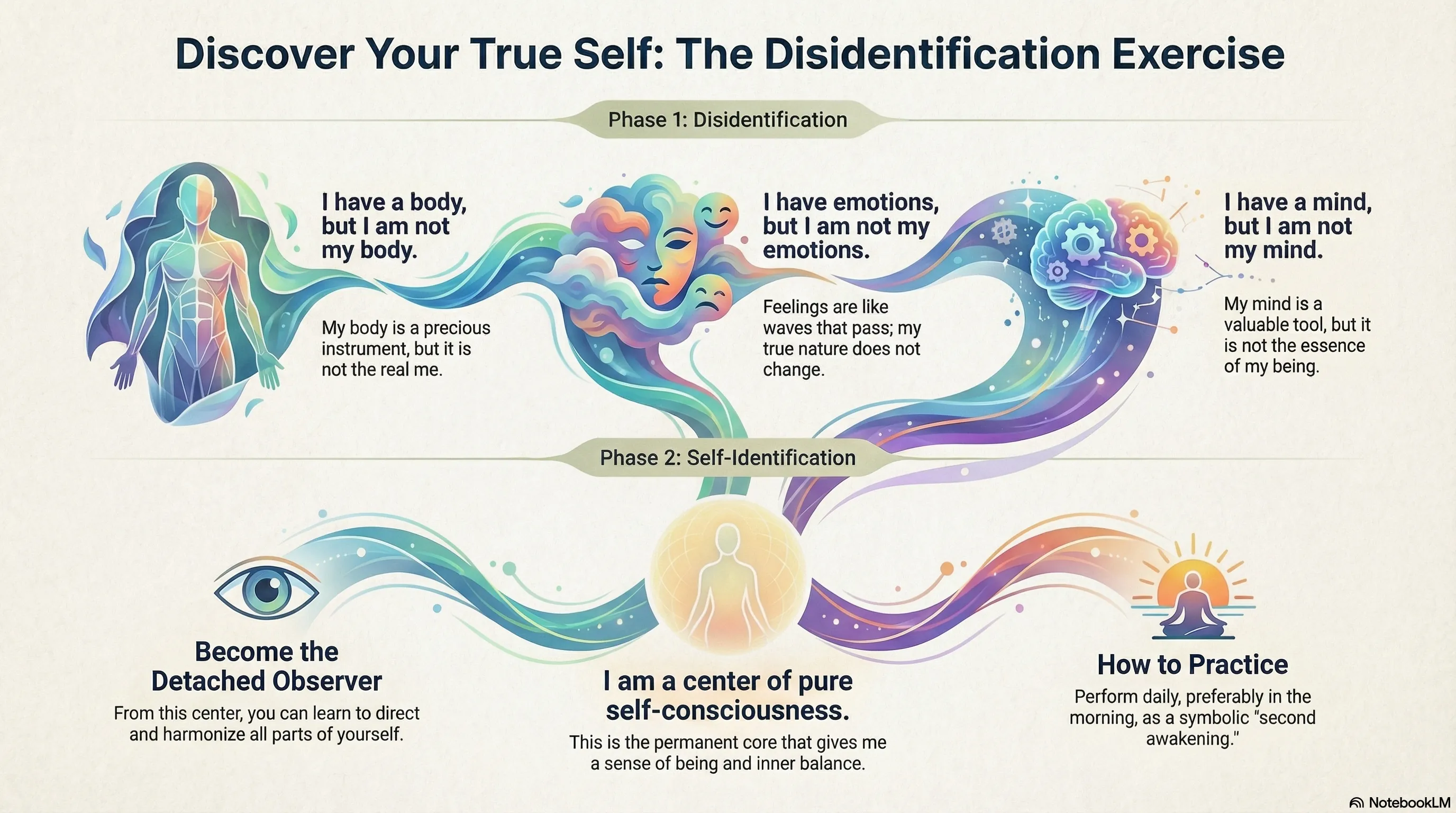
Purpose
Make self-consciousness (“I”) explicit by practicing disidentification from changing contents of consciousness and deliberate self-identification as a center of will.
Learning Outcomes
By the end of this chapter, you should be able to:
- Define identification vs disidentification in the appendix’s terms and give one personal example of each.
- Perform the full self-identification exercise (body/emotion/mind disidentification + identification phase) as written, without skipping stages.
- Use the brief form to disidentify “at will” from a current emotion/thought/role and write a short “detached observer” description of the situation.
- Explain why the appendix says self-consciousness is usually implicit, and how the exercise addresses that.
- Design one conservative modification (e.g., adding “desires” or “roles”) and place it correctly in the sequence.
Core Insights
Insight 1
When you identify with a content of consciousness (body, feelings, thoughts, roles), it dominates you; disidentifying from it restores the ability to dominate, direct, and utilize it.
- The appendix opens with the governing rule: domination follows identification; direction follows disidentification.
- The rationale repeatedly frames disidentification as the first requirement for making self-consciousness clear and vivid.
- You gain “freedom and the power of choice” regarding what you identify with in each situation.
- You can “master, direct, and utilize” multiple elements of the personality in a more inclusive synthesis.
Insight 2
Self-consciousness (the “I”) is usually implicit and distorted because it is mixed with consciousness contents; the exercise makes the “I” explicit by sequential disidentification and then self-identification.
- The text states self-consciousness is generally implicit and “veiled” by contents of consciousness.
- The procedure is explicitly designed to produce the “consciousness of the self” while maintaining the observer standpoint (“the observer is not that which he observes”).
- You learn to hold the “point of view of the observer” while examining body/emotions/mind.
- You explicitly affirm: “I am a center of pure self-consciousness… a center of will, capable of observing, directing, and using” your processes and body.
Insight 3
With practice, the exercise can be condensed and used “at will” in daily life to step out of overpowering states and respond more effectively.
- The appendix instructs abridgment (“swiftly and dynamically”) once the state is grasped.
- It explicitly describes “at will, and at any moment” disidentification from overpowering emotion, annoying thought, or inappropriate role to gain clearer understanding and find the most effective way to deal with it.
- You adopt daily practice (preferably early day; “symbolic second awakening”) and brief repetitions during the day.
- You can add customized disidentification stages (e.g., desires, roles, possessions) according to “purpose and existential needs.”
Key Quotes
“We are dominated by everything with which our self becomes identified. We can dominate, direct, and utilize everything from which we disidentify ourselves.”
“If we are to make self-consciousness explicit, clear, and vivid, we must first disidentify ourselves from the contents of our consciousness.”
“This exercise is intended as a tool for achieving the consciousness of the self… while maintaining the point of view of the observer and recognizing that the observer is not that which he observes.”
Key Concepts
Identification: A state in which the self experiences itself as a particular content of consciousness (e.g., body, feelings, mind, role), resulting in being dominated by it.
Disidentification: Separating the sense of self from contents of consciousness so they can be observed, directed, and utilized.
Self-consciousness: Awareness of the self (“I”) which is usually implicit and becomes clear and vivid through disidentification.
The “I”: The self as a center of pure self-consciousness (and, in the exercise, explicitly linked to will).
Contents of consciousness: The changing experiences that commonly veil self-consciousness (sensations, emotions, thoughts, etc.).
Spurious identifications: Mistaken identifications of the self with consciousness contents rather than with consciousness itself.
Observer (detached observer): The standpoint maintained during the exercise: observing aspects/roles while recognizing the observer is not what is observed.
Instrument: The body (and mind) as a valuable means for experience/action/discovery/expression, but not the self.
Role: A specific but partial identity (mother, husband, teacher, etc.) that one plays and can observe oneself playing.
Disidentified “I” consciousness: The state of self-identification after disidentification, to which one can return briefly during the day.
Self-identification: Affirming identity as a center of pure self-consciousness and will after disidentifying from sensations/emotions/thoughts.
Experiential realization: Treating the central affirmation as an experienced fact in awareness, not merely an idea.
Freedom and power of choice: The capacity to choose identification or disidentification with personality aspects depending on what is appropriate.
Inclusive and harmonious synthesis: Learning to master and utilize all elements/aspects of personality together rather than being confined to one part.
Symbolic second awakening: Practicing shortly after waking as a deliberate re-entry into “I” consciousness.
Check Your Understanding
- In one paragraph, explain why “I have emotions, but I am not my emotions” is not a denial of emotions.
- What is the “central realization” of the identification phase, and what capacity does it claim you have from that center?
- Describe (in 3–5 steps) how you would use the exercise “at will” in the middle of an overpowering emotion or an inappropriate role.
Reflection Questions
Choose one of the prompts below. Read through it and think about how it relates to your life or experiences. Spend some time writing about it in your journal or notebook.
- Which content of consciousness do you most habitually identify with (body, feelings, mind, role), and what drawback from the appendix best matches your experience?
- When you try the “observer” standpoint, what becomes clearer about the situation’s meaning, causes, and the “most effective way” to deal with it?
- What would it look like, in your daily life, to “gain the freedom and the power of choice” about identification in at least one recurring situation?
- If you notice “frantic clinging” to an old identity, what broader identification might be needed?
- How does practicing shortly after waking as a “symbolic second awakening” change your day’s tone of self-identification (if at all)?
Exercises
Self-identification Exercise
Aim to complete at least the short-form version 2 or 3 times during the coming week. Assagioli recommended performing this shortly after waking, as a symbolic second awakening.
- Refer to The Act of Will — Appendix One: Self-identification Exercise for this exercise.
- Alternatively, you can listen to a recorded version online: Disidentification Exercise (playlist)
7-Day “Swift & Dynamic” Disidentification Challenge
Goal (within 1 week): Build the ability to return to disidentified “I” consciousness quickly, using only the central affirmations.
Morning practice
Begin your day with the Self-identification Exercise. Ideally, perform the full exercise, as above. If time doesn’t allow, perform the short version.
Sit or stand comfortably. Take 2 slow breaths.
Say (silently or aloud), slowly but without extra words:
- “I have a body, but I am not my body.”
- “I have emotions, but I am not my emotions.”
- “I have a mind, but I am not my mind.”
Then shift to identification:
- “I am a center of pure self-consciousness and of will.”
Stay with that “I” awareness for 30–60 seconds (no analysis—just remain).
“In-the-moment” Self-identification
Any time you feel unsettled by:
- an overpowering emotion,
- an annoying thought,
- unsettling feelings,
- slipping into an “inappropriate role.”
After the sequence, write (or think internally) one sentence from the detached observer’s standpoint:
- “From here, the most effective way to deal with this is ___.”
Success criteria (end of the week)
- You completed at least 5 daily sessions and several in-the-moment reps.
- At least 3 times, you clearly noticed a shift from being “submerged” in a state to observing it.
- You can name one recurring state (emotion/thought/role) you can now disidentify from more quickly than at the start.
Review & Practice: Appendix 1: Self-identification Exercise
Test your understanding of the core ideas from this chapter and capture your personal reflections. Scored questions provide immediate feedback; reflections are stored privately on your device.
What does “disidentification” mean?
Which contrast best matches the chapter?
The exercise teaches that you should reject or dislike your body, emotions, and mind.
Which option best corrects a common misunderstanding?
Scenario: You feel a surge of irritation during a meeting and your mind starts repeating, “This is pointless.” You still need to respond. What best fits the appendix’s approach?
Complete the following statement by filling in the missing term(s):
Which option best states what this appendix is trying to do?
Which option best summarises the appendix’s main contribution?
The appendix suggests the exercise can be shortened once you understand the purpose, using brief key affirmations.
In 3–5 sentences, describe how you would use the exercise in a mild everyday moment (e.g., feeling tense before a task). Keep it practical and simple.