
Appendix 2: Thinking and Meditation
Purpose
Define meditation precisely, distinguish its three main types, and teach the discipline, preparation, aims, methods, and safeguards needed for effective inner action.
Learning Outcomes
By the end of this chapter, you should be able to:
- Distinguish reflective, receptive, and creative meditation by aim, direction of attention, and typical method.
- Perform the chapter’s triple preparation and explain why it is required for effective meditation.
- Demonstrate reflective meditation by sustaining concentration on a chosen theme, detecting deviations, and extending inquiry beyond initial conclusions.
- Apply at least two methods for achieving inner silence and state when to interrupt practice (somnolence/overstimulation).
- Use registration (immediate writing) and describe how delayed reception and “meditative attitude” are handled.
Core Insights
Insight 1
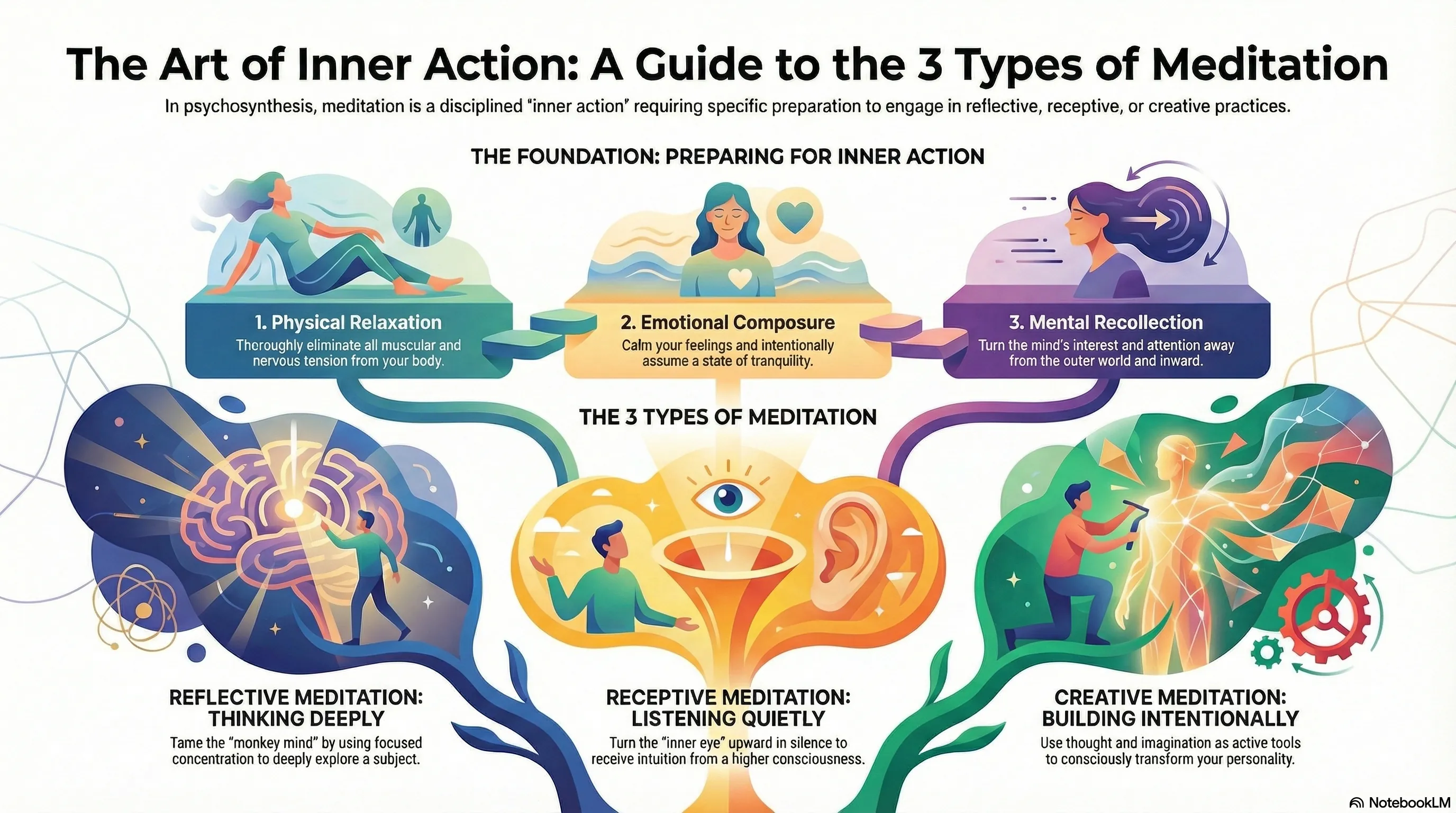
Meditation (in psychosynthesis’ wider sense) is an effective form of “inner action” that requires deliberate preparation (physical, emotional, mental) and disciplined direction of attention.
- The text explicitly says meditation “needs adequate preparation,” and specifies the preparation as physical relaxation, emotional composure, and mental recollection.
It frames meditation as a shift from outwardly monopolized attention to inner action, implying deliberate transition and training.
- You treat meditation as a trained procedure (with prerequisites) rather than a vague “thinking about things.”
- You begin with preparation and concentration instead of “starting from wherever the mind happens to be.”
Insight 2
Reflective meditation is regulated thinking: it depends on concentration and on monitoring deviations, and it corrects common thinking errors (hasty conclusions, one-sidedness, preconceptions) through persistent probing.
- The text distinguishes ordinary spontaneous mental activity from true thinking/meditation, which requires a “dominating interest backed by a firm and decided will” and sustained concentration.
- It specifies two requisites for developing thinking: instant awareness of deviations and persistence/tenacity beyond the point where the subject seems exhausted.
- You evaluate your “thinking” by whether you can hold the mind steadily on a chosen line and detect drift.
- You deliberately push past the “nothing more to say” plateau to uncover “unsuspected aspects.”
Insight 3
Receptive meditation requires silence and careful discrimination; without vigilance it can be distorted by passivity (somnolence) or deceptive “messages” from non-transpersonal sources, so safeguards and clear handling (including recording) are essential.
- The text says inner silence is necessary for reception and warns that receptive meditation “must be vigilantly conducted if damaging effects are to be avoided.”
- It repeatedly emphasizes discrimination: between higher impressions and “hunches,” between “true” transpersonal hearing and psychic voices, and between valid inner replies and misleading contents from unconscious sources.
- You treat receptivity as a disciplined skill with risk-management (interrupting when somnolent; pausing during overstimulation).
- You immediately register impressions in writing and maintain a watchful attitude for delayed reception.
Key Quotes
“The three principal types are: reflective meditation, receptive meditation; creative meditation. Meditation, to be effective, needs adequate preparation. It is a matter of passing from normal life with its outward orientation, in which interest and attention are monopolized by our concerns, plans, and activities, to the ‘inner action’ of meditation. This preparation is triple: physical, emotional, and mental.”
Key Concepts
Meditation (restricted sense): Disciplined thought or reflection on an idea.
Meditation (wider sense, psychosynthesis): A broader set of inner actions for which disciplined thought is a prerequisite.
Reflective meditation: Regulated thinking that explores a subject’s implications and meanings under directed attention.
Receptive meditation: An inwardly silent, upward-directed attention aimed at receiving intuition/inspiration/messages/stimuli from higher levels than ordinary consciousness and mind.
Creative meditation: Inner action used to create/modify forms, including self-creation (transforming personality) through staged constructive use of thought, imagery, feeling, and desire.
Preparation: The preparatory shift into meditation via physical relaxation, emotional composure, and mental recollection.
Physical relaxation: Eliminating muscular and nervous tension as thoroughly as possible.
Emotional composure: Endeavoring to assume tranquility.
Mental recollection: Turning interest and attention inward.
Concentration: The first step in mastery of mind; sustained one-pointed attention enabling regulated thinking and further direction.
Mind as “instrument”: The mind is an inner tool to be used deliberately; control requires disidentification from it.
Psychological distance / detachment: A stance of observing the mind “from a distance” to enable control rather than identification.
Seed-thought: A sentence expressing a thought used as a meditation theme.
Deviation (in thinking): Drift away from the chosen line of reflection that must be noticed immediately.
Silence (receptive meditation): Inner quiet required to allow reception into consciousness by removing what impedes descent.
Somnolence (risk): A heavy/drowsy state that must be resisted because it can become passive and allow unconscious eruptions.
Registration: The phase after reception where clear awareness is reached and maintained, often by immediate writing.
Delayed reception: Receiving inspiration later (during the day/following days) after apparently “dark” meditation, requiring watchful waiting.
Meditative attitude / watchful waiting: Maintaining a receptive inner stance after meditation and sometimes throughout the day.
Double awareness: The trained ability to focus on outer activities while keeping part of attention toward the inner world.
Check Your Understanding
- In one paragraph, differentiate reflective vs receptive meditation using the “mind as inner eye” analogy (horizontal vs upward).
- List the three elements of preparation and give one sentence on what each accomplishes.
- Describe the two requisites for developing the art of thinking and give a concrete example of each.
- Name two risks specific to receptive meditation described in the chapter and the prescribed response to each.
- What is “registration” and why does the chapter recommend writing immediately?
Reflection Questions
Choose one of the prompts below. Read through it and think about how it relates to your life or experiences. Spend some time writing about it in your journal or notebook.
- Where do you most often confuse spontaneous mental activity with real thinking, and what chapter method would correct that?
- Which of the “superficial thinking” habits (hasty conclusions, one-sidedness, preconceptions) shows up most in your reflection, and how will you detect it “instantly” next time?
- In receptive work, what would count (for you) as a warning sign that the content is not “of high origin” as described here, and what safeguard will you apply?
- What does “mind as instrument” require you to do differently when you start meditating (in terms of identification vs use)?
- How could you practice “double awareness” during ordinary activity?
Exercises
A full meditation on the will is given in Appendix Two: Thinking and Meditation. However, if you’re a beginner, you might find it easier to start with the simplified meditations here.
Preparation + Concentration (Do this first)
Purpose: Prepare yourself for the three different types of meditation.
Steps
- Physical relaxation: Release muscular and nervous tension as thoroughly as you can.
- Emotional composure: Intentionally assume a tranquil state.
- Mental recollection: Turn interest and attention inward.
- Concentration: Choose one simple object (short phrase, calm image, or single idea). Hold it for 2–4 minutes.
- Deviation notice: Each time attention wanders, make a brief mark, then return without argument.
Success criteria
- You can name all three preparations in order and you actually did each.
- You noticed at least one deviation in real time and returned.
Reflective Meditation
Purpose: Practice reflective meditation as regulated thinking: directing the mind, catching drift, and going beyond superficial conclusions.
Steps
- Begin with Exercise 1 to prepare.
- Choose a seed-thought: a short sentence you regard as obvious.
- Generate questions in the chapter’s style (aim for 8+), covering:
- What does X mean? (definition)
- What kinds of X exist? (kinds)
- In what ways am I capable/incapable of X? (capability)
- If not, why not? What blocks it? (obstacles)
- What depends on others vs on my own nature? (conditions)
- When you feel “nothing more remains,” persist 3 more minutes to find 2 additional aspects.
- Identify one place you slipped into hurried conclusions, one-sidedness, or preconceptions. Rewrite one conclusion more carefully.
Success criteria
- 8+ real questions and 2 “unsuspected” aspects after the plateau.
- One detected bias/one-sidedness corrected in writing.
Silence Method
Purpose: Train the first requirement of receptive meditation—silence—and apply the chapter’s key safeguard against somnolence.
Steps
- Start with Exercise 1 to prepare.
- Choose one method to cultivate silence:
- Observer attitude: watch the mind patiently until it tires; or
- Repetition: repeat a word/phrase aloud steadily; or
- Calming picture: hold a tranquil image (e.g., tranquil lake, mountaintop, starry sky).
- Monitor what shows up:
- Restlessness/escape attempts, or
- Heaviness/somnolence.
- If somnolence appears, stop immediately and suspend the meditation for a while.
- Write 2–3 lines: method used, what happened, what obstacle appeared.
Success criteria
- You can report the method used and its effect.
- If somnolence appeared, you interrupted and suspended as instructed.
Reception Mediation
Purpose: Practice receptive meditation with disciplined handling: silence, possible reception, immediate registration, and openness to delayed reception.
Steps
- Begin with Exercise 1 to prepare.
- Use your best silence method from Exercise 3 for 2–3 minutes.
- If anything arises, treat it as possible received material in any form described in the chapter (e.g., illumination/clear meaning, intuition/inspiration, brief message with symbolic quality, “contact,” or a stimulus to action).
- Registration: write immediately what was perceived (exact words/images/meaning).
- Set watchful waiting: choose one moment in the next 24 hours when you will check whether anything arrives later.
- Next day, add a short note: what arrived, or “nothing noticed” neutrally.
Success criteria
- Immediate writing captured the impression concretely.
- At least one deliberate check for delayed reception occurred within 24 hours.
Review & Practice: Appendix 2: Thinking and Meditation
Test your understanding of the core ideas from this chapter and capture your personal reflections. Scored questions provide immediate feedback; reflections are stored privately on your device.
In this appendix, what does “meditation” mean in the broader psychosynthesis sense?
Which set names the three principal types of meditation described?
The preparation for meditation is described as physical relaxation, emotional composure, and mental recollection.
Which option best corrects a common misunderstanding about “thinking” in reflective meditation?
Scenario: You sit down to reflect for 10 minutes. After 2 minutes you feel “There’s nothing more to think about,” and you want to stop. What response best fits the chapter’s guidance?
Complete the following statement by filling in the missing term(s):
Which option best states what this appendix is trying to do?
Which option best summarises the chapter’s main contribution?
In receptive meditation, a heavy sleepy state is harmless and should be encouraged to deepen the experience.
In 3–5 sentences, describe the difference between reflective and receptive meditation, and give one simple safety guideline mentioned for receptive practice.