
Appendix 5: Differential Psychology
Purpose
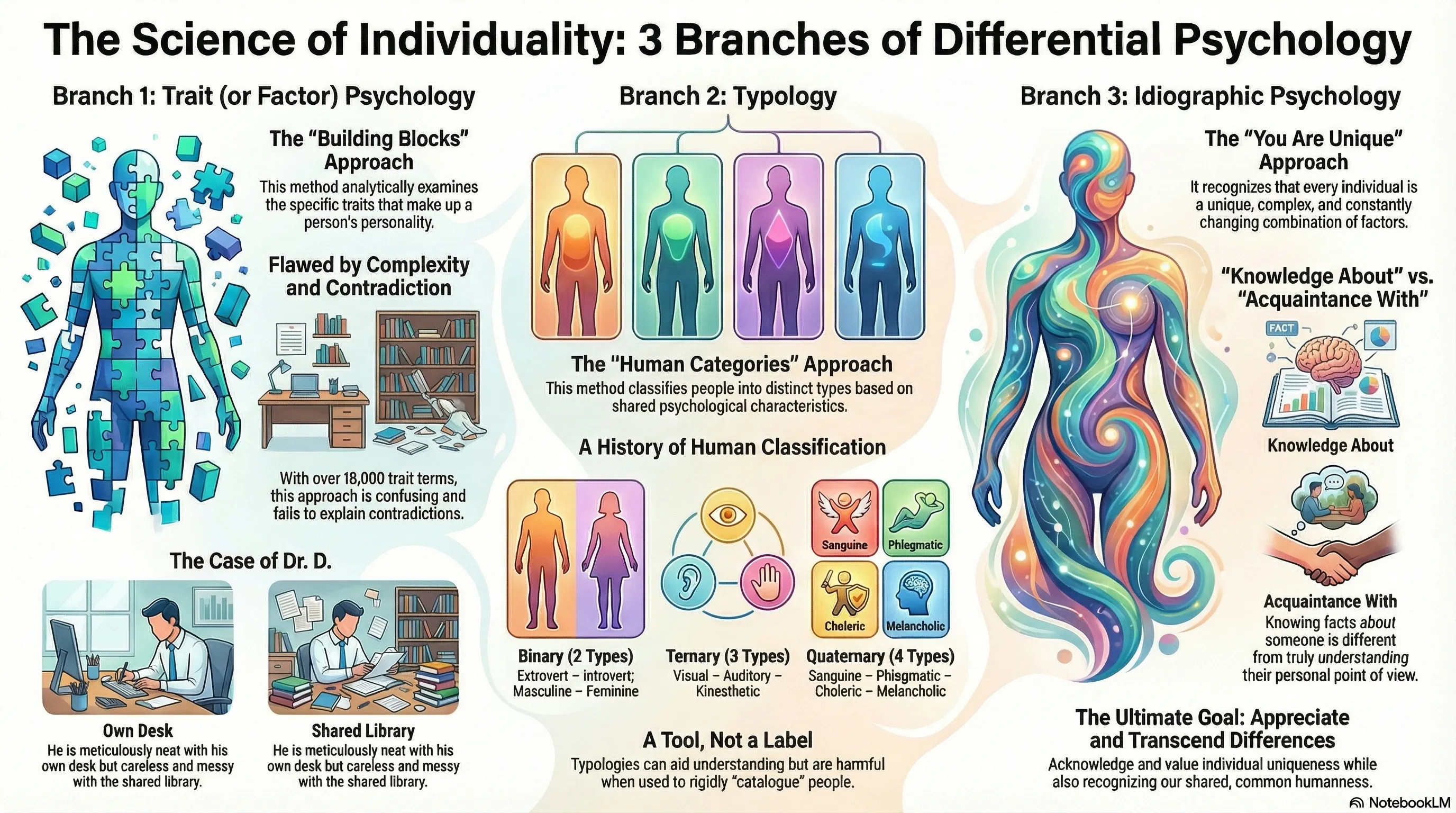
Clarify what “differential psychology” can and cannot explain about people, and how to use traits and types without distortion while recognizing the unique, changing individual.
Learning Outcomes
By the end of this chapter, you should be able to:
- Define “differential psychology” and distinguish its three branches.
- Explain why trait (factor) psychology is insufficient by itself, using the Assagioli’s reasons and examples.
- Apply the Assagioli’s cautions to evaluate whether a typology is useful or distorting in a given case.
- Describe extroversion/introversion as tendencies that can vary by level, age, and conditions, including the active/passive distinction.
- Describe infraversion, supraversion, and poliversion, and state how poliversion is defined as a psychosynthetic goal.
- Distinguish “knowledge about” from “acquaintance with” and state what acquaintance requires.
Core Insights
Insight 1
Lists of traits are an inadequate basis for understanding a person because traits are numerous, can conflict within the same person, and vary across situations; underlying dispositions and motivations must be considered.
- The appendix argues that trait analysis becomes confusing (sheer number of trait terms) and fails to account for contradictory behaviour in different contexts.
- It illustrates how opposed “stylistic dispositions” can coexist, and points toward a more fundamental “cardinal (motivational) disposition.”
- It shifts attention from “what trait label fits?” to “what disposition is activated by this situation?” and “what underlying motivation explains the pattern?”
- It reduces overconfidence in “descriptive” trait lists as sufficient explanations of behaviour.
Insight 2
Typologies can help recognize real differences, but they easily become misleading when treated as rigid, final categories; classifications must remain subtle, flexible, and resistant to labeling individuals.
- The appendix repeatedly cautions against giving excessive value to typological classifying and attaching labels, describing how this can condition and limit perception.
- It emphasizes that types are tendencies that can alternate within the same person across age and conditions, and can combine across levels/functions.
- It encourages using typology as a provisional aid (“a first knowledge”) rather than a static verdict, and keeping room for overlap, gradation, and change.
- It frames misunderstanding and antagonism as partly arising from unrecognized differences in “worlds” of perception and interest.
Insight 3
Even the best typology cannot replace understanding the unique, changing individual; “acquaintance with” a person requires taking their point of view and reasoning from their premises, and the psychosynthetic aim is flexible direction of energies according to purpose (“poliversion”).
- Each individual is a unique, non-static combination of factors and argues for an emerging “psychology of the individual” based on understanding from within.
- Assagioli defines a psychosynthetic goal: directing energies “in any direction and fashion” according to purposes, intentions, needs, and demands, naming this “poliversion.”
- It replaces “knowledge about” with a disciplined attempt at “acquaintance with” (frame-of-reference understanding).
- It treats orientations (outward, inward, downward, upward; future vs past) as directions to be directed deliberately in response to specific demands.
Key Quotes
“Differential psychology is ‘the branch of psychology that investigates the kinds, amounts, causes and effects of individual or group differences in psychological characteristics.’”
“Therefore, the tendency—rather, the temptation—to accord an excessive value to typological classifying needs to be resisted; and even more the inclination to attach labels to individuals.”
“The psychosynthetic goal is to acquire the ability to direct energies at will—that is, through the directing function of the will—in any direction and fashion, according to specific purposes, intentions, needs, and demands. This can be called poliversion.”
Key Concepts
Differential psychology: The branch of psychology that studies kinds, amounts, causes, and effects of differences in psychological characteristics across individuals or groups.
Traits (Factor) psychology: The analytical examination of traits or characteristic elements used to describe a person’s makeup.
Descriptive approach (descriptive psychology): Approaches that describe people via traits/types but may not adequately explain the person as a whole.
Stylistic dispositions: Opposed behavioural styles that can both exist in one person and be activated by different situations.
Cardinal (motivational) disposition: A dominant underlying motivational disposition from which contrasting styles can proceed.
Typology: Systems that classify people into psychological types; potentially useful but prone to arbitrary or superficial divisions and misuse.
Labeling (attaching labels to individuals): Treating type classifications as fixed tags for persons; warned against as conditioning, limiting, and provoking rebellion.
Extrovert / Introvert (as a tendency or disposition): A predominating direction/orientation of life interest; a tendency that can alternate with conditions and combine with other variations.
Passive (reactive) extrovert: A form of extroversion characterized by hypersensitivity to external influences and tendency to accept others’ viewpoints/psychic influences.
Passive introversion: Excessive preoccupation with one’s physical/psychological state; can lead to fear of disease and hypochondria (extremes cited).
Infraversion: A “downward” direction of life interest toward lower aspects of the unconscious; compared to underwater diving and linked to psychoanalysis’ “descent into hell.”
Supraversion: An “upward” direction of life interest toward the higher psyche, the superconscious and the Self; compared to mountaineering.
Poliversion: The psychosynthetic ability to direct energies at will in any direction and fashion according to specific purposes, intentions, needs, and demands.
Forwardverted / Retroverted: Opposing time-directions of life interest: future-oriented (forwardverted) vs past-oriented (retroverted).
Knowledge about vs acquaintance with: “Knowledge about” is informational; “acquaintance with” is an internal comprehension that can take another’s viewpoint and reasoning.
Understanding psychology (verstehende): A psychology of the individual aiming at comprehension “from within,” incorporating but going beyond descriptive contributions.
Check Your Understanding
- In one paragraph, explain why a long list of trait labels can fail to “understand a human being,” using at least one example.
- What two misuses of typology does the appendix explicitly warn against, and what is the recommended stance instead?
- Explain “poliversion” in your own words.
What does it mean to be “acquainted with” a person, and how does that differ from “knowledge about” them?
Reflection Questions
Choose one of the prompts below. Read through it and think about how it relates to your life or experiences. Spend some time writing about it in your journal or notebook.
- Where have you seen “contradictory traits” in the same person (including yourself) that were better explained by different situations arousing different dispositions?
Which typology label have you found most limiting or distorting, and what would “subtle and flexible” use look like instead? - Think of a recent disagreement: how might the other person have been “inhabiting a different world” of interest or perception in the appendix’s sense?
- What is one relationship where you have “knowledge about” but not “acquaintance with”? What would it mean (specifically) to reason from their premises?
Exercises
Label → Tendency → Acquaintance Check
Grounding (30 sec): Sit comfortably, take 2 slow breaths, and recall a recent moment you mentally described yourself or someone else with a “type” label.
Steps:
- Write one label you’ve used (e.g., “introvert,” “thinker,” “practical type”).
- Rewrite it as a tendency with conditions using this template:
- “In situations like ___, the tendency is to ___; in situations like ___, it shifts to ___.”
- Add a third line to force flexibility across domains/levels:
- “At the ___ level (e.g., feeling/mental/practical), I/they tend to ___; at the ___ level, it differs as ___.”
- Write two bullets:
- Avoid: one way you will avoid rigid labeling (e.g., “I won’t treat this as fixed across all contexts.”)
- Use for: one legitimate use as first-pass understanding (e.g., “a starting hypothesis to test against observations.”)
- “Acquaintance check” (2–3 lines): If this is about someone else, write one sentence that attempts to reason from their premises (their likely frame of reference) without asserting hidden motives.
Success criteria:
- The rewrite treats the type as a tendency that can alternate with conditions, not a fixed identity.
- You explicitly apply the warning against attaching labels.
- Your added “level” line shows the label can vary across functions/domains.
- The acquaintance check stays viewpoint-based (premises/frame) rather than diagnostic labeling.
Poliversion Micro-Plan
Grounding (20 sec): Take 1 slow breath, then write today’s date and one concrete demand you’re facing (a task, conversation, decision).
Steps:
- Write the four direction terms as headings: Extroversion / Introversion / Infraversion / Supraversion.
- Under each heading, write one activity example in the appendix’s sense (1 sentence each):
- Extroversion = outward interest/action in the world.
- Introversion = inward interest in one’s inner state/process.
- Infraversion = downward exploration of lower unconscious material (as described).
- Supraversion = upward orientation toward higher aspects (superconscious/Self, as described).
- Choose one current purpose/need (1 sentence): “Today I need ___.”
- Write a direction choice statement (1–2 sentences):
- “Given this purpose/need, I will emphasize ___ today by doing ___ (specific action).”
- Add one “flex rule” bullet to avoid one-sidedness:
- “If I notice ___ (sign), I will switch to ___ (direction) for ___ minutes.”
Success criteria:
- Each direction is used in the outward/inward/downward/upward sense given in the appendix.
- Your chosen emphasis is explicitly tied to a stated purpose/need/demand.
- The plan includes a concrete action and a conditional switch that expresses “directing energies at will” rather than drifting into a fixed orientation.
Review & Practice: Appendix 5: Differential Psychology
Test your understanding of the core ideas from this chapter and capture your personal reflections. Scored questions provide immediate feedback; reflections are stored privately on your device.
What is “differential psychology” mainly about?
Which option best matches the three main branches of differential psychology?
Assagioli suggests that listing many traits is often insufficient for truly understanding a person.
Which option best corrects a common misunderstanding about “types”?
A colleague is highly organised with their own tasks but careless with shared equipment. Someone says, “They’re just an organised person, full stop.” What best fits the chapter’s explanation?
Complete the following statement by filling in the missing term(s):
Which option best states what this chapter is trying to do?
Which option best summarises the chapter’s main contribution?
“Introvert” and “extrovert” are presented as tendencies that can shift with age and circumstances, not permanent boxes.
Describe one way a “type” idea can be helpful in daily life, and one way it can become misleading if used rigidly.