
Appendix 4: Historical Survey
Purpose
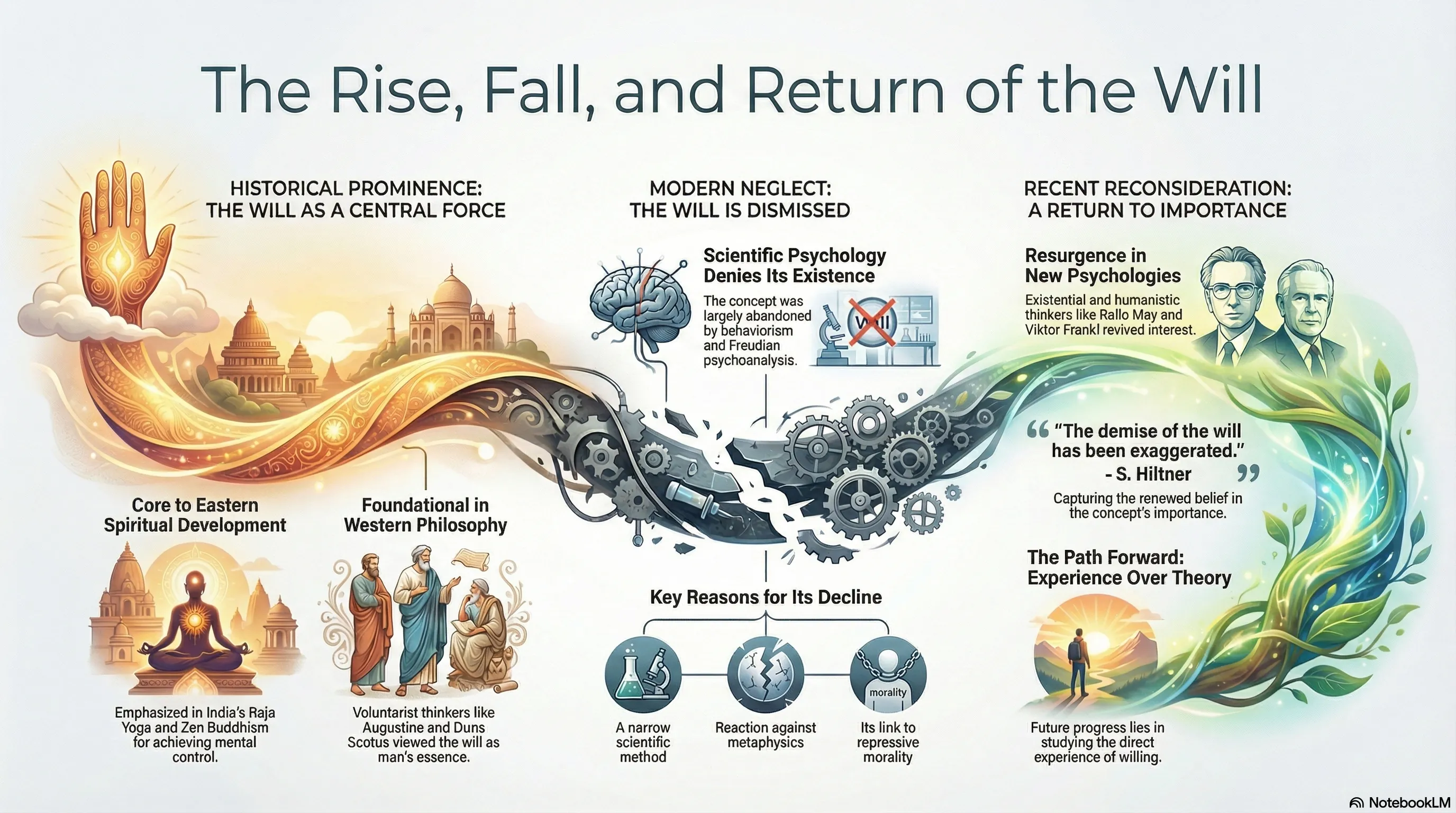
Provide perspective on historically conflicting “will” concepts and justify a practical way forward: direct existential study plus experiments on willing.
Learning Outcomes
By the end of this chapter, you should be able to:
- Explain (in your own words) why theory-first approaches to “the will” tend to produce confusion.
- Apply the boundary condition for “human will” by distinguishing conscious choice of an aim from broader “conation/striving” and from mislabeling other functions.
- Describe the proposed method for progress.
- Identify at least two “failure modes” in will-talk that the appendix explicitly criticizes.
- State one experimental/introspective marker that is relevant to voluntary decision (e.g., “I truly will,” or effortless volition).
Core Insights
Insight 1
Theoretical/intellectual debates about “the will” tend to produce confusion rather than usable clarity, so a practical approach must start elsewhere.
- The appendix explicitly draws a “most striking conclusion” that theory-led approaches lead to contradiction and bewilderment.
- It frames the survey as perspective-setting and implies the goal is a “way out of the impasse” that yields “useful and practical results.”
- Shifts effort from debating definitions (or “free will” disputes) to gathering direct data from willing and testing it.
Insight 2
To speak precisely about “human will,” you must distinguish it from broader “conation/striving” and from mislabeling other functions; conscious choice of an aim is essential.
- Assagioli criticizes “very broad” will-concepts (including “unconscious will”) for missing the specific human feature: conscious choice.
- It notes persistent definitional disorder in psychology and widespread misuse: “will” used for suggestion, imagination, or “power” talk.
- Forces a vocabulary discipline: when you say “will,” you must check whether you mean conscious choosing/deciding vs other processes.
Core Insight 3
The best forward method is: begin from direct existential experience of willing and then institute experiments on the stages/characteristics/uses of willing
- Assagioli explicitly specifies this procedure as the “way” out of the impasse: lived experience → description of yielded data → experiments on stages.
- It cites early experimental work and introspective phase-analysis (e.g., the lived element “I truly will”) as relevant evidence of what such work can reveal.
- Treats willing as something to observe and test (including stages like decision/affirmation/execution-direction), not just to theorize.
Key Quotes
“When we approach the subject of the will, we are faced with a peculiar, even a paradoxical, situation.”
“The most striking conclusion to be drawn from this historical survey is that attempts to solve the problem of the will on theoretical, intellectualistic lines have led not only to no solution but to contradiction, confusion, and bewilderment. This being so, a way out of the impasse needs to be sought in another direction, one that can produce useful and practical results. Such a way exists: its starting point is the direct, existential experience of willing, unhampered by preconceived notions; and it proceeds to a description of the data yielded and to the institution of experiments on the various stages, characteristics, and uses of the willing action.”
“The present book has been written with the specific purpose of providing signposts pointing in such a direction and presenting a comprehensive program of research and application in the field of this neglected but so important and essential reality of human life.”
Key Concepts
Historical survey: A perspective-setting overview of significant past views on the will, not a full history.
Voluntaristic schools: European schools that assign a central position to will in human life.
Conations: Broad strivings/impulses that some thinkers included under “will,” expanding it too far.
Unconscious will: A proposed “will” operating outside awareness; criticized here as too broad and as missing conscious choice.
Conscious choice: The specific characteristic of human will emphasized here: deliberate choosing of an aim/purpose.
Deterministic view: A strict determinism associated here with behaviorism and Freudian psychoanalysis, linked to sidelining will.
Repressive/coercive conception of will: A “mistaken conception” (attributed to some moralists/educators) that helped provoke reactions against “will.”
Voluntary vs involuntary movement: An empirically noticeable difference that psychology struggles to define precisely, yet cannot discard.
Effortless volition: The finding/claim that a volition can occur without felt effort, even in difficult action.
“Will as responsible mover”: A conception (credited to Farber) valued for keeping will from being “smuggled” into systems under other names.
Intentionality: A basis of will/decision (credited to Rollo May) linked here to the first stage of willing and to identity.
Stage of affirmation (“fiat”): The affirmation/command phase noted as important by William James.
Existential experience of willing: Direct lived experience taken as the starting point for understanding the will, “unhampered by preconceived notions.”
Experiments on the willing action: Systematic inquiry proposed here: describing data yielded by lived willing and experimenting on stages/characteristics/uses.
Check Your Understanding
- In one sentence, what does the appendix claim happens when people try to solve the will “on theoretical, intellectualistic lines”?
- Give one example of “will” being used to refer to another psychological function (as named in the appendix), and explain why that’s a problem.
- What single criterion does the appendix treat as essential to the human will?
- What is the proposed “way out of the impasse,” and what comes after the starting point?
Reflection Questions
Choose one of the prompts below. Read through it and think about how it relates to your life or experiences. Spend some time writing about it in your journal or notebook.
- Where do you notice yourself sliding into “will = power/effort” talk, and what does the Assagioli say that misses?
- Which mistaken broadening of “will” (e.g., “unconscious will,” or conflating with other functions) do you find most tempting—and why?
- What would it mean, in your own inquiry, to treat willing as something to be experimentally studied “on the various stages” rather than argued about in general terms?
- Do you believe (from your own observation) that some volitions can be “absolutely effortless”? Give one concrete instance or explain why you can’t find one.
Exercise
Experiment: Design on the Stages of a Willed Act
Steps:
- Choose one small action you can complete today that involves a decision (not a reflex).
- Define the aim/purpose in one sentence.
- Write a simple observation plan: what you will note for (i) choosing/deciding, and (ii) how execution unfolds (including whether it feels effortful or effortless at moments).
- After completing the action, write a short “data log” of what you observed.
Success criteria:
- Your log includes at least one observation about decision and one about execution, and treats the episode as data for later comparison.
Review & Practice: Appendix 4: Historical Survey
Test your understanding of the core ideas from this chapter and capture your personal reflections. Scored questions provide immediate feedback; reflections are stored privately on your device.
In this appendix, what is a key feature of specifically human will?
Which contrast best fits the chapter’s emphasis?
The appendix suggests that “unconscious will” is a clear and useful way to define human willing.
Which option best corrects a common misunderstanding?
Scenario: You say, “I have no willpower,” because you keep scrolling instead of starting a task. You also notice you never decided what “start” means or when you’ll begin. What best fits the appendix’s framing?
Complete the following statement by filling in the missing term(s):
Which option best states what this appendix is trying to do?
Which option best summarises the appendix’s main contribution?
In 3–5 sentences, explain one reason the will was neglected in modern psychology and one way this book proposes to address that problem.