
Evolving The Will Project
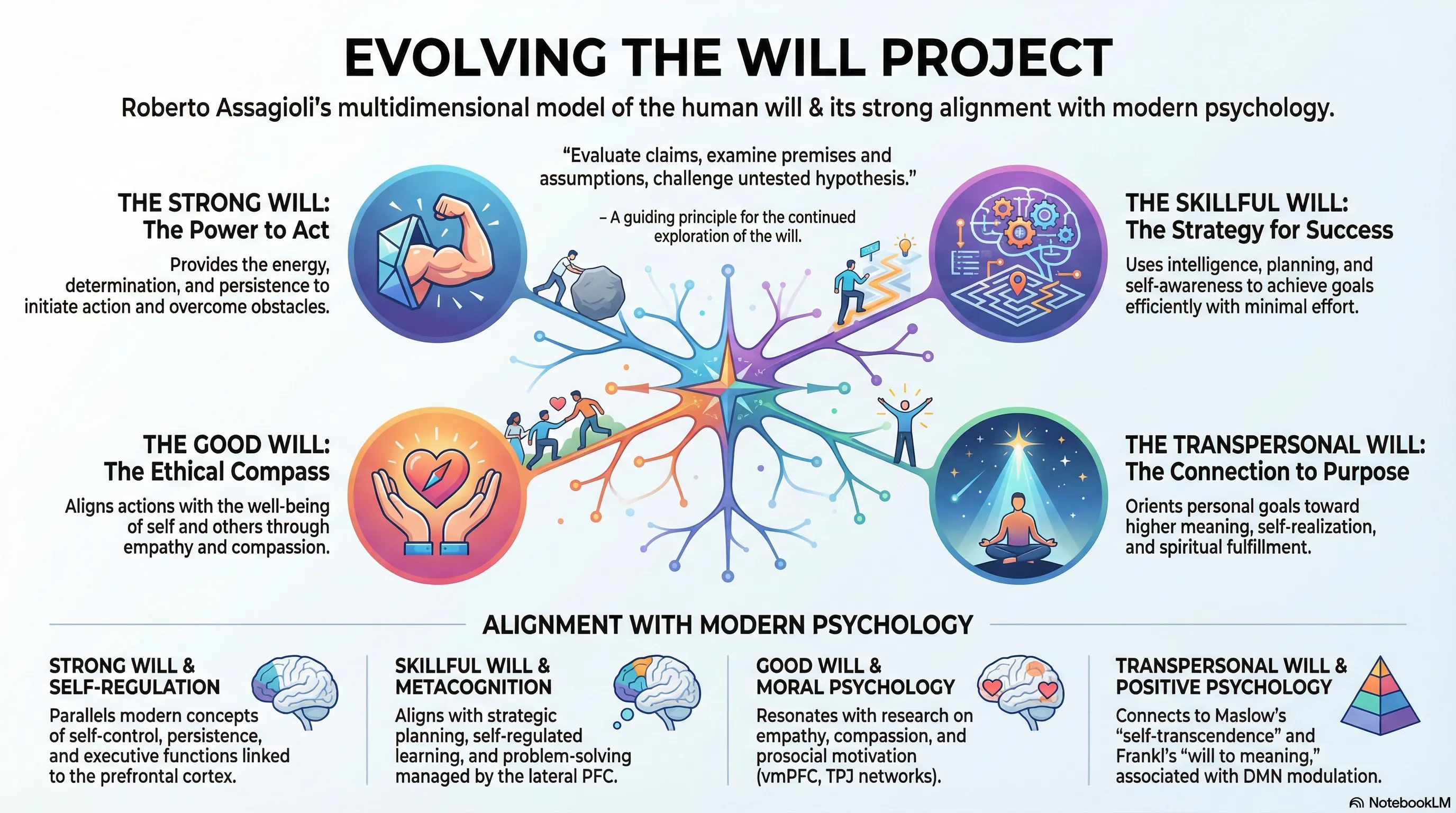
50 years after Roberto Assagioli’s The Act of Will was published, what is needed for the advancement of The Will Project?1
For the advancement of The Will Project, I propose that there is a need for several things to happen. These include:
- Evaluate claims relating to laws and principles of psychological functions.
- Examine underlying premises that Assagioli’s frameworks and models are built upon.
- Challenge assumptions and untested hypothesis.
- Clarify where different definitions of the same terms are used, helping avoid equivocation and reconcile apparent contradictions.
- Map modern terminology and concepts to Assagioli’s framework, providing a bridge for future expansion and modification in line with newer developments in psychology.
I believe that this is in line with the spirit of Assagioli’s philosophy, as evidenced from his writings. For example, in the Preface to The Act of Will, he states (emphasis added):
“This volume is also a preliminary map of the act of willing from the point of view of the newer developments in psychology—that is to say, existential, humanistic, and transpersonal psychology—although it has roots in various older contributions.”
There have been many developments in psychological and neuroscience over the past 50 years. What was once cutting edge is often now accepted as current understanding, adapted as new evidence emerged, or rejected based on findings and observations.
In the Introduction to the Will Project, Assagioli made clear that the proposed program could be expanded and modified:
“The following program is intended as a preliminary map for further exploration of the will. It can be expanded and modified. It is a basis for future work which can yield enormous rewards.”
While this is around expanding and modifying the Will Project, not Assagioli’s models and frameworks, I suggest that he would have taken the same attitude towards the parts, given the earlier statement that The Act of Will was a “preliminary map” and reflected “newer developments in psychology.”
There are many places in The Act of Will and beyond that Assagioli refers to scientific method and empiricism. Another example if from Psychosynthesis – Its Essential Components, where he makes the following claims about psychosynthesis:
“On this point particularly, psychosynthesis takes no theoretical position, but sticks to the existential experience of the individual. Here it is necessary to emphasize that psychosynthesis is essentially empirical; it is based on the description and interpretation of existential experiences, and therefore it has no specific theoretical setting. It is independent from and neutral towards any philosophical or theological framework, but it can fit in most of them.”
And:
“Psychosynthesis is a scientific conception and practice. Therefore, it follows scientific method and procedure, understanding science in a broad sense as some of the present scientists do, such as Maslow and others”
In Appendix 5 of The Act Will, he indicates a beliefs that a scientific approach is possible, in this case around a “psychology of the individual”:
But important as this realization is, it should not lead us to believe that it is hopeless to establish a scientific “psychology of the individual.” Such a psychology is possible, and is beginning to be developed.
While it is important to note that Assagioli balanced some of these statements with commentary around the scientific method being too narrow, that doesn’t invalidate the necessity to analyze and synthesis a new perspective (or perspectives) of the act of will and, more broadly, psychosynthesis. Assagioli concept of scientific method is clearly outlined in Psychosomatic Medicine and Bio-Psychosynthesis:
“Yet in reality, the scientific method, which can be said to have originated in Francis Bacon’s Novum Organum, consists principally in the elimination of errors of judgment and language. These he called ‘idols,’ and they have been unmasked even more adroitly by modern semantics. Essentially, it is a matter of reasoning soundly. Thus everything qualifies as a legitimate object of scientific concern; there exists no reason why sexuality should be scientific and love not. This conception has received recognition recently from a number of avant-garde psychologists who have adopted the humanistic, existential and anthropological position, such as Sorokin, Maslow, Frankl and others.”
So, as a matter of reasoning soundly, and the elimination of errors of judgment and language, it seems prudent to put all earlier claims to the test. Consider also though, that reasoning soundly must rest on solid premises (even if the premises themselves are unprovable or the realm of individual experience). If current evidence suggests something is not the case, then it is not sound reasoning to continue accepting it as fact.
I will start posting some observations and questions that I come across while exploring The Act of Will. I invite you to respond, whether or not you are familiar with Roberto Assagioli, The Act of Will, or psychosynthesis. You are welcome to respond in comments (publicly) or via direct message / email if you wish to do so privately.
My intention is to stimulate conversation and hopefully re-invigorate interest in the will (whether using modern terminology and framing or the language that Assagioli used) and encourage people to work towards a balance of existing in both external and inner worlds.
As of January 2026, I believe that the words that Assagioli used in Introduction To The Will Project are as valid now as they were in the 1960s and 1970s. I’ll leave this with you to consider:
“A very important and urgent application of the use of the will is that concerning the great issue of peace and war. In my view, no amount of political agreements and treaties or of external manipulation can by itself ensure a lasting peace. Many such political agreements and treaties have proved futile. As it is stated so aptly in the Preamble to the constitution of UNESCO, ‘Since wars begin in the minds of men, it is in the minds of men that the defenses of peace must be constructed.’”
- Roberto Assagioli’s The Act of Will was first published in 1973. Assagioli died shortly after, in 1974. ↩︎